You read a news story. It says “youths.” Then you read another story. It says “youth.” Now you wonder, which one is right?
This question comes up a lot. People search for “youth or youths” because the word can be tricky. It is not like most words. Most words just add an “s” for more than one. But “youth” can mean one thing in one sentence and a totally different thing in the next. That mix-up is what causes the confusion.
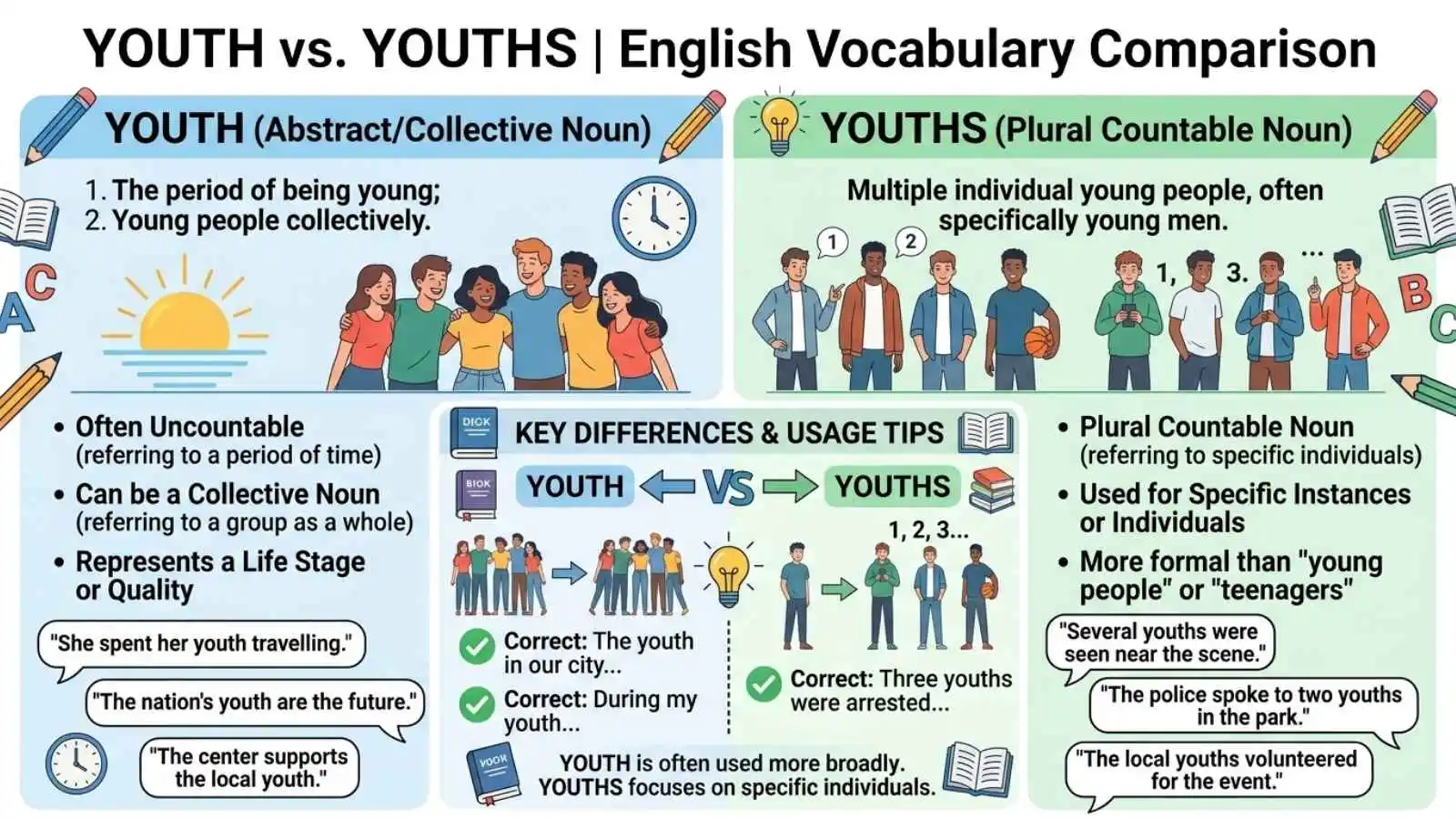
Here is the short version of the problem. “Youth” can mean young people as a whole group. It can also mean just one young person. “Youths” means more than one young person, named one by one. Both words are correct. But they are used in different ways.
This guide will clear it all up. You will learn:
- The quick, simple answer
- Where this word came from
- How British and American writers use it
- Which form fits your writing
- Common mistakes to avoid
- Real examples from daily life
By the end, you will know exactly when to use “youth” and when to use “youths.” Let’s get started.
Youth or Youths – Quick Answer
Here is the short answer.
“Youth” can mean two things:
- The time of life when someone is young. Example: “She was full of energy in her youth.”
- A general group of young people, all together. Example: “The youth of today use phones a lot.”
“Youths” means more than one young person, talked about as separate people. Example: “Three youths were seen near the park.”
So the easy rule is this:
- Talking about young people as one big group? Use youth.
- Talking about a few young people, like a number of them? Use youths.
Both words are correct English. You just need to pick the right one for your sentence.
The Origin of Youth
This word is very old. It comes from an Old English word, “geoguð.” This word meant “young people” or “the state of being young.”
Over hundreds of years, the spelling changed. “Geoguð” slowly turned into “youthe,” and then into the word we use today: “youth.” This happened through the Middle English period, which was used a long time ago in England.
The word stayed mostly the same in meaning. It always pointed to being young, or to young people as a group. What changed over time was how people used the plural form.
In old English, group words like “youth” did not always need an “s” to show more than one. Many old English nouns worked like “sheep” or “deer.” You did not need to add a letter to show many of them. “Youth” kept some of that old pattern. That is why we can say “the youth” to mean many young people, without adding an “s.”
But English speakers still needed a way to count young people one by one. So “youths” came into use too. This gave writers two tools: one word for the whole group, and one word for individual people within that group.
British English vs American English Spelling
Here is something important to know. This is not really a spelling difference, like color and colour. The word “youth” is spelled the same in both American and British English. There is no extra letter, like the “a” in “haemorrhoid” versus “hemorrhoid.”
Instead, the real difference is about how the word is used, not how it is spelled.
In British English, especially in UK news, “youths” is used a lot. It often shows up in crime stories. For example: “Youths were arrested after the incident.” This use is common in British newspapers.
In American English, writers often avoid “youths” in news stories. Many American style guides, like the AP Stylebook, suggest using softer terms like “young people” or “teens” instead. American writers tend to use “youth” as a single group word more often.
Here is a simple table to show the pattern:
| Term | British English Use | American English Use |
| Youth (group) | Common in formal and news writing | Common in formal and news writing |
| Youths (plural people) | Common in news, especially crime stories | Less common; “teens” or “young people” preferred |
| Youth (singular person) | Used, but less common than “young person” | Used, but less common than “young person” |
| Young people | Used often as a softer term | Used often as the top choice in news |
So the real lesson here is this: both regions spell the word the same way. But British writing uses “youths” more freely, while American writing often swaps it for a different phrase.
Which Spelling Should You Use?
Since spelling is not the issue here, let’s talk about which form fits your writing.
- If you write for a US audience: Use “youth” as a group term. For separate people, try “young people” or “teens” instead of “youths.” This matches most American news and style guides.
- If you write for a UK or Commonwealth audience (UK, Ireland, Australia, New Zealand): “Youths” is common and accepted, especially in news writing. You can use it freely when talking about a small group of named or counted young people.
- If you write for a global audience: Use “youth” for the general idea of young people. Save “youths” for cases where you are clearly counting people, like “five youths attended the event.” This keeps your writing clear no matter where your reader lives.
- If you are writing something formal, like a report or essay: “Youth” as a group word sounds more professional. “Youths” can sound a bit harsh or negative in some contexts, especially in news about crime. Choose your word with care, based on your tone.
Common Mistakes with Youth or Youths
Let’s go over the most common errors people make with this word.
- Using “youths” when you mean the whole group. Wrong: “The youths of this country need better schools.” Right: “The youth of this country need better schools.” Here, you mean young people as one big group, so “youth” fits better.
- Using “youth” when you mean a few specific people. Wrong: “Two youth were at the store.” Right: “Two youths were at the store.” When you count people one by one, you need the “s.”
- Forgetting that “youth” can also mean one person. Example: “He is a youth.” This is correct. It means one young person. People often forget this use and think “youth” can only mean a group.
- Adding an extra “s” by mistake. Some people write “youthes.” This is wrong. The correct plural is “youths,” with just one extra “s” at the end.
- Using “youths” in a way that sounds unkind. In news writing, calling a group “youths” again and again, especially in crime stories, can sound negative. Many writers now choose “young people” instead, to sound more fair and neutral.
- Mixing up “youth” the noun with “youth” the adjective. “Youth” can describe something too, like “youth center” or “youth sports.” This use never changes, no matter how many people are involved.
Youth or Youths in Everyday Examples
Let’s look at how this word shows up in daily life.
In a news headline: “Local Youth Wins National Art Award”
In a UK crime report: “Three youths were taken in for questioning after the break-in.”
In an American news story: “Police say several young people were involved in the incident.”
In a formal report: “The program aims to support youth in low-income communities.”
In a casual text message: “Saw a bunch of youths skateboarding outside, looked fun.”
On social media: “Today’s youth are way more aware of climate issues than past generations.”
In an email from a school: “Our youth program will begin new classes next month.”
In a job posting: “Seeking a coordinator to lead our youth outreach team.”
Notice how “youth” shows up far more often as a group word. “Youths” appears mostly in news and reports about specific people or events.
Youth or Youths – Google Trends & Usage Data
Let’s look at how people search for and use these words.
“Youth” gets far more searches than “youths” around the world. This makes sense, since “youth” covers more uses: a time of life, a group of people, and even a single person.
In the United States, “youth” is the clear favorite in both search results and news writing. American style guides often suggest avoiding “youths” altogether.
In the United Kingdom, “youths” shows up more often than in the US, mostly in news stories about crime or local events. British search data shows steady use of “youths” in formal news writing, even though “youth” still leads overall.
In Australia, Canada, and other English-speaking countries, both words appear, but “youth” stays the top choice for general writing. “Youths” appears mostly in news reports, just like in the UK.
There is also a cultural pattern worth noting. Some people feel that “youths” sounds less friendly than “young people,” especially in crime news. Because of this, many newsrooms have slowly reduced their use of “youths,” even in the UK, switching to softer terms like “teenagers” or “young people.”
Keyword Variation Comparison Table
| Word Form | Common Region | Typical Use |
| Youth (group) | Worldwide | Young people as a whole, formal and casual writing |
| Youth (single person) | Worldwide | One young person, slightly formal tone |
| Youths (plural) | UK, Ireland, Australia | Several young people, often in news |
| Young people | US, Worldwide | Softer, neutral term, common in news |
| Teens / Teenagers | US, Worldwide | Casual term for ages roughly 13-19 |
| Youth (adjective) | Worldwide | Describes programs, centers, or sports for young people |
FAQs:
1. Is “youths” a real word? Yes. “Youths” is a correct plural form of “youth.” It means more than one young person.
2. When should I use “youth” instead of “youths”? Use “youth” when talking about young people as one whole group, or when talking about a single young person. Use “youths” only when you are counting or naming a few specific young people.
3. Is “youths” considered rude or negative? The word itself is not rude. But in news writing, especially in crime stories, repeated use of “youths” can sound harsh. Many writers now use “young people” instead, to keep a fair and neutral tone.
4. Is “youth” singular or plural? “Youth” can be both. It can mean a single young person, or a whole group of young people. It depends on the sentence.
5. Do British and American English spell “youth” differently? No. Both regions spell it the same way. The real difference is in how often “youths” is used, especially in UK news writing compared to US writing.
6. What is a simple way to remember the rule? Think of “youth” like “the public” or “the team.” It can mean one group. “Youths” works more like “students” or “kids,” counting separate people.
7. What word should I use instead of “youths” if I want a softer tone? Try “young people” or “teenagers.” Both sound more neutral and are widely accepted in modern writing.
8. Can “youth” be used as an adjective? Yes. Words like “youth center,” “youth sports,” or “youth program” use “youth” to describe something made for young people. This form never changes, no matter how many people it serves.
Conclusion:
Let’s wrap up everything we learned today.
“Youth” and “youths” are both correct words. The mix-up is not about spelling. It is about meaning and use. “Youth” can mean a whole group of young people, or even just one young person. “Youths” means more than one young person, counted or named separately.
There is no real US versus UK spelling split here, like there is with words such as “color” and “colour.” Instead, the difference is about style. British news writing uses “youths” more freely. American writing often swaps it for softer terms like “young people” or “teens.”
If you want a simple rule to remember, think this way: use “youth” for the big picture, and “youths” for counting people one by one. And if you want your writing to sound kind and fair, especially in news or formal writing, “young people” is often the safest and most respectful choice.
Whatever you choose, stay consistent across your writing. That keeps your message clear and easy for every reader to follow, no matter where they live.








