You are writing about rules. You type “obay.” But it looks odd. Is that the right way to spell it? Should it be “obey” instead?
This mix-up happens a lot. People search “obay or obey” because the word can be hard to spell. This is not like British spelling versus American spelling. It is not like “color” and “colour.” It is much simpler than that. One spelling is right. The other one is just a mistake.
This trips up many people. Kids learning to spell mix it up. People typing fast mix it up too. The word sounds one way but looks a bit different in writing. That is why this mistake happens so often.
This guide will fix the mix-up for good. You will learn:
- The quick, easy answer
- Where the word “obey” came from
- Why “obay” is not a real word
- How to spell it right every time
- Real examples from daily life
By the end, you will never mix these up again. Let’s start.
Obay or Obey – Quick Answer
Here is the short answer.
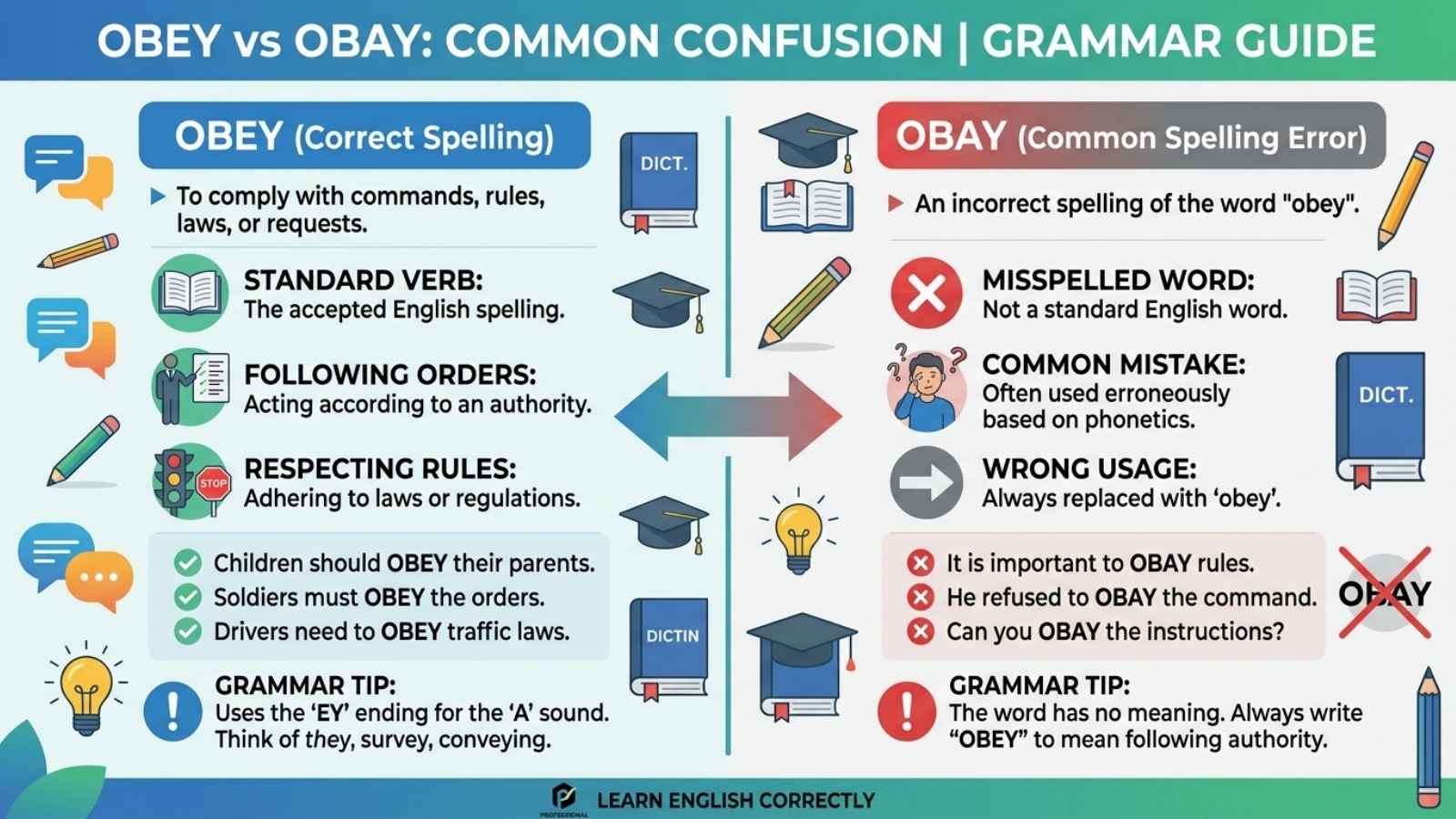
“Obey” is the correct word. It means to follow rules. It means to do what someone tells you to do.
“Obay” is not a real word. It is just a mistake. People write it when they mean “obey.”
Correct: “The dog learned to obey simple commands.”
Wrong: “The dog learned to obay simple commands.”
So the rule is easy:
- Always use obey.
- Never use obay. No dictionary has this word. No type of English writing uses it.
This is not like “color” and “colour,” where both are correct in different places. With “obey,” there is only one right way to spell it. This is true all over the world.
The Origin of Obey
The word “obey” is old. It comes from a Latin word, “obedire.” This word meant “to listen to” or “to do what someone says.”
This old word had two small parts. “Ob” meant “toward.” “Audire” meant “to hear” or “to listen.” Put the two parts together, and you get a word about listening closely and doing what you are told.
From Latin, the word moved into French. It became “obeir.” English later took the word from French, a long time ago, around the 1300s. Slowly, it turned into “obey,” the word we use today.
So where does “obay” come from? It has no real history. they is just a mistake. It happens because of how the word sounds. When people say “obey” out loud, the middle part can sound like “ay.” This makes some people spell it with an “a” instead of an “e.” But this spelling has no roots in any language. It is simply wrong.
This same kind of mistake happens with other words too. Some people write “definately” instead of “definitely.” It happens for the same reason. The word sounds one way, so people spell it that way, even though it is not correct.
British English vs American English Spelling
This part is a little different from most tricky word pairs.
With many English words, American and British spelling split into two correct forms. Think of “color” versus “colour.” Or “favorite” versus “favourite.” Both forms are correct. They are just used in different places.
“Obey” does not work this way. Both American English and British English spell it the same way: o-b-e-y. There is no British way to spell it “obay.” There is no American way either. Every English-speaking country uses the same one spelling.
Here is a simple table to show this:
| Word | American Spelling | British Spelling | Is It Correct? |
| Obey | obey | obey | Yes, in both |
| Obay | obay | obay | No, in both |
| Color / Colour | color | colour | Yes, both are right |
| Favorite / Favourite | favorite | favourite | Yes, both are right |
This table shows something important. Unlike real British versus American word pairs, “obay” is not a true second option. It is just wrong, no matter where you live.
Which Spelling Should You Use?
The answer stays the same no matter who reads your writing.
- If you write for people in the US: Use “obey.” There is no other correct spelling.
- If you write for people in the UK or other Commonwealth places: Use “obey.” The same rule applies.
- If you write for readers all over the world: Use “obey.” This word does not change based on where someone lives.
There is no choice to make here based on your reader. Every dictionary says the same thing. “Obey” is the only correct spelling. “Obay” should never show up in your writing, no matter who reads it.
Common Mistakes with Obey
Let’s look at the most common errors people make with this word.
- Spelling it “obay.” This is the biggest mistake people make. Slow down and check this word if you are typing fast.
- Mixing up “obey” with words that sound close to it. Some people confuse “obey” with “okay” or “away,” since the sounds are close. Check your sentence and make sure you picked the right word for the meaning.
- Spelling the related word wrong too. The noun form is “obedience,” not “obayence.” Many people make this same mistake here, since the sound carries over.
- Adding the word “to” by mistake. Wrong: “She obeyed to the rules.” Right: “She obeyed the rules.” You do not need “to” after this word.
- Trusting autocorrect too much. Some phones do not always catch “obay” as wrong, especially in fast texting. Always check your own writing, even if your phone does not flag it.
- Spelling the adjective form wrong too. The correct word is “obedient,” not “obayent.” Example: “The obedient dog sat right away.”
Obey in Everyday Examples
Let’s look at how this word shows up in daily life. It is always spelled the same correct way.
In a casual email: “Just a reminder, please obey all safety rules this weekend.”
In a news article: “Officials are asking people to obey the new traffic rules next month.”
On social media: “My dog finally learned to obey simple commands after weeks of training 🐶”
formal report: “All workers must obey safety rules at all times.”
In a text message: “Lol my little brother never listens, he just doesn’t obey anyone at home.”
school rule sheet: “Students must obey classroom rules during school hours.”
In a legal paper: “People are asked to obey local laws within the city.”
Every example uses “obey,” spelled the same way. The setting may change, but the spelling never does.
Obay or Obey – Google Trends & Usage Data
Many people search “obay or obey” online every day. This shows just how common this mix-up really is.
People from many countries search this term by mistake while trying to spell “obey.” This happens in the United States, the United Kingdom, Canada, Australia, and many other places. The mistake is not tied to one country. It happens because of how the word sounds when spoken.
Search engines like Google often catch this mistake right away. When someone types “obay,” Google often shows results for “obey” instead. It may show a small note, like “Showing results for obey.” This shows that search engines already treat “obay” as a typo, not a real word.
This search term often goes up among kids learning to spell, parents helping with homework, and people typing fast on their phones. Even with all these searches, “obay” never shows up in real books or news articles. It only shows up in fast, casual writing.
Keyword Variation Comparison Table
| Word Form | Is It Correct? | Where It Shows Up |
| Obey | Yes | Books, news, formal writing, daily use |
| Obay | No | Typos in texts, social media, fast chats |
| Obeyed | Yes | Past tense form, used in any setting |
| Obedience | Yes | The noun form, means following rules |
| Obedient | Yes | The adjective form, describes someone who follows rules |
FAQs:
1. Is “obay” ever a correct spelling? No. “Obay” is not a real word. It is always a mistake when someone tries to spell “obey.”
2. Why do so many people type “obay” by mistake? It happens because of how “obey” sounds when said out loud. The middle part can sound like “ay,” so people use an “a” by mistake.
3. Is this a British versus American spelling difference? No. This is not like “color” and “colour.” There is only one correct spelling here: “obey.” Both British and American English agree on this.
4. What does “obey” really mean? It means to follow rules or do what someone tells you to do. Example: “Soldiers must obey their leader.”
5. What is the past tense of “obey”? The past tense is “obeyed.” Example: “She obeyed every rule without complaint.”
6. Will spell-checkers always catch “obay”? Most spell-checkers and search engines will catch this mistake. But some chat apps may miss it. It is smart to check your own spelling too.
7. What other words are close to “obey”? “Obedience” is the noun form. “Obedient” is the adjective form. Both use an “e,” not an “a,” just like “obey.”
8. Is it okay to use “obay” in texts, since people still understand it? It is best to avoid it everywhere, even in texts. Getting used to spelling it right will help you avoid mistakes later, in school work or job writing.
Conclusion:
Let’s wrap up everything we learned today.
“Obey” is the only correct spelling. “Obay” is not a real word in any type of English, in any country. This is different from true British versus American word pairs, like “color” and “colour,” where both spellings are correct. With “obey,” there is just one right answer, everywhere in the world.
The mix-up mostly comes from how the word sounds out loud. The middle part can trick your ear, making “obay” feel okay, even though it is not. Knowing this simple fact can help you stop the mistake for good.
Going forward, the rule is easy to remember. Always use “obey.” Slow down and check your spelling if you are typing fast. Whether you are writing a school paper, a work email, or a quick text, this one small fix will help your writing look clean and correct.

Ethan Carter is a language writer at Wordellect who helps readers understand word differences, grammar rules, and spelling variations through simple and accurate guides.







