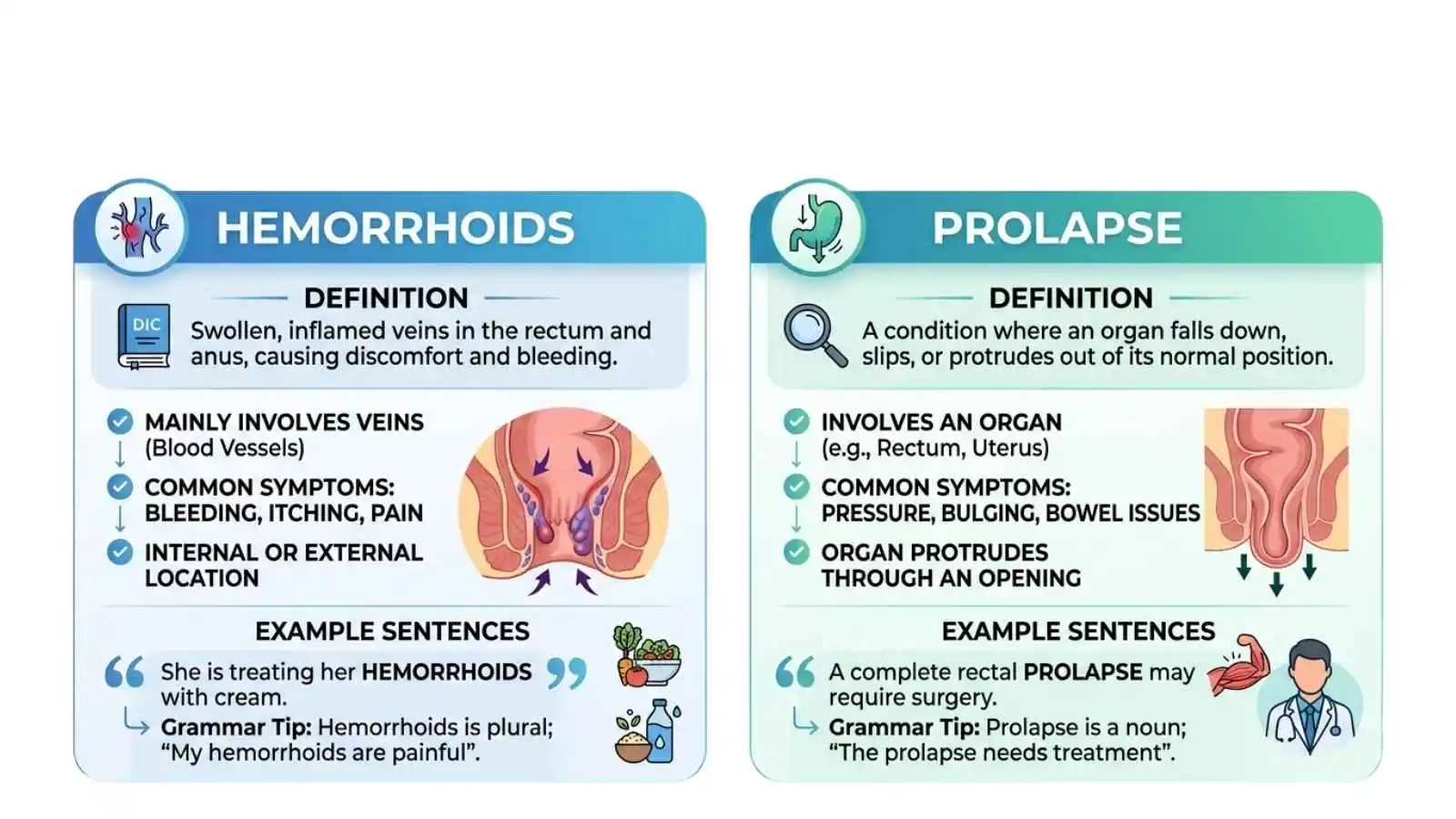
You typed “hemorrhoids” into Google. Then you saw “haemorrhoids” on another page. Now you feel unsure. Which one is right?
This mix-up happens a lot. Two things cause it. First, this word has two spellings. One is used in the US. One is used in the UK. Both are correct. Second, people often see the word “prolapse” next to “hemorrhoid.” They think it is a new, scary disease. But it is not a new disease at all. A prolapse is just a hemorrhoid that has grown and pushed outward. It is a stage of the same problem, not a brand new one.
This guide will help you in a simple way. You will learn:
- The right spelling for your country
- Where this word came from
- How a hemorrhoid and a prolapse are linked
- How people use this word in real life
- Quick answers to common questions
We will keep things short and clear. No hard words. No long sentences. Just the facts you need, in plain English. By the end, you will know exactly which spelling to use and why people get confused.
Hemorrhoid – Quick Answer
A hemorrhoid is a swollen vein.
Here is the short version:
- American spelling: hemorrhoid
- British spelling: haemorrhoid
- Prolapse: when the hemorrhoid swells so much it pokes out
Example in American English: “He has a small hemorrhoid that is sore.”
Example in British English: “He has a small haemorrhoid that is sore.”
A “prolapsed hemorrhoid” just means the hemorrhoid has pushed out a bit. It is still the same hemorrhoid. It has just grown bigger or moved outward. Many people get scared by the word “prolapse,” but it just means the swelling came out. It is not a brand new health problem.
The Origin of Hemorrhoid
This word is very old. It comes from Ancient Greek, a language spoken long ago.
In Greek, “haima” means blood. And “rhoos” means flow. Put them together and you get “haimorrhoides.” This means “blood that flows.” That makes sense, since hemorrhoids can bleed.
Later, Latin took this word and changed it a bit. It became “haemorrhoida.” English then borrowed the word from Latin.
So why do we have two spellings today? Over time, American English liked to make words shorter and simpler. It dropped some extra letters from old Latin words. British English did not drop those letters. It kept the spelling closer to the old Latin form.
This same pattern shows up in other words too. Here are a few:
- Anesthesia (US) vs. anaesthesia (UK)
- Pediatric (US) vs. paediatric (UK)
- Anemia (US) vs. anaemia (UK)
So hemorrhoid is not the only word like this. It is part of a bigger pattern in English spelling.
British English vs American English Spelling
Let’s slow down and look at the actual rule.
American English often removes the “a” from the letter pair “ae.” British English keeps it. That one small rule explains a lot of spelling differences in medical words.
Here is a simple table to show the pattern:
| Word | American Spelling | British Spelling |
| Hemorrhoid | hemorrhoid | haemorrhoid |
| Anemia | anemia | anaemia |
| Esophagus | esophagus | oesophagus |
| Pediatric | pediatric | paediatric |
| Anesthesia | anesthesia | anaesthesia |
| Orthopedic | orthopedic | orthopaedic |
Look closely. In every British word, there is an extra “a” before the “e.” In American English, that “a” is gone. This is the main rule to remember.
This is not a random mistake. It is just two different writing styles. Both are correct. Both are used by millions of people every day.
Which Spelling Should You Use?
So which one should you pick? It depends on who is reading your words.
- If you write for people in the US: Use “hemorrhoid.” This is what doctors, news sites, and health blogs use in America.
- If you write for people in the UK, Ireland, Australia, New Zealand, or other Commonwealth countries: Use “haemorrhoid.” This matches what the NHS and local doctors use.
- If you write for a mixed or global audience: Pick one spelling. Then use that same spelling all through your text. Do not switch back and forth. Many global sites use the American spelling because more people search for it. But the British spelling is just as correct.
If you work for a company or a magazine, check their style guide first. Many places have a rule about which spelling to use. When in doubt, just stay consistent. That matters more than which spelling you pick.
Common Mistakes with Hemorrhoid
Let’s look at the most common errors people make with this word.
- Switching spellings in one piece of writing. If you use “hemorrhoid” in one line and “haemorrhoid” in the next, it looks messy. Pick one spelling and stick to it the whole way through.
- Thinking “prolapse” is a different illness. It is not. A prolapse is just a hemorrhoid (or other body part) that has pushed outward. It is a stage, not a new sickness.
- Spelling it wrong. Some people write “hemmoroid” or “hemoroid.” Both miss a letter. The right spelling has two R’s in a row: hem-orrhoid.
- Mixing up rectal prolapse and prolapsed hemorrhoid. These sound alike but are not the same. A rectal prolapse means part of the rectum itself slips out of place. A prolapsed hemorrhoid means a swollen vein pushes out. They can feel similar, but they need different care from a doctor.
- Using the word for any pain near the anus. Not every ache in that area is a hemorrhoid. Other issues, like small tears or a prolapse, can feel the same but are different problems.
- Forgetting that the plural is just adding an “s.” It’s “hemorrhoids,” not “hemorrhoidss” or “hemorroides.” Keep it simple.
Hemorrhoid in Everyday Examples
Let’s see how this word shows up in real life. The spelling changes, but the meaning stays the same.
In a US doctor’s note: “The patient has a small external hemorrhoid. It is mildly swollen.”
In a UK doctor’s note: “The patient has a small external haemorrhoid. It is mildly swollen.”
In a casual text message: “Ugh, my hemorrhoid is acting up again. Can’t sit right today.”
In a news headline: “New Cream Promises Fast Relief From Hemorrhoid Pain”
On social media: “Pregnancy hemorrhoids are no joke. Anyone have tips that actually work?”
On a UK pharmacy shelf: “Haemorrhoid relief cream — soothes and cools fast.”
In a formal report: “Following the exam, the hemorrhoid was graded as a first-degree internal hemorrhoid with no signs of prolapse.”
Notice how the spelling shifts with the country, but the word always means the same thing: a swollen vein near the anus.
Hemorrhoid – Google Trends & Usage Data
Where do people search for this word the most?
“Hemorrhoid” gets the most searches in the United States, Canada, and the Philippines. These places mostly use American spelling for health words.
“Haemorrhoid” gets more searches in the United Kingdom, Ireland, Australia, New Zealand, and South Africa. These places follow British spelling rules.
If you add up searches from the whole world, “hemorrhoid” wins by a lot. That is mostly because the US has so many people using the internet in English. But if you only look inside the UK, “haemorrhoid” beats the American spelling on local search results.
There is one more pattern worth noting. Searches for “prolapse” often go up at the same time as searches for “hemorrhoid.” People search things like:
- “prolapsed hemorrhoid treatment”
- “hemorrhoid vs prolapse”
- “is my hemorrhoid prolapsed”
This tells us something important. Many people are not totally sure how these two words connect. They are trying to learn the difference, just like you are doing right now by reading this guide.
Keyword Variation Comparison Table
| Word Form | Where It’s Common | How People Use It |
| Hemorrhoid | US, Canada, Philippines | Health writing, news, daily talk |
| Haemorrhoid | UK, Ireland, Australia, New Zealand, South Africa | Health writing, news, daily talk |
| Hemorrhoids (plural) | Everywhere | Most common form in daily speech |
| Prolapsed hemorrhoid | US | A hemorrhoid that has pushed outward |
| Prolapsed haemorrhoid | UK | Same meaning, British spelling |
| Piles | UK, Ireland, and casual speech worldwide | A simple, informal word for hemorrhoids |
FAQs:
Why do British and American English spell medical words differently? Long ago, American Engli started dropping extra letters from old Latin and Greek words to make them shorter. British English kept the older spelling. This is why “hemorrhoid” lost the “a” but “haemorrhoid” kept it.
What is the difference between a hemorrhoid and a prolapse? A hemorrhoid is a swollen vein. A prolapse means that vein (or other body part) has pushed outward. A “prolapsed hemorrhoid” is just a hemorrhoid at a later stage, not a new illness.
Is “hemorrhoid” or “haemorrhoid” the correct way to spell it? Both are correct. “Hemorrhoid” is the American way. “Haemorrhoid” is the British way. Pick one based on your reader.
Is “piles” the same thing as hemorrhoids? Yes. “Piles” is just a casual British word for hemorrhoids. People use it a lot in everyday talk, especially in the UK and Ireland.
Can a prolapsed hemorrhoid go back inside on its own? Sometimes, yes. A mild prolapse may go back in by itself or with gentle pressure. Bigger or more painful cases may need help from a doctor. This article is for general learning only. It is not medical advice.
Which spelling is best for writing to people all over the world? Just pick one spelling and use it the whole way through your text. American spelling is searched more often around the world, but British spelling is just as correct for UK-based readers.
Is a rectal prolapse the same as a prolapsed hemorrhoid? No. A rectal prolapse means the rectum itself slips out of place. A prolapsed hemorrhoid means a swollen vein pushes out. They can feel alike, but a doctor treats them in different ways.
Does the spelling change the meaning of the word at all? No. “Hemorrhoid” and “haemorrhoid” mean the exact same thing. Only the spelling changes, not the meaning.
Conclusion:
Let’s wrap up what we learned today.
The mix-up between “hemorrhoid” and “haemorrhoid” is just about spelling, not meaning. Both words point to the same thing: a swollen vein near the anus. American English dropped the extra “a.” British English kept it. This is a normal pattern, seen in many other medical words too, like “anemia” and “anaemia.”
The mix-up between “hemorrhoid” and “prolapse” is a bit different. A prolapse is not its own disease. It is simply a stage. It means the hemorrhoid has swollen enough to push outward. Knowing this one fact clears up a lot of confusion when reading health articles or talking to a doctor.
If you are writing content, the rule is easy to remember. Use “hemorrhoid” for American readers. Use “haemorrhoid” for UK, Irish, Australian, or other Commonwealth readers. Whatever you choose, stay consistent across your whole piece of writing.
And if you are reading this because you have symptoms yourself, remember this guide is only meant to explain words and ideas. It does not replace real medical care. If you feel pain, see blood, or notice a bulge, talk to a doctor or pharmacist. They can give you the right diagnosis and the right treatment plan for your body.

Ethan Carter is a language writer at Wordellect who helps readers understand word differences, grammar rules, and spelling variations through simple and accurate guides.







