Have you ever stopped while writing because you were unsure whether to write “no one” or “noone”? You are not alone. These forms look almost the same, but only one is the standard spelling in modern English.
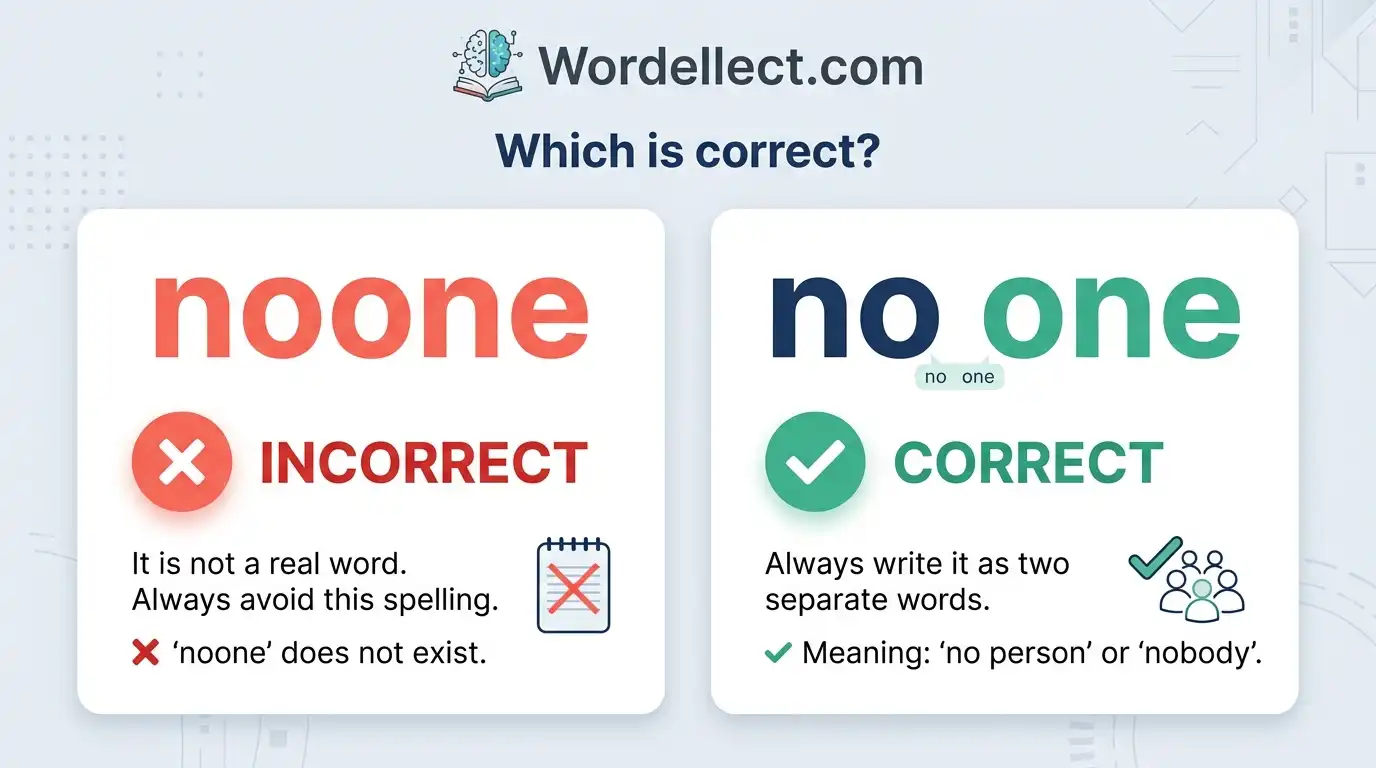
The correct choice is no one, written as two separate words. It means “not any person” or “nobody.” For example, you can write, “No one answered the phone.” This means that nobody answered it.
The spelling “noone”, written as one word, is generally considered incorrect when you want to say that nobody did something. It is best to avoid it in schoolwork, emails, business writing, and other formal text.
You may also see “no-one”, with a hyphen. Some British English sources accept this form, but the two-word spelling is widely used in both British and American English.
Below, you will learn the meaning of “no one,” the difference between these spellings, how to use the phrase in a sentence, and which form to choose when writing.
No One or Noone: Quick Answer
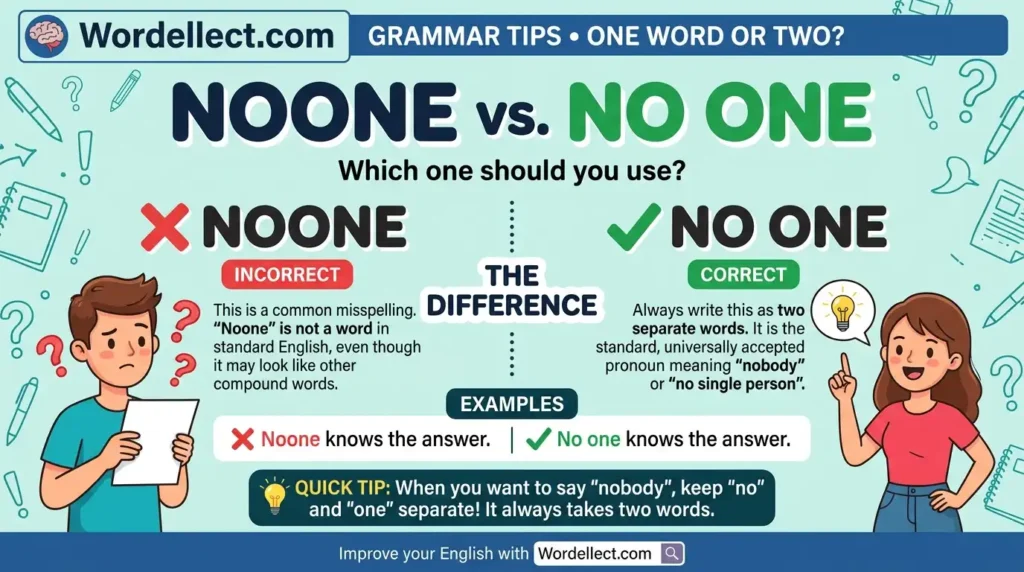
“No one” is the correct standard spelling. Write it as two words when you mean “nobody” or “not any person.”
- No one: Correct standard spelling.
- Noone: Not the standard spelling. Avoid it in normal English writing.
- No-one: A hyphenated form accepted by some British English sources.
- Nobody: A correct one-word alternative to “no one.”
Correct: No one came to the party.
Incorrect: Noone came to the party.
Also accepted in some usage: No-one came to the party.
For most writing, choose “no one.” It is clear, common, and easy to use.
What Does “No One” Mean?
“No one” is a pronoun that means not any person. It refers to zero people.
You use it when you want to say that nobody is present, nobody did something, or nobody knows something.
Here are a few simple examples:
- No one is home. This means nobody is at home.
- No one called me. This means nobody called me.
- No one knows the answer. This means nobody knows it.
- No one was waiting outside. This means there were no people waiting outside.
You can use “no one” to talk about people in the past, present, or future.
Past: No one visited us yesterday.
Present: No one wants to leave.
Future: No one will forget this day.
In each sentence, “no one” means the same thing: not any person.
What Is the Difference Between “No One” and “Noone”?
The main difference is spelling. “No one” is the standard form, while “noone” is generally treated as a spelling error when used to mean “nobody.”
The space matters because English spelling follows accepted word forms. Although “noone” may look like a natural combination of “no” and “one,” it is not the normal written form of this pronoun.
Compare these sentences:
- Correct: No one helped me with my work.
- Incorrect: Noone helped me with my work.
Both sentences may be easy to understand, but only the first uses the standard spelling.
If you are writing an essay, an exam answer, a work email, or a website article, use “no one.” A spell-check tool may also flag “noone” as an error.
Why Do People Write “Noone”?
People may write “noone” because they say the phrase quickly and hear it as one unit. They may also think that it follows the pattern of words such as “nobody” and “nothing.”
However, English does not combine every phrase into one word. “No one” remains two words in standard writing.
The easiest way to remember it is to learn the full phrase as one spelling unit, even though it contains a space.
No One vs. No-One vs. Noone
These three forms can look confusing, but the difference is easy to remember.
| Form | Is it correct? | Meaning or use | Example |
| No one | Yes | Standard form meaning nobody | No one was there. |
| No-one | Accepted in some styles | Hyphenated form, especially seen in British usage | No-one was there. |
| Noone | Not standard for this meaning | Usually a spelling error | Avoid “Noone was there.” |
| Nobody | Yes | One-word alternative to no one | Nobody was there. |
For everyday and formal writing, “no one” is the safest choice. “No-one” may be acceptable if your chosen dictionary or style guide allows it.
Is “No One” One Word or Two?
“No one” is two words.
The word “no” shows that there are zero people. The word “one” refers to a person. Together, they mean “not any person.”
For example:
- No one called.
- No one understands.
- No one was ready.
- No one can help us.
Do not remove the space when using this phrase in standard English.
You may see “no-one” with a hyphen in some books or news reports. That is a separate spelling choice. It does not make “noone” the standard form.
Is “No One” Singular or Plural?
“No one” is treated as singular in standard grammar. This means it normally takes a singular verb.
For example:
- Correct: No one is ready.
- Incorrect: No one are ready.
- Correct: No one knows the answer.
- Incorrect: No one know the answer.
The rule stays the same even when you are talking about a group of people.
For example, you might say, “No one in the class knows the answer.” The sentence refers to all the students, but “no one” takes the singular verb “knows.”
This is an important rule for schoolwork and formal writing.
No One vs. Nobody: What Is the Difference?
“No one” and “nobody” have the same basic meaning. Both mean “not any person,” and you can often use them in the same sentence without changing its meaning.
For example:
- No one answered the door.
- Nobody answered the door.
Both sentences tell us that no person answered.
The main difference is style. “No one” is two words, while “nobody” is one word. Both are correct, so you can choose the one that sounds more natural in your sentence.
If you are unsure which one to use, either is usually fine. Just remember that “noone” is not the standard spelling of either form.
No One in British English vs. American English
There is no major difference in the meaning of “no one” between British and American English. Both use it to mean “not any person.”
The standard spelling is the same in both varieties:
- British English: No one was at home.
- American English: No one was at home.
The hyphenated form “no-one” is also accepted by some British English references. However, you do not need to change “no one” when writing for a British or American audience.
Best advice: Use “no one” in both British and American English unless a specific style guide asks you to use another accepted form.
Which Form Should You Use?
The best choice depends on your writing, but “no one” works well in almost every normal situation.
In Schoolwork and Exams
Use “no one” in essays, homework, and exam answers.
Example: No one in my group knew the answer.
This is the standard form and avoids spelling problems.
In Emails and Business Writing
Use “no one” in work emails, reports, and messages that need a clear, professional tone.
Example: No one from the team was available for the meeting.
In Everyday Messages
You can use “no one” in texts and online chats, too.
Example: No one told me about the change.
Even in casual writing, the standard spelling is a good habit.
In British English
“No one” is a safe choice. You may use “no-one” if it matches the style guide you follow.
In American English
Use “no one” as the standard spelling.
Simple rule: If you want to avoid confusion, write “no one” as two words.
Common Mistakes With “No One”
Here are common errors to watch for when using this phrase.
1. Writing “Noone” as One Word
Incorrect: Noone came to see me.
Correct: No one came to see me.
Why: “No one” is the standard two-word spelling.
2. Using a Plural Verb
Incorrect: No one know the answer.
Correct: No one knows the answer.
Why: “No one” takes a singular verb in standard grammar.
3. Using “Are” Instead of “Is”
Incorrect: No one are in the room.
Correct: No one is in the room.
Why: “No one” is grammatically singular.
4. Adding an Extra Negative
Unclear: No one didn’t call me.
Clearer: No one called me.
Why: “No one” already gives the sentence a negative meaning. Adding “didn’t” can create a confusing double negative. If you mean that every person failed to call, say, “No one called me.”
5. Confusing “No One” With “Every One”
Incorrect for the intended meaning: No one of the students passed, when you mean all students passed.
Correct: Every one of the students passed.
Why: “No one” means not any person. “Every one” means each person or thing in a group.
These phrases have different meanings, so choose the one that matches your message.
10 Everyday Examples of “No One”
Here are ten natural sentences that show how to use “no one” correctly.
- No one answered the phone.
- No one was at the bus stop.
- I told no one about the surprise.
- No one knows where my keys are.
- No one came to class yesterday.
- She felt that no one was listening.
- No one can solve every problem alone.
- The room was quiet because no one spoke.
- No one from our team missed the meeting.
- He waited for an hour, but no one arrived.
Notice that “no one” stays as two words in every example. It can appear at the start or in the middle of a sentence.
How to Use “No One” in Real Life
You can use “no one” in many everyday situations.
In a conversation:
“Who helped you?”
“No one. I did it myself.”
In an email:
“No one from our team is available at that time.”
At school:
“No one in the class knew the answer.”
At work:
“No one has sent the final report yet.”
On social media:
“No one warned me that this game would be so hard!”
These examples all use the same standard spelling. The phrase works in both casual and formal writing.
Does “No One” Have a Different Meaning From “No-One”?
Usually, no. When “no-one” is used as a hyphenated form of the pronoun, it has the same meaning as “no one.”
For example:
- No one was home.
- No-one was home.
Both mean that nobody was at home. The choice depends on the spelling style followed by the writer or publication.
By contrast, “noone” without a space or hyphen is not the standard spelling for this meaning. It is best to avoid it in edited writing.
Frequently Asked Questions
1. Is “noone” ever correct?
“Noone” is not the standard spelling of the pronoun meaning “nobody.” In normal English writing, use “no one.” If you see “Noone” as a name or another special use, that is a different matter from the pronoun.
2. Is “no one” always two words?
Yes, “no one” is written as two words in standard usage. Some writers use “no-one” with a hyphen, but the two-word form is a safe choice for school, work, and everyday writing.
3. Is “no-one” wrong in American English?
The two-word form “no one” is the safest standard choice in American English. The hyphenated form appears in some English usage, but style preferences can vary. Follow the dictionary or style guide used by your school, publisher, or workplace.
4. Can I use “nobody” instead of “no one”?
Yes. “Nobody” and “no one” usually mean the same thing. For example, “Nobody came” and “No one came” both mean that not any person came. Both forms are correct.
5. Should I write “no one knows” or “no one know”?
Write “no one knows.” The pronoun “no one” is singular, so it takes the singular verb “knows.” The same rule applies to sentences such as “No one wants to leave” and “No one understands me.”
6. Is “no one” formal or informal?
“No one” works in both formal and informal writing. You can use it in essays, reports, work emails, text messages, and everyday conversations. It is a normal English phrase, not slang.
7. What is the easiest way to remember the correct spelling?
Remember that the standard phrase has a space: no one. If you want a one-word alternative, use “nobody.” Avoid joining the words to make “noone.”
Conclusion: No One or Noone?
The correct standard spelling is “no one,” written as two words. It means “nobody” or “not any person.” You can use it to talk about people who are not present, people who did not do something, or people who do not know something.
For example, “No one answered the phone” means that nobody answered it. The phrase works in everyday speech, schoolwork, business emails, reports, and other forms of writing.
The spelling “noone” is generally treated as incorrect when you want to express this meaning. Avoid it in formal and informal writing. You may also see “no-one” with a hyphen, which some British English sources accept. However, you do not need to use the hyphen to write the phrase correctly.
Remember these three forms:
- No one: Standard spelling.
- No-one: Accepted in some styles.
- Noone: Avoid this spelling for the meaning “nobody.”
If you want the simplest rule, use “no one” every time you mean “not any person.” It is clear, easy to remember, and suitable for most writing.

I explore and explain the difference between commonly confused English words to make writing clearer and more accurate. I provide simple, SEO-friendly explanations with examples to help you understand usage easily. I help improve grammar skills by making word differences easy to learn and remember.







