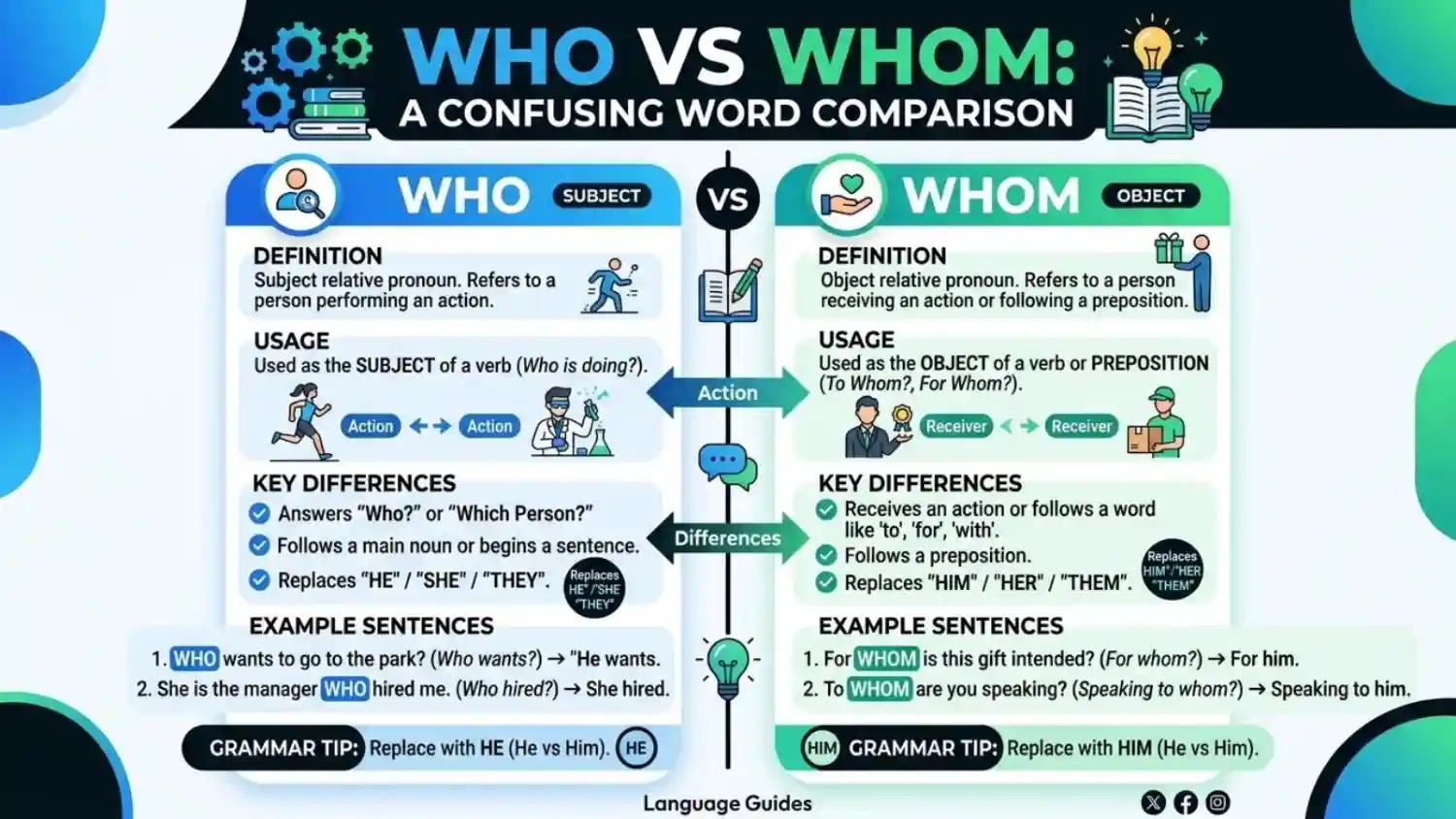
Many people get confused about who vs whom. These two words look similar and have related meanings, but they are used in different ways. Even native English speakers sometimes struggle to choose the correct one.
You may have heard sentences like “Who is calling?” and “To whom should I send the email?” Both sentences are correct, but they use different words. This often makes people wonder when to use who and when to use whom.
The good news is that the difference is easier than it seems. In simple terms, who is usually the subject of a sentence, while whom is usually the object. Knowing this rule can help you write more clearly and confidently.
This guide will explain everything in simple language with clear examples. By the end, you will know exactly how to use both words correctly.
Who vs Whom – Quick Answer
The easiest rule is:
- Who = the person doing the action.
- Whom = the person receiving the action.
Easy Trick
Replace the word with:
- Him/Her → Use Whom
Example:
Who called?
He called.
So who is correct.
Whom did you call?
I called him.
So whom is correct.
Quick Comparison Table
| Word | Function | Example |
| Who | Subject | Who is coming? |
| Whom | Object | Whom did you invite? |
The Origin of Who vs Whom
The words who and whom come from Old English.
Hundreds of years ago, English had many word forms that changed depending on how they were used in a sentence. Similar systems still exist in some languages today.
The word who was used as the subject form.
The word whom was used as the object form.
Over time, English became simpler. Many old grammar forms disappeared. However, whom survived and is still used in formal English.
Today, many people use who in casual speech, even where traditional grammar would use whom.
Origin Comparison
| Word | Historical Role |
| Who | Subject form |
| Whom | Object form |
British English vs American English Spelling
Unlike some English words, there is no spelling difference between British English and American English.
Both varieties use:
- Who
- Whom
The difference is mainly in usage.
American English often uses who in everyday conversation.
British English also uses who frequently in speech but keeps whom in more formal situations.
American English Examples
- Who are you talking to?
- Who did you invite?
British English Examples
- Who are you talking to?
- Whom did you invite?
Both versions may be accepted depending on the level of formality.
Comparison Table
| Situation | American English | British English |
| Casual speech | Who | Who |
| Formal writing | Whom | Whom |
| Business writing | Whom often used | Whom often used |
| Academic writing | Whom preferred | Whom preferred |
Which Spelling Should You Use?
Since there is no spelling difference, the real question is which word you should use.
Use Who When It Is the Subject
Examples:
- Who is at the door?
- Who made the cake?
- Who wants pizza?
Use Whom When It Is the Object
Examples:
- Whom did you meet?
- Whom are you calling?
- To whom should I send this?
For American Readers
In casual writing, who is often acceptable.
In formal writing, use whom when grammar requires it.
For British Readers
The same rule applies.
Formal writing often keeps whom.
For Global Readers
Use:
- Who for subjects.
- Whom for objects.
This works well everywhere.
Common Mistakes with Who vs Whom
Many writers make mistakes because the words are very similar.
Mistake 1
❌ Whom is coming to dinner?
✅ Who is coming to dinner?
Why?
The person is doing the action.
Mistake 2
❌ Who did you invite?
✅ Whom did you invite?
Why?
The person receives the action.
Note: In casual English, many people still say “Who did you invite?”
Mistake 3
❌ To who should I send the email?
✅ To whom should I send the email?
Why?
The person is the object of the preposition “to.”
Mistake 4
❌ Whom wrote the report?
✅ Who wrote the report?
Why?
The person performed the action.
Mistake 5
❌ Whom wants ice cream?
✅ Who wants ice cream?
Why?
The person is the subject.
Who vs Whom in Everyday Examples
Real-life examples make grammar easier to understand.
Emails
- Who should receive this report?
- To whom it may concern.
- Whom should I contact for support?
News Articles
- Who won the election?
- Police are looking for the person whom witnesses described.
- Who made the statement?
On Social Media
- Who watched the game?
- Who is excited for the weekend?
- Whom did you tag in this photo?
In School Writing
- Who discovered gravity?
- Whom did the teacher choose?
- Who completed the project?
Business Writing
- To whom should I send the invoice?
- Who approved the request?
- Whom should customers contact?
Daily Conversation
- Who is calling?
- Who wants coffee?
- Who did you see yesterday?
Who vs Whom – Google Trends & Usage Data
Search data shows that who vs whom is one of the most common grammar questions online.
Many students, professionals, and English learners search for this topic because the rule is not always obvious.
Usage Trends
- Who is used far more often than whom.
- Whom appears mainly in formal writing.
- Searches increase during school and exam periods.
Popular Countries
People often search this topic in:
- United States
- United Kingdom
- Canada
- Australia
- India
Why Who Is More Common
Most conversations use who.
Many speakers avoid whom because it sounds formal.
However, whom remains important in:
- Academic writing
- Business communication
- Legal documents
- Formal letters
Usage by Context
| Context | Common Word |
| Everyday speech | Who |
| Social media | Who |
| Business writing | Whom |
| Academic writing | Whom |
| Formal letters | Whom |
| Casual texting | Who |
Who vs Whom Comparison Table
| Feature | Who | Whom |
| Subject | Yes | No |
| Object | No | Yes |
| Casual speech | Very common | Less common |
| Formal writing | Common | Common |
| Academic writing | Used | Frequently used |
| Business writing | Used | Frequently used |
| Example | Who called? | Whom did you call? |
FAQs About Who vs Whom
1. What is the difference between who and whom?
Who is a subject. Whom is an object.
2. Is whom still used today?
Yes. It is common in formal writing.
3. Can I use who instead of whom?
In casual conversation, many people do.
4. How do I know which word to use?
Use the he/him trick.
- He = Who
- Him = Whom
5. Is “Who did you invite?” wrong?
Traditionally, “Whom did you invite?” is correct. However, “Who did you invite?” is very common.
6. Why is whom less common now?
Modern English has become simpler, and many speakers prefer who.
7. Is whom used in business writing?
Yes. Formal business writing often uses whom.
8. What does “To whom it may concern” mean?
It is a formal phrase used when the reader’s name is unknown.
Conclusion
Understanding who vs whom can make your English more accurate and professional. Although the two words seem confusing at first, the basic rule is simple. Use who when talking about the person performing an action. Use whom when talking about the person receiving the action.
A helpful trick is to replace the word with he or him. If he sounds correct, use who. If him sounds correct, use whom. This method works in most situations and makes the choice much easier.
In everyday conversation, many people use who for almost everything.Knowing how to use both words correctly can improve your grammar and make your writing more polished.
With a little practice, choosing between who and whom becomes simple. Remember the subject-object rule, use the he/him test, and you will avoid common mistakes with confidence.

Ethan Carter is a language writer at Wordellect who helps readers understand word differences, grammar rules, and spelling variations through simple and accurate guides.







