Have you ever written “altogether” and wondered if it should be two words? Or typed “all together” and felt unsure? You are not alone. This pair confuses writers every single day.
The mix-up is easy to understand. The two forms sound exactly the same when spoken. They look almost identical on paper. But they mean very different things. Using the wrong one can change your whole sentence.
Many people search for this answer when writing emails, essays, or reports. They want to sound clear and correct. A small mistake here can make writing look careless. Even native English speakers get this wrong.
This guide will clear up the confusion fast. You will learn the quick answer first. Then we will look at where each word came from. We will cover spelling rules, real examples, and common errors. You will also see a side-by-side table that makes the difference easy to spot.
By the end, you will know exactly when to use “altogether” and when to use “all together.” Your writing will be sharper, and your meaning will be clear. Let us start.
Altogether vs All Together – Quick Answer
These two phrases are not the same. They have different meanings.
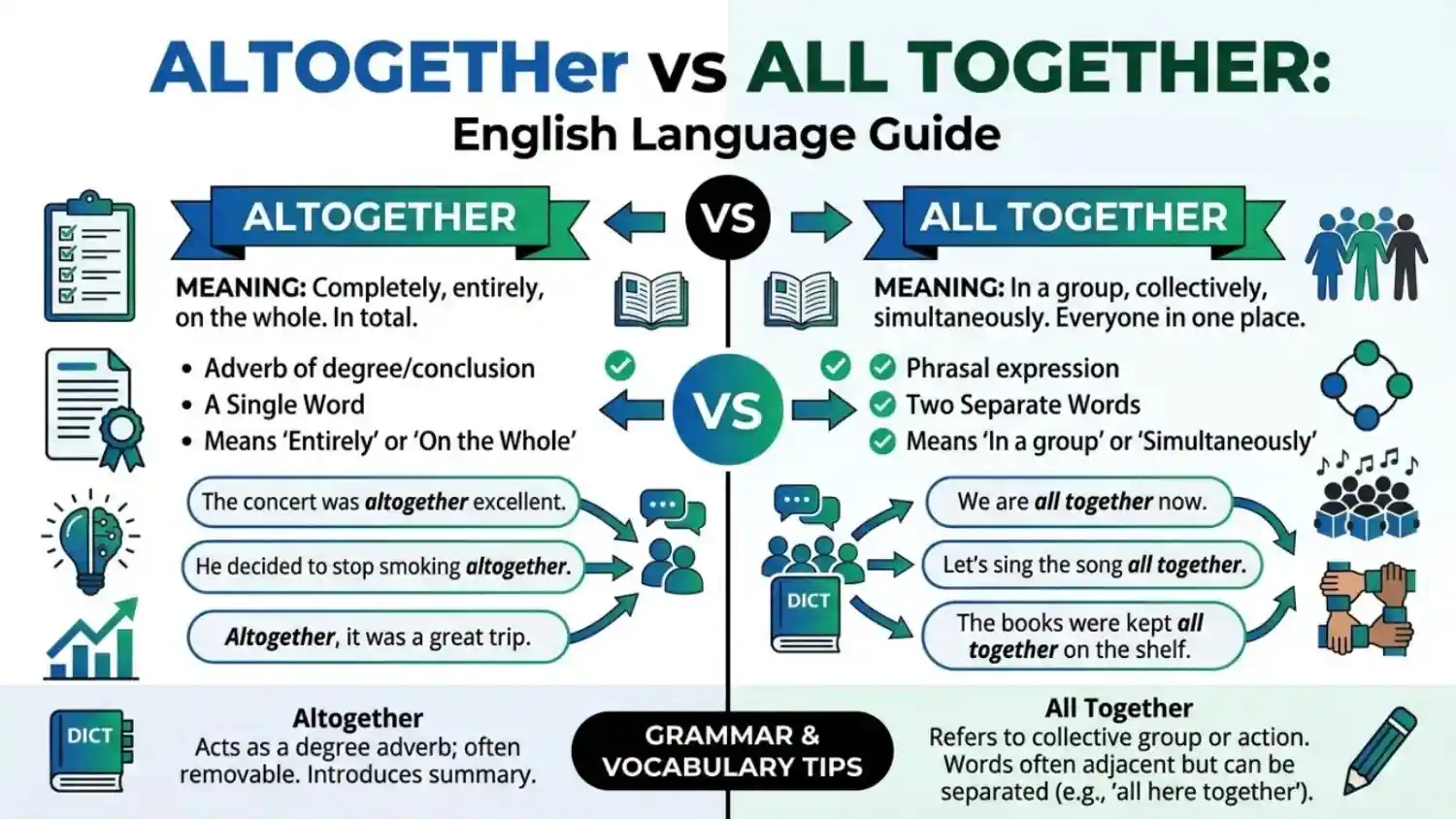
Altogether (one word) is an adverb. It means “completely,” “in total,” or “on the whole.”
Examples:
- The movie was altogether boring.
- You owe me $50 altogether.
- Altogether, it was a good year.
All together (two words) means “everyone or everything in one place” or “at the same time.”
Examples:
- The family was all together for the holidays.
- Let us sing all together now.
- The books were stacked all together on the shelf.
A simple test helps. Can you split “all” and “together” in the sentence? If yes, use two words. For example, “We were all sitting together” works the same as “We were all together.”
If you cannot split them, use one word. “The trip was altogether amazing” cannot become “all together amazing.”
The Origin of Altogether vs All Together
Both forms come from Old English roots. The word “all” is one of the oldest words in English. It comes from the Old English eall, meaning “every” or “the whole.” The word “together” comes from togædere, meaning “into one group.”
For centuries, people wrote “all together” as two words. This was the only form. It simply meant a group of things or people joined as one.
In the Middle English period, around the 14th century, “altogether” began to appear as one word. Writers used it to mean “completely” or “wholly.” This new form had a different role. It was an adverb that described how much or how fully something happened.
Over time, the two forms split into clear meanings. “All together” kept its original sense of group unity. “Altogether” took on the meaning of totality or completeness.
This is why spelling matters here. The space between “all” and “together” is not just a typo. It changes the word’s job in the sentence. One word describes a state. Two words describe a group.
British English vs American English Spelling
Good news. Both British and American English follow the same rules for this pair. There is no spelling difference between regions.
“Altogether” is always one word when used as an adverb meaning “completely” or “in total.” “All together” is always two words when describing a group acting as one.
This rule holds true in the UK, US, Canada, Australia, India, and every other English-speaking country.
The confusion is not about region. It is about meaning. Writers everywhere mix these two up, no matter where they live.
Here is a clear comparison:
| Usage | British English | American English | Canadian English | Australian English |
| Meaning “completely” | altogether | altogether | altogether | altogether |
| Meaning “in a group” | all together | all together | all together | all together |
| In total amounts | altogether | altogether | altogether | altogether |
| Same place/time | all together | all together | all together | all together |
So the rule does not change with location. It changes with meaning. This makes things simple. Learn the meanings, and you can use both forms anywhere in the world.
Which Spelling Should You Use?
The right choice depends on what you mean, not where you live.
Use altogether when you mean “completely,” “entirely,” or “in total.” This is an adverb. It modifies a verb, adjective, or whole sentence. You cannot break it apart without losing meaning.
Use all together when you mean “everyone or everything in one place” or “at the same time.” This is a phrase. You can often add words between “all” and “together,” like “all of us together.”
For US writers, this rule applies in school, business, and casual writing. American style guides like AP and Chicago both treat these as separate words with separate meanings.
For UK and Commonwealth writers, the rule is the same. British style guides like Oxford and Cambridge also keep these forms distinct.
For global writing, you do not need to worry about region. Just focus on meaning. If you are not sure, try the split test. Can the sentence still work if you separate “all” from “together”? If yes, use two words. If no, use one.
For formal writing, double-check each use. This pair is a common reason for editing marks.
Common Mistakes with Altogether vs All Together
People make a few common errors. Here are the top ones with fixes.
Mistake 1: “The team worked altogether on the project.”
Correct: “The team worked all together on the project.” (They worked as a group.)
Mistake 2: “There were all together 20 guests.”
Correct: “There were altogether 20 guests.” (Total count.)
Mistake 3: “The plan was all together a success.”
Correct: “The plan was altogether a success.” (Completely a success.)
Mistake 4: “We sang altogether at the concert.”
Correct: “We sang all together at the concert.” (Sang as one group.)
Mistake 5: Using “all together” when you mean “in total.”
Correct: Use “altogether” for totals or sums.
Mistake 6: Using “altogether” when describing a group.
Correct: Use “all together” for groups in one place.
A simple trick helps. Replace the word with “completely.” If the sentence still makes sense, use “altogether.” If not, use “all together.”
For example: “The movie was completely boring” works. So “altogether” is right.
But “The family was completely for the holidays” does not work. So “all together” is right.
Altogether vs All Together in Everyday Examples
Let us see both forms in real life.
In emails:
“We had altogether 15 responses to the survey.”
“The team will be all together in the meeting room at 3 PM.”
In news headlines:
“Altogether, the storm caused $2 billion in damage.”
“World leaders stood all together at the peace summit.”
On social media:
“This vacation was altogether amazing!”
“So happy to have my friends all together again.”
In formal writing:
“The report was altogether convincing.”
“The committee members were all together for the vote.”
In casual conversation:
“That movie was altogether weird.”
“Let us go all together in one car.”
In business contexts:
“Altogether, we sold 5,000 units this quarter.”
“The departments worked all together on the launch.”
In academic writing:
“The findings are altogether different from previous studies.”
“The data points were grouped all together in one chart.”
Notice how each form fits a clear role. “Altogether” sums things up or shows degree. “All together” describes people or things sharing a space or moment.
Altogether vs All Together – Google Trends & Usage Data
Google Trends data shows this is a popular search worldwide. People look up “altogether vs all together” thousands of times each month. The confusion is global.
The top countries searching this query are the United States, the United Kingdom, India, Canada, and Australia. English learners search this often. Native speakers also check, especially when writing important documents.
Searches peak during weekdays. This points to workplace use. Many people write reports, emails, or marketing copy and want to be sure.
Usage data from books and news shows “altogether” appears slightly more often than “all together.” This is because “altogether” works as an adverb in many contexts. “All together” is more limited to group settings.
Related searches include “altogether meaning,” “all together synonym,” and “altogether vs all together examples.” These show people want both quick answers and deeper learning.
Major dictionaries like Merriam-Webster, Oxford, and Cambridge list both as correct. They just have different meanings. None mark either as wrong or outdated.
Interestingly, mistakes with this pair appear in published books, news articles, and even legal documents. Even careful writers slip up. That is why this remains a top search term year after year.
Comparison Table: Altogether vs All Together
| Feature | Altogether | All Together |
| Part of speech | Adverb | Phrase (adjective + adverb) |
| Meaning | Completely, in total, on the whole | Everyone/everything in one place or at once |
| Number of words | One | Two |
| Can be split? | No | Yes |
| Replace with “completely”? | Yes | No |
| Example | “It was altogether wrong.” | “We were all together at dinner.” |
| Common context | Totals, sums, degree | Groups, gatherings |
| Spelling in UK | altogether | all together |
| Spelling in US | altogether | all together |
| Synonyms | entirely, wholly, in all | in unison, in a group |
FAQs:
1. Is “altogether” one word or two?
“Altogether” is one word. It means “completely” or “in total.” “All together” (two words) means “in a group.”
2. How do I know which one to use?
Try the split test. If you can separate “all” and “together” without losing meaning, use two words. If not, use one word.
3. Can I use “altogether” to describe people?
Not usually. “Altogether” describes degree or totals. To describe people in a group, use “all together.”
4. Is “all together now” correct?
Yes. It means “everyone at the same time.” For example, “Sing all together now!” is correct.
5. Are “altogether” and “all together” pronounced the same?
Yes. They sound identical in spoken English. The difference only shows up in writing.
6. Is one form more formal than the other?
No. Both are correct in formal and casual writing. The choice depends on meaning, not formality.
7. What is a good memory trick?
Replace the word with “completely.” If the sentence still works, use “altogether.” If not, use “all together.”
Conclusion:
The difference between “altogether” and “all together” is clear once you know the rule. Use altogether (one word) when you mean “completely,” “in total,” or “on the whole.” Use all together (two words) when you mean “in a group” or “at the same time.”
The forms sound the same, but they do different jobs. “Altogether” is an adverb. It modifies verbs, adjectives, or sentences. “All together” is a phrase that describes people or things sharing a place or moment.
This rule is the same in British English, American English, and every other form of English. There is no regional difference. The choice depends only on meaning.
A simple memory trick makes it easy. Try replacing the word with “completely.” If the sentence still works, use “altogether.” If not, use “all together.” This test never fails.
Next time you write an email, report, or post, you will pick the right form with ease. Your meaning will be clear, and your writing will look polished. Skip the guesswork. Use the test, and you will get it right every time.








