Many English learners get confused about some vs any. Both words talk about an amount or number of things, but they are not used in the same way. This can make writing and speaking English harder than it needs to be.
You may ask questions like: Should I say some water or any water? Why do people say Do you have any money? but I have some money? These questions are very common.
The good news is that the difference between some and any is easy to understand. In this guide, you will learn the meaning of some and any, where they came from, how they are used, common mistakes, real-life examples, and answers to frequently asked questions. By the end, you will know exactly when to use each word with confidence.
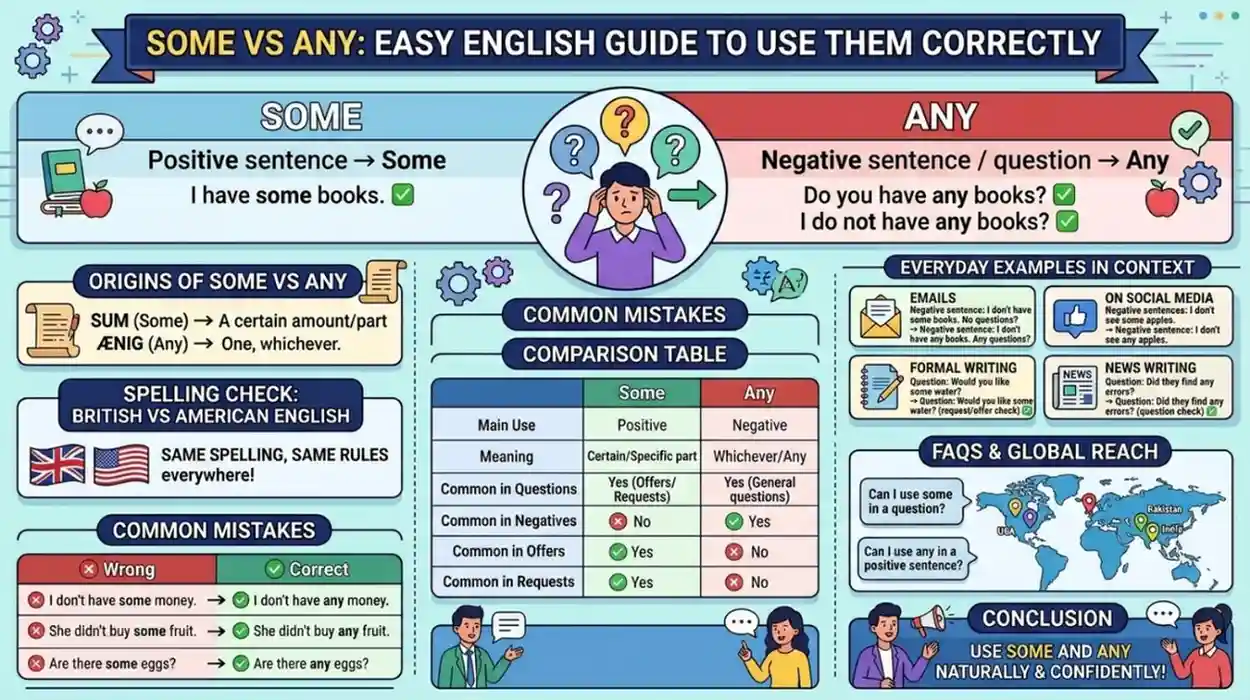
Some vs Any – Quick Answer
The simple rule is:
- Some is usually used in positive sentences.
- Any is usually used in questions and negative sentences.
Examples
| Word | Example |
| Some | I have some books. |
| Some | She bought some apples. |
| Any | Do you have any books? |
| Any | I do not have any apples. |
Easy Rule
- Positive sentence → Some
- Negative sentence → Any
- Question → Any
Examples:
✅ I need some help.
✅ Can I have some water? (offer/request)
✅ Do you have any water?
✅ I don’t have any water.
The Origin of Some vs Any
The words some and any are very old English words.
Origin of Some
The word some comes from Old English sum. It meant a certain amount, number, or part of something.
Example:
- Some people like tea.
- Some food is ready.
Origin of Any
The word any comes from Old English ænig. It meant one, whichever, or no matter which.
Example:
- Any person can join.
- Do you have any questions?
Why the Difference Exists
Over time, English speakers started using:
- Some when talking about a known or expected amount.
- Any when talking about an unknown amount or asking questions.
This pattern became part of modern English grammar.
British English vs American English Spelling
Unlike words such as colour/color or travelling/traveling, some and any have the same spelling in both British and American English.
There is no spelling difference.
Examples
| British English | American English |
| Some water | Some water |
| Any questions | Any questions |
| Some people | Some people |
| Any money | Any money |
Comparison Table
| Feature | British English | American English |
| Some | Same spelling | Same spelling |
| Any | Same spelling | Same spelling |
| Meaning | Same | Same |
| Grammar Rules | Same | Same |
Both countries use these words in exactly the same way.
Which Spelling Should You Use?
The answer is simple.
Use:
- Some when grammar requires it.
- Any when grammar requires it.
There is no British or American spelling choice to make.
For US Audience
Use normal grammar rules.
Example:
- I have some friends.
- Do you have any friends?
For UK Audience
Use the same rules.
Example:
- We bought some bread.
- We don’t have any bread.
For Global Audience
The same grammar works everywhere.
Whether your readers are in the United States, the United Kingdom, Canada, Australia, New Zealand, India, or Pakistan, the rules stay the same.
Common Mistakes with Some vs Any
Many learners make small mistakes when using these words.
Mistake 1
❌ I don’t have some money.
✅ I don’t have any money.
Mistake 2
❌ Do you have some questions?
✅ Do you have any questions?
Mistake 3
❌ She didn’t buy some apples.
✅ She didn’t buy any apples.
Mistake 4
❌ Is there some milk?
✅ Is there any milk?
Mistake 5
Using any in a positive sentence when not needed.
❌ I bought any books.
✅ I bought some books.
Quick Correction Table
| Wrong | Correct |
| I don’t have some money. | I don’t have any money. |
| Do you need some help?* | Do you need any help? |
| She didn’t buy some food. | She didn’t buy any food. |
| I bought any books. | I bought some books. |
*Note: “Do you need some help?” can be correct when offering help.
Some vs Any in Everyday Examples
In Emails
Some
- I have some updates about the project.
- We received some feedback.
Any
- Do you have any questions?
- Please let me know if you need any help.
In News Writing
Some
- Some residents left the area.
- Some roads remain closed.
Any
- Officials did not report any injuries.
- Any new updates will be shared later.
On Social Media
Some
- I bought some new shoes today.
- Some people love this movie.
Any
- Any recommendations for good books?
- Does anyone have any advice?
In Formal Writing
Some
- The study found some differences.
- Some results were unexpected.
Any
- Researchers did not find any errors.
- Any future changes will be announced.
Some vs Any – Google Trends & Usage Data
Google search data shows that many people search for some vs any because it is a common English grammar topic.
Countries Where Interest Is High
- India
- Pakistan
- United Kingdom
- United States
- Philippines
- Bangladesh
Why People Search It
People often want to know:
- Which word is correct?
- Can some and any be used together?
- Why is any used in questions?
- When should some be used?
Usage Context
| Context | Common Choice |
| Positive sentence | Some |
| Negative sentence | Any |
| Question | Any |
| Offer | Some |
| Request | Some |
The topic remains popular because English learners use these words every day.
Some vs Any Comparison Table
| Feature | Some | Any |
| Main Use | Positive sentences | Questions and negatives |
| Meaning | A certain amount | An unknown amount |
| Common in Questions | Sometimes | Yes |
| Common in Negatives | No | Yes |
| Common in Offers | Yes | Rare |
| Common in Requests | Yes | Rare |
Examples
| Some | Any |
| I have some money. | Do you have any money? |
| She bought some fruit. | She didn’t buy any fruit. |
| We need some help. | We don’t need any help. |
FAQs:
1. What is the main difference between some and any?
Some is usually used in positive sentences, while any is usually used in questions and negative sentences.
2. Can I use some in a question?
Yes.
Example:
- Would you like some tea?
- Can I have some water?
These are offers and requests.
3. Can I use any in a positive sentence?
Yes.
Example:
- Any student can join.
Here, any means “every” or “no matter which.”
4. Is “I don’t have some money” correct?
No.
The correct sentence is:
- I don’t have any money.
5. Which word is more common?
Both are very common because they are used in different situations.
6. Are some and any used the same way in British and American English?
Yes. The grammar and spelling are the same.
7. Can some and any be used with countable and uncountable nouns?
Yes.
Examples:
- Some books
- Some water
- Any books
- Any water
Conclusion:
Understanding some vs any is an important step in learning English. While these two words may look similar, they are used in different situations. In most cases, some is used in positive sentences, while any is used in questions and negative sentences. This simple rule helps learners avoid many common grammar mistakes.
It is also useful to remember that some often appears in offers and requests, such as Would you like some coffee? or Can I have some water? Meanwhile, any is often used when asking about an unknown amount or when saying that something does not exist.
The words, meanings, and grammar rules are the same in both forms of English.
By practicing these rules in daily speaking and writing, you can use some and any naturally and confidently. The more examples you read and write, the easier it becomes to choose the correct word every time.

Ethan Carter is a language writer at Wordellect who helps readers understand word differences, grammar rules, and spelling variations through simple and accurate guides.







