Have you ever stopped and asked, “Do I say waiting or awaiting?” You are not the only one. Both words come from the same base word. Both talk about staying until something happens. But they are not used the same way in a sentence.
People search for “waiting vs awaiting” when they write emails, letters, school work, or work reports. Using the wrong word can make a sentence sound odd, especially in formal writing like “I am awaiting for your reply,” which is not correct. Workers want to sound professional. Students want clean grammar. People learning English just want one easy rule to follow.
Here is the good news. This is not a spelling rule like British vs American English. It is a small grammar rule about how each word is used with other words in a sentence. Once you learn this one rule, you will never mix them up again. This article gives you a fast answer first. Then it shows you where the words came from, how people use them, common mistakes, and real examples.
Key Takeaways
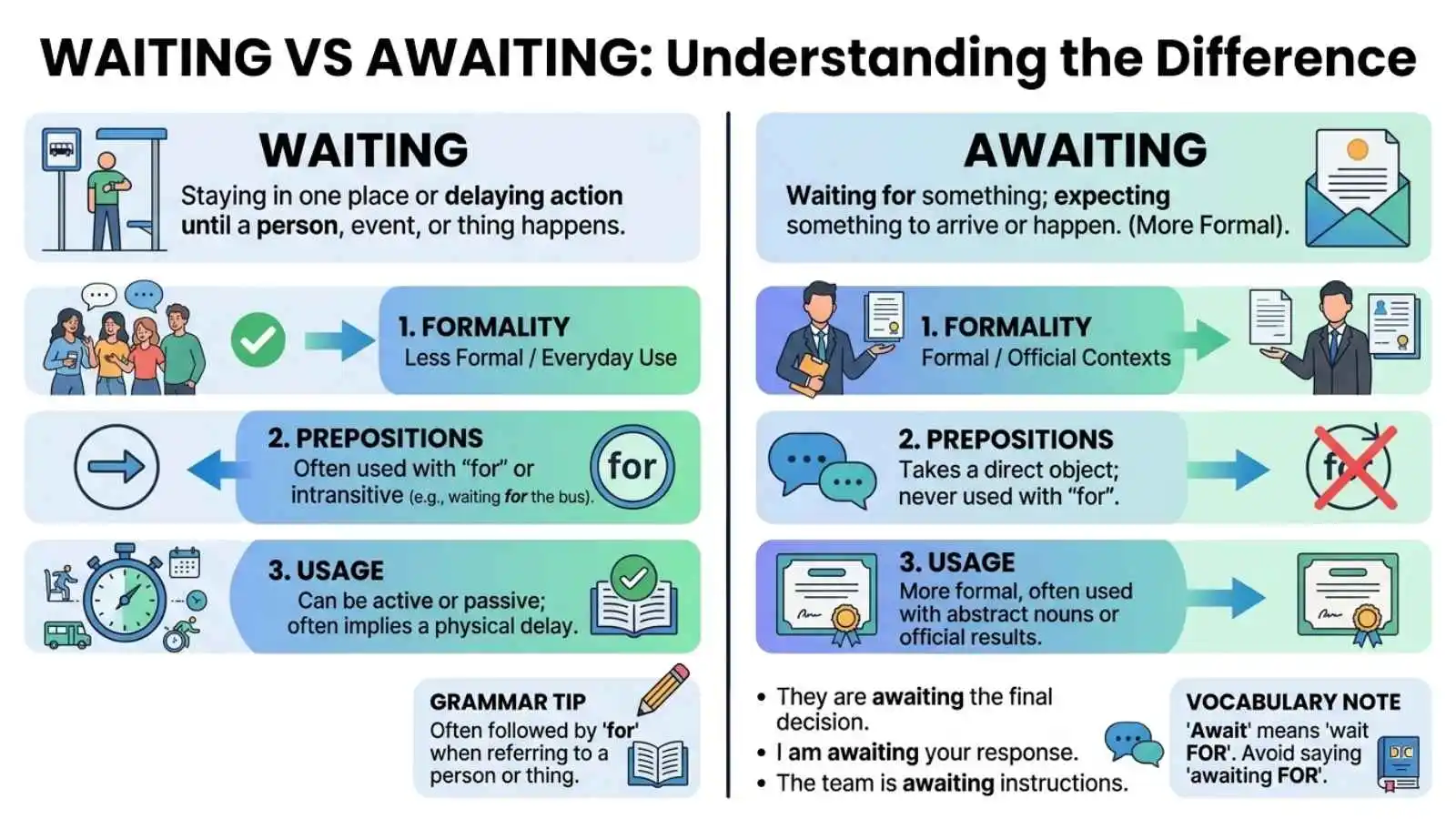
- Waiting usually needs the word “for” before the thing you expect.
- Awaiting does not need “for.” It goes straight before the thing you expect.
- Both words mean almost the same thing: staying until something happens.
- Awaiting sounds more formal. Waiting is used in everyday talk.
Table of Contents
- Waiting or Awaiting – Quick Answer
- The Origin of Waiting or Awaiting
- British English vs American English Spelling
- Which Word Should You Use?
- Common Mistakes with Waiting or Awaiting
- Waiting or Awaiting in Everyday Examples
- Quick Tips to Get It Right Every Time
- Waiting or Awaiting – Search Trends
- Comparison Table
- FAQs
Waiting or Awaiting – Quick Answer
Both words come from the verb “wait.” They mean almost the same thing, but they are used in different ways.
- Waiting is the more common word. It usually needs “for” before the thing you expect.
- Awaiting is a more formal word. It does not need “for.” It goes right before the thing you expect.
Easy Examples
- I am waiting for the bus.
- I am awaiting the bus. (formal, no “for” needed)
- She is waiting for your call.
- She is awaiting your call. (formal, no “for” needed)
Simple Rule
Use:
- Waiting + for + the thing you expect.
- Awaiting + the thing you expect (no “for”).
| Word | Meaning | Needs “For”? |
| Waiting | Staying until something happens | Yes |
| Awaiting | Staying until something happens | No |
The Origin of Waiting or Awaiting
Both words come from the same old root. The word “wait” comes from an old Germanic and French word that meant “to watch” or “to look out for something.”
“Await” formed when English added the small word part “a-” to the front of “wait.” This small part often means “toward” or “on.” So “await” first meant something close to “to watch toward” or “to look out for, directly.”
Over time, “wait” became the everyday word people use every day. “Await” stayed as a more formal word, often used in writing, business, and official talk. This is why “await” can skip the word “for,” while “wait” almost always needs it.
British English vs American English Spelling
This is not a British vs American spelling case, like “colour” and “color.” Both “waiting” and “awaiting” are spelled the same way in UK English and US English.
The real difference is about grammar and tone, not region. Both the UK and the US use “waiting for” in everyday talk and “awaiting” in formal writing.
Comparison Table
| English Style | Everyday Word | Formal Word |
| British English | Waiting (for) | Awaiting |
| American English | Waiting (for) | Awaiting |
Example Sentences
- UK: We are waiting for your reply.
- US: We are waiting for your reply.
- UK: We are awaiting your reply.
- US: We are awaiting your reply.
Both countries use these words in the exact same way.
Which Word Should You Use?
Ask yourself: Am I talking in a casual way, or a formal way?
Use “Waiting” When:
- You are talking or texting in a casual way
- You use “for” right after the word
- You are speaking about everyday things, like a bus, a friend, or food
Use “Awaiting” When:
- You are writing a formal email, letter, or report
- You do not want to use “for”
- You are talking about something official, like a decision, a reply, or a delivery
Advice by Reader
| Reader | Best Choice |
| US Reader | Waiting for casual talk, Awaiting for formal writing |
| UK Reader | Waiting for casual talk, Awaiting for formal writing |
| Global Reader | The rule stays the same everywhere |
If you are not sure, “waiting for” is always a safe, correct choice in almost any writing.
Common Mistakes with Waiting or Awaiting
Many writers use these words in the wrong way because they seem so close in meaning.
Mistakes
1: Using “For” After “Awaiting”
- ❌ I am awaiting for your reply.
- ✅ I am awaiting your reply.
- ✅ I am waiting for your reply.
2: Dropping “For” After “Waiting”
- ❌ I am waiting your call.
- ✅ I am waiting for your call.
3: Using “Awaiting” in Very Casual Talk
- ❌ Hey, I’m awaiting you at the mall. (sounds too stiff for texting)
- ✅ Hey, I’m waiting for you at the mall.
Easy Way to Remember
- “Waiting” needs a partner word: “for.”
- “Awaiting” walks alone. No “for” needed.
Waiting or Awaiting in Everyday Examples
In Emails
- I am awaiting your response by Friday.
- Just checking in, still waiting for your reply.
In News
- The company is awaiting approval from the government.
- Fans have been waiting for the new movie for months.
On Social Media
- Still waiting for my package to arrive!
- Awaiting the results of the big game tonight.
In Formal or Work Writing
- We are awaiting further instructions from the head office.
- The team is waiting for feedback before moving forward.
Quick Tips to Get It Right Every Time
Use this short checklist before you hit send on your next email or message:
- Check for “for.” If you wrote “awaiting for,” delete the word “for.”
- Check your tone. Formal report or email? Lean toward “awaiting.” Casual text or chat? Use “waiting for.”
- Read it out loud. If “awaiting” sounds too stiff for the moment, switch to “waiting for.”
- When unsure, pick “waiting for.” It works almost everywhere and is never wrong.
Waiting or Awaiting – Search Trends
People search for “waiting vs awaiting” a lot because both words show up often in emails and messages, and the small grammar rule is easy to forget.
Why People Search for This
- Writing emails at work
- School essays and formal letters
- Grammar and spell-check tools
- Learning English as a second language
- Everyday texting and social posts
How Each Word Is Used
| Word | Common Use | Popularity |
| Waiting | Everyday talk, texts, casual writing | Very High |
| Awaiting | Formal emails, business writing, news | High |
Search interest for “awaiting” often rises in job and business writing, since people want to sound polished in emails like “awaiting your response.”
Waiting vs Awaiting – Side by Side
| Feature | Waiting | Awaiting |
| Meaning | Staying until something happens | Staying until something happens |
| Needs “For”? | Yes | No |
| Tone | Casual, everyday | Formal, polished |
| Common Use | Texts, chats, daily talk | Emails, reports, news |
| Common Mistake | Dropping “for” | Adding “for” |
| Spelling by Country | Same in UK and US | Same in UK and US |
FAQs:
Is “awaiting for” correct? No. “Awaiting” should not be followed by “for.” Just say “awaiting your reply,” not “awaiting for your reply.”
Can I use “waiting” and “awaiting” the same way? Not exactly. “Waiting” needs “for” before the thing you expect. “Awaiting” does not need “for.”
Why do people confuse waiting and awaiting? Both words come from the same root and mean almost the same thing, which makes the small grammar rule easy to forget.
Do British and American English use these words differently? No. Both “waiting” and “awaiting” are spelled and used the same way in UK and US English.
Which word should I use in a work email? “Awaiting” often sounds more polished in formal emails, such as “I am awaiting your approval.” “Waiting for” also works and is never wrong.
Is “awaiting” more formal than “waiting”? Yes. “Awaiting” is seen as more formal and is common in business and news writing. “Waiting for” is used in both casual and formal writing.
Can “awaiting” be used in texting or casual chat? It can, but it may sound too formal or stiff. “Waiting for” fits better in casual texts and chats.
Conclusion:
The difference between waiting or awaiting comes down to one small grammar rule. Waiting needs the word “for” before the thing you expect. Awaiting does not need “for” at all. Both words mean almost the same thing: staying until something happens.
This is not a British vs American English issue. Both words are spelled and used the same way everywhere. The real key is remembering the small rule about “for” and matching the word to your tone, casual or formal.
If you are ever unsure, “waiting for” is a safe choice that works in almost any writing. Save “awaiting” for emails, reports, and formal writing, where it adds a polished touch. Getting this small rule right will make your writing sound clear and correct every time.

Ethan Carter is a language writer at Wordellect who helps readers understand word differences, grammar rules, and spelling variations through simple and accurate guides.







