You write a sentence. They want to say something is not even, not steady, or not fair. You stop. Do you say “unbalanced” or “imbalanced”? Both words look real. Both words sound close. But do they mean the same thing?
Many people search “unbalanced or imbalanced” because they see both words used in health articles, news, and school papers. They want to know if one word is wrong, or if both are fine to use.
This mix-up happens a lot, since both words come from the same root word: “balance.” But they grew in slightly different ways, and today, most style guides treat one as the better choice.
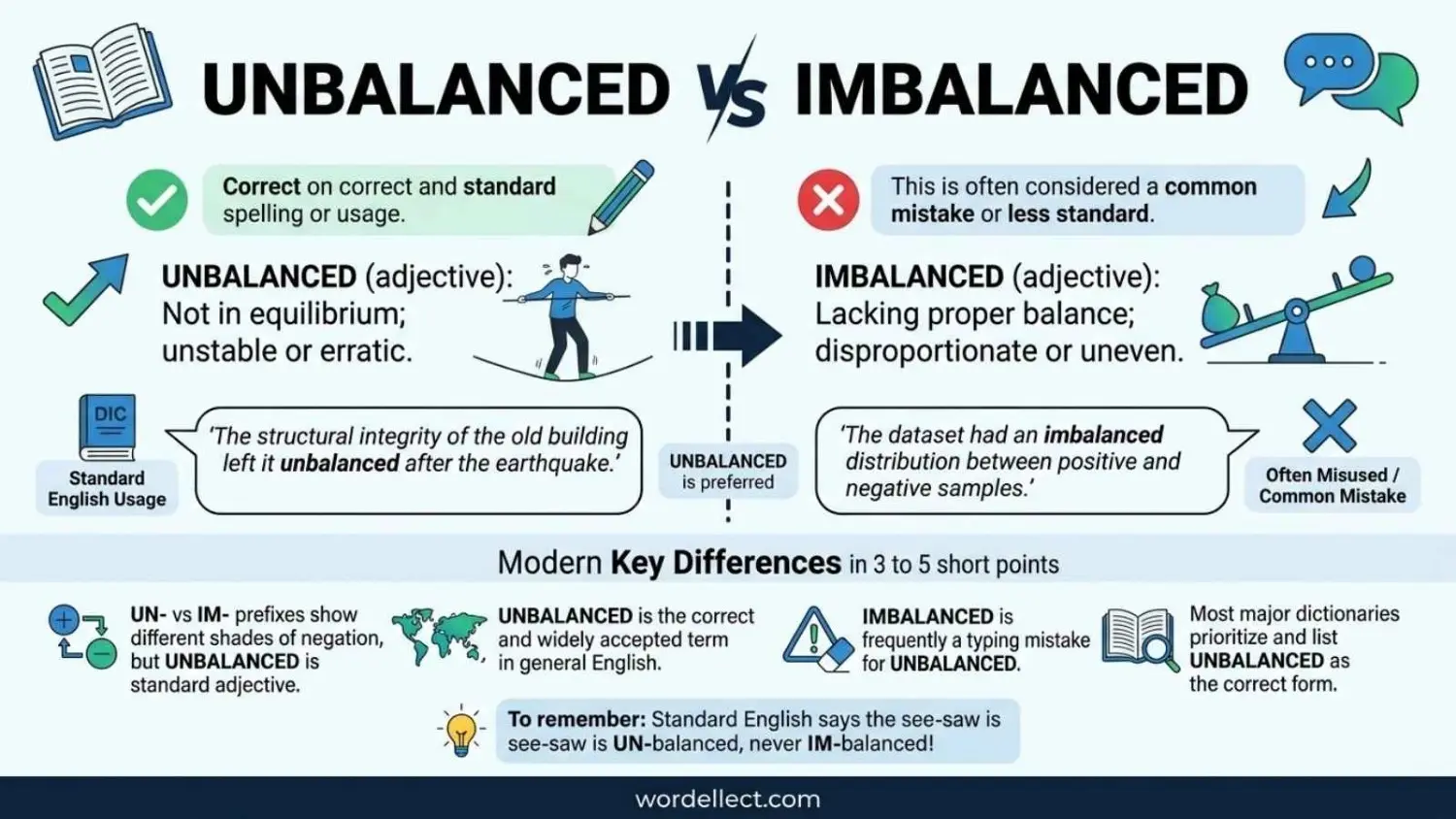
The short answer is this: “Unbalanced” is the safe, standard word to use. The noun form, “imbalance,” is fully correct and very common.
In this article, you will learn what each word means, where they come from, and which one to use in your own writing. You will also see real examples so you feel sure next time you write this word.
Quick Answer
- Unbalanced = not steady, not even, not fair. This is the standard adjective. Example: “The washing machine felt unbalanced during the spin cycle.”
- Imbalanced = used by some people the same way as “unbalanced,” but many guides do not fully accept it as a standard word. Example: “Her diet felt imbalanced.” (Better: “Her diet was out of balance” or “unbalanced.”)
- Imbalance = the correct noun form. Example: “There is an imbalance in her diet.”
If you are not sure which word to pick, use “unbalanced” as your safe choice.
Where Do These Words Come From?
All three words come from the word “balance,” which comes from Latin bilanx, meaning “having two scales” (like an old weight scale with two sides).
- Balance entered English hundreds of years ago from this Latin root.
- Unbalanced is simply “balance” with “un-” added to mean “not.” This is a normal English pattern, like “unhappy” or “unfair.”
- Imbalance is a noun formed with “im-” (a form of “in-” meaning “not”), added to “balance.” This gives us a word for “a state of being not balanced.”
- Imbalanced came later, when some writers began to use “imbalance” as if it were also an adjective, adding “-ed” to the end.
So “unbalanced” follows an old, common pattern. “Imbalanced” is a newer, less standard word built from a noun.
Unbalanced vs Imbalanced: The Real Difference
This is not a spelling variant like British and American English. This is about word form and which one fits proper grammar.
| Word | Word Type | Standard Use? | Example |
| Balance | Noun/Verb | Yes | “Keep your balance.” |
| Unbalanced | Adjective | Yes, fully standard | “The scale looked unbalanced.” |
| Imbalance | Noun | Yes, fully standard | “There is an imbalance in the numbers.” |
| Imbalanced | Adjective | Used by some, but many guides avoid it | “The report felt imbalanced.” (many guides prefer “unbalanced”) |
Which One Should You Use?
Your choice depends on the type of writing you do.
For school papers and formal writing: Use “unbalanced” as your adjective. It is the safe, widely accepted choice.
For business reports and news writing: Use “unbalanced” for the adjective form, and use “imbalance” as your noun. Example: “There is an imbalance in trade, which has left the market unbalanced.”
For casual writing, like social media or texts: “Imbalanced” is used often and most readers will understand it. But it is still safer to use “unbalanced” if you want to follow strict grammar rules.
For health and science writing: Both words show up a lot, since people talk about “hormone imbalance” or “an unbalanced diet.” Use “imbalance” as the noun and “unbalanced” as the adjective for the clearest, most standard writing.
Common Mistakes with These Words
Mistake 1: Using “imbalanced” as if it is the only correct adjective.
Fix: Use “unbalanced” instead, since it is the safer and more accepted word.
Mistake 2: Mixing up “imbalance” (noun) with “unbalanced” (adjective). Wrong: “She has an unbalanced diet.”
Right: “She has an imbalance in her diet.” or “Her diet is unbalanced.”
Mistake 3: Thinking these words are spelling versions of each other, like British vs American English.
Fix: They are not regional spelling differences. They are different word forms with different levels of acceptance in formal writing.
Mistake 4: Avoiding “imbalanced” completely, even in casual writing.
Fix: “Imbalanced” is not wrong in casual speech or informal writing. It is just less standard in formal writing, like books, reports, or school papers.
These Words in Everyday Examples
In health articles: “A hormone imbalance can affect your mood and energy levels.” “Her diet was unbalanced, with too much sugar and not enough protein.”
News writing: “The trade imbalance grew larger this year.” “Critics say the new law leaves the system unbalanced.”
In social media: “Feeling so imbalanced today, need more sleep ” (casual, informal use) “My work-life balance feels totally unbalanced this month.” (safe, standard use)
In formal writing: “The report highlights a clear imbalance between supply and demand.” “The committee found the budget unbalanced and asked for changes.”
Google Trends and Usage Data
“Imbalanced” also shows up in search data, mostly from casual writers and some health blogs, but it appears far less in formal writing, news, and style guides. Most professional writers and editors prefer “unbalanced” as the adjective, paired with “imbalance” as the noun.
This pattern stays about the same across the US, UK, Canada, Australia, and India. The real split is between formal writing (which favors “unbalanced”) and casual writing (which sometimes uses “imbalanced”).
| Keyword Variation | Word Type | Common Use |
| Unbalanced | Adjective | Formal and casual writing |
| Imbalance | Noun | Health, business, and science topics |
| Imbalanced | Adjective (less standard) | Casual writing, some health blogs |
| Balance | Noun/Verb | General use in all writing |
Frequently Asked Questions
1. Is “imbalanced” a real word? It shows up in some dictionaries as an informal adjective, but many style guides and editors prefer “unbalanced” for formal writing.
2. What is the correct noun form of “balance” gone wrong? The correct noun is “imbalance.” Example: “There is an imbalance in the team’s workload.”
3. Which word should I use in a school essay? Use “unbalanced” as your adjective and “imbalance” as your noun. This is the safest, most standard choice.
4. Can I use “imbalanced” in a text message to a friend? Yes. In casual writing, “imbalanced” is understood and used often. It is just less common in formal writing.
6. Why do people confuse these words? Because they both come from the word “balance” and both talk about something not being even or steady. The confusion comes from having two similar word forms grow from the same root.
7. Is there a British vs American spelling difference for these words? No. This is not a regional spelling issue. The real question is which word fits proper grammar, not which country you write from.
Conclusion
“Unbalanced” and “imbalanced” both come from the word “balance,” but they are not equal in formal writing. “Unbalanced” is the safe, standard adjective used in schools, news, and business writing. The noun form, “imbalance,” is always correct and used often in health, business, and science writing.
If you want to play it safe, use “unbalanced” as your adjective and “imbalance” as your noun. This choice works well in almost every type of writing, from emails to reports to school essays.
Remember, this is not about British vs American spelling. It is about picking the word form that fits standard grammar. Once you know this simple rule, you will always pick the right word with confidence.