I’ll be honest, I still pause sometimes before I type this word. You’re writing about your dog, your fingers hover over the keyboard, and suddenly you’re not sure. Is it “dogs” or “dog’s”? Just one tiny mark, and somehow it feels like a big decision.
You’re not the only one. This little apostrophe trips up people all the time, even folks who write for a living. I’ve seen it wrong on pet store signs, in text messages, on social media captions, even in news headlines. It’s a small mistake, but it stands out.
Here’s why it happens. The apostrophe has more than one job in English, and nobody really explains this clearly in school. Sometimes it shows something belongs to someone. Sometimes people just toss it in because a word “looks plural” and it feels right. Spoiler: that second reason is usually wrong.
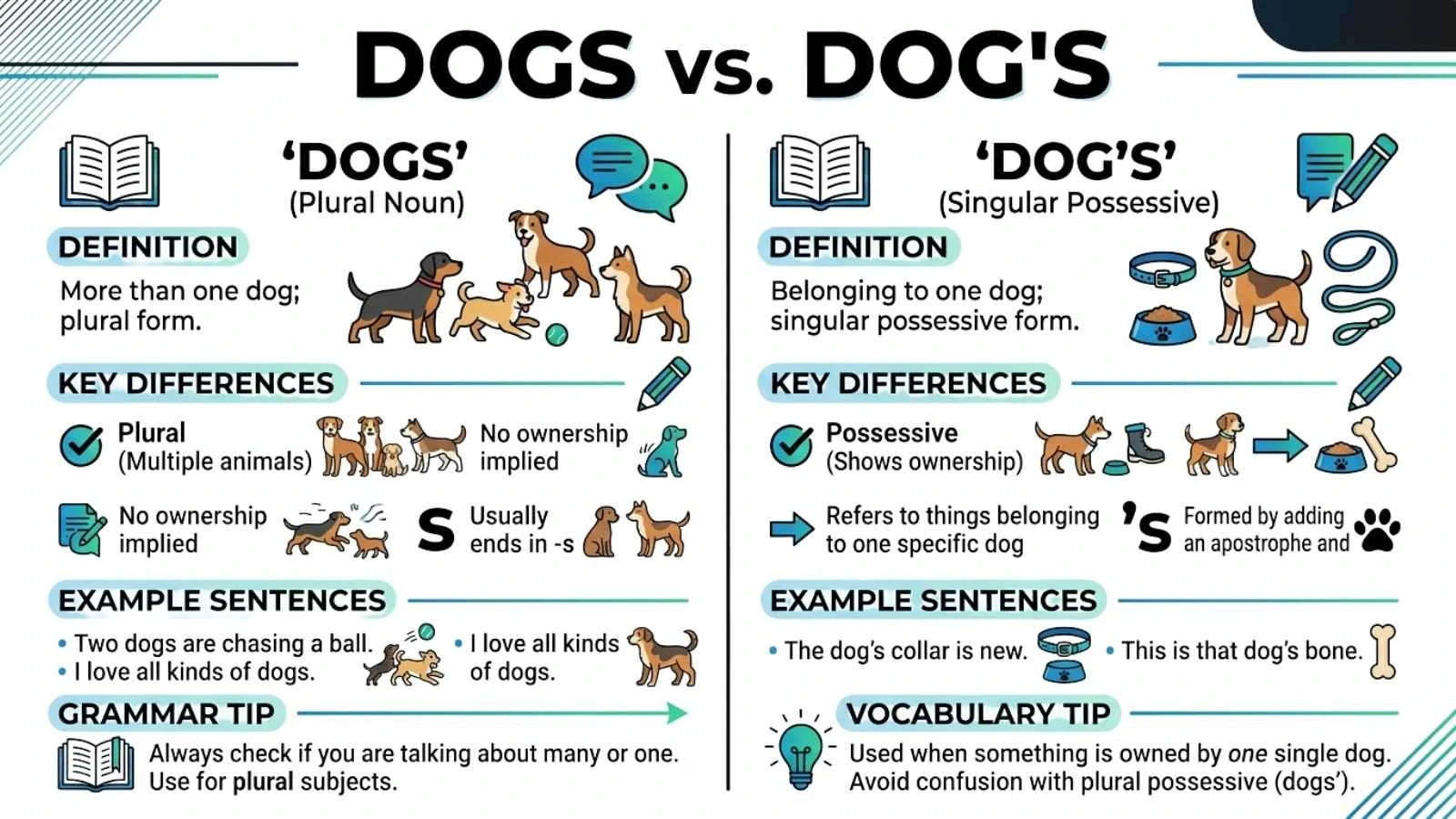
So let’s clear this up for good. “Dogs” just means more than one dog. “Dog’s” means something belongs to one dog. And yes, there’s a third one too, “dogs’,” for when something belongs to a whole group of dogs.
Stick with me for a few minutes, and you’ll never second-guess this one again.
Quick Answer
- Dogs = more than one dog (plural, no ownership) Example: “I saw three dogs at the park.”
- Dog’s = something that belongs to one dog (singular, shows ownership) Example: “The dog’s leash is red.”
- Dogs’ = something that belongs to more than one dog (plural, shows ownership) Example: “The dogs’ food bowls are empty.”
If you are just talking about more than one dog, drop the apostrophe. If you are talking about something that belongs to a dog, add the apostrophe.
Why Does This Mix-Up Happen?
English uses the apostrophe for two very different jobs, and this causes a lot of confusion.
Job 1: Showing ownership. “The dog’s bone” means the bone belongs to the dog.
Job 2: Making a word plural (only in a few special cases, and even then, it is rare and often wrong to use). Many people wrongly add an apostrophe just to make a word plural, like writing “I have two dog’s” instead of “I have two dogs.” This is one of the most common apostrophe mistakes in English.
Since we do not use an apostrophe to make most words plural, the safe rule is: only add an apostrophe when you want to show that something belongs to someone or something.
The Simple Rule, Step by Step
Here is an easy way to check your sentence.
1: Ask yourself, “Am I just talking about more than one dog?” If yes, write dogs. No apostrophe needed.
2: Ask yourself, “Does something belong to one dog?” If yes, write dog’s. Add the apostrophe before the “s.”
3: Ask yourself, “Does something belong to more than one dog?” If yes, write dogs’. Add the apostrophe after the “s.”
This same rule works for almost every plural noun in English, not just “dog.”
Dogs vs Dog’s vs Dogs’: Side by Side
This is not a British vs American spelling issue. This is about grammar rules that apply the same way in every English-speaking country.
| Form | Meaning | Example |
| Dogs | More than one dog | “The dogs ran across the yard.” |
| Dog’s | Something that belongs to one dog | “The dog’s bowl is empty.” |
| Dogs’ | Something that belongs to many dogs | “The dogs’ toys are all over the floor.” |
Which Form Should You Use?
Your choice depends on what you want to say, not on where you live or who you write for.
If you are just counting or naming more than one dog: Use “dogs.” Example: “We adopted two dogs last year.”
If you are talking about one dog’s item, trait, or action shown as belonging to it: Use “dog’s.” Example: “The dog’s fur is very soft.”
If you are talking about something shared by more than one dog: Use “dogs’.” Example: “The dogs’ beds need to be washed.”
If you are unsure and just naming dogs with no ownership at all: Leave out the apostrophe. Most mistakes come from adding an apostrophe when it is not needed.
Common Mistakes with Dogs and Dog’s
Mistake 1: “I have two dog’s.” Fix: “I have two dogs.” (No ownership here, so no apostrophe.)
Mistake 2: “The dogs bowl is empty.” (missing apostrophe)
Fix: “The dog’s bowl is empty.” (The bowl belongs to one dog.)
Mistake 3: “The dog’s are barking.” (wrong use of apostrophe)
Fix: “The dogs are barking.” (This is just a plural, not ownership.)
Mistake 4: Mixing up “dog’s” and “dogs'” when more than one dog owns something.
Fix: “The dogs’ leashes are hanging by the door.” (Many dogs, many leashes, so the apostrophe goes after the “s.”)
Dogs and Dog’s in Everyday Examples
In a text message: “Can you walk the dogs while I’m at work?”
On a pet store sign: “The dog’s favorite toy is 20% off this week!”
In a news article: “Rescue dogs found new homes this weekend.”
On social media: “My dog’s face when I open a treat bag ” “These two dogs are best friends for life “
In formal writing: “The shelter reported that the dogs’ health had improved after treatment.”
Google Trends and Usage Data
Search data shows that “dogs” is searched far more often overall, since most searches are about pet care, dog breeds, and dog training in general, with no need for an apostrophe. “Dog’s” and “dogs'” show up more in specific searches, like “dog’s diet” or “dogs’ toys,” where people are asking about something that belongs to a dog or dogs.
This pattern is the same in the US, UK, Canada, Australia, and every other English-speaking country. This is not a regional spelling topic like “color” and “colour.” It is a grammar rule that stays the same everywhere English is written.
| Keyword Variation | Meaning | Common Search Use |
| Dogs | More than one dog | General pet topics |
| Dog’s | Belongs to one dog | Specific pet care questions |
| Dogs’ | Belongs to many dogs | Shared items, group pet care |
| Dog | One dog | Breed and general topics |
FAQs:
1. Do I need an apostrophe to make “dog” plural? No. Just add “s” to make it plural: “dogs.” Never use an apostrophe just to show more than one.
2. When do I use “dog’s” with an apostrophe? Use it when something belongs to one dog, like “the dog’s collar.”
3. When do I use “dogs'” with the apostrophe after the “s”? Use it when something belongs to more than one dog, like “the dogs’ collars.”
4. Is this a British vs American English difference? No. This rule is the same in every English-speaking country. It is a grammar rule, not a regional spelling choice.
5. What if I’m not sure if something shows ownership? Ask yourself, “Does this belong to the dog?” If yes, add an apostrophe. If you are just naming more than one dog, leave it out.
6. Is “dogs’s” ever correct? No. This form does not exist in standard English. Use “dog’s” for one dog or “dogs'” for many dogs.
7. Can I use “dog’s” to mean “dog is” or “dog has”? Yes, in casual writing, “dog’s” can be short for “dog is” or “dog has,” like “The dog’s hungry” (dog is hungry) or “The dog’s eaten already” (dog has eaten). Context tells you which meaning fits.
Conclusion:
“Dogs,” “dog’s,” and “dogs'” may look close, but they each have a clear job. “Dogs” simply means more than one dog, with no apostrophe needed. “Dog’s” shows that something belongs to one dog. “Dogs'” shows that something belongs to more than one dog.
This is not about British or American English. It is a basic grammar rule that stays the same no matter where you write from. The easiest way to check your sentence is to ask: am I just naming more than one dog, or does something belong to a dog?
Once you learn this simple rule, you can use it for almost any plural word in English, not just “dog.” A small apostrophe makes a big difference, so take a moment to check before you hit send or submit your writing.

Ethan Carter is a language writer at Wordellect who helps readers understand word differences, grammar rules, and spelling variations through simple and accurate guides.







