Your joints hurt. Your back aches. You look at two pill bottles. One says meloxicam. One says naproxen. Which one should you take?
Many people search “meloxicam or naproxen” because both drugs treat pain and swelling. Both come from the same drug family. Both need a doctor’s advice before use. But they are not the same drug, and they do not work the same way for every person.
This question comes up a lot for people with arthritis, back pain, or muscle injuries. Doctors often choose one of these two drugs, and patients want to understand why.
Important note: This article gives general information only. It is not medical advice. Always talk to your doctor or pharmacist before starting, stopping, or switching any medicine.
In this article, you will learn what each drug is, how they are alike, how they are different, and what questions to ask your doctor. This will help you understand your treatment better, not replace your doctor’s advice.
Quick Answer: What Are These Two Drugs?
Both meloxicam and naproxen belong to a group of medicines called NSAIDs. NSAID stands for “non-steroidal anti-inflammatory drug.” These drugs reduce pain, swelling, and fever.
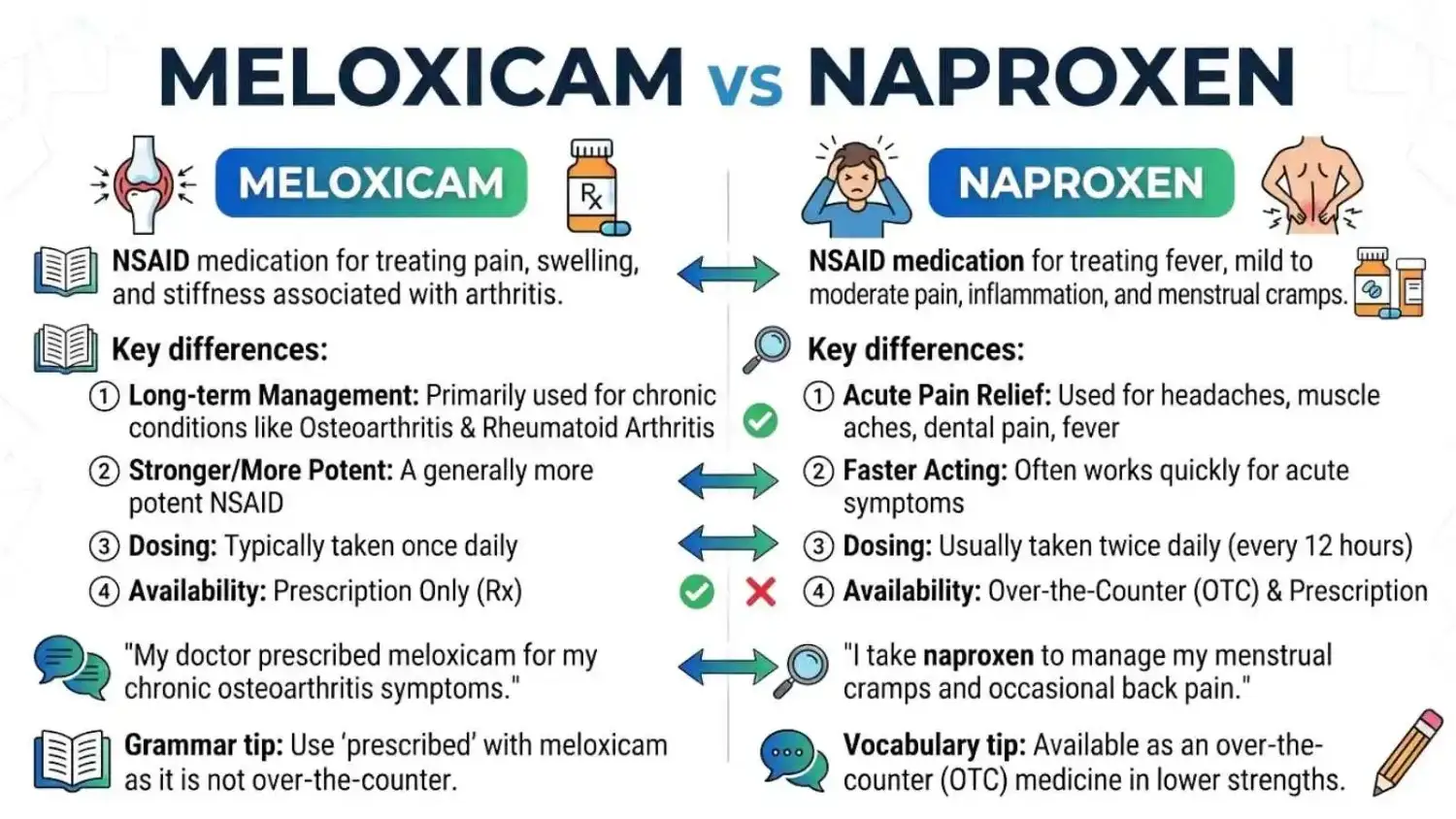
- Meloxicam is often taken once a day. Doctors often use it for long-term joint pain, like arthritis.
- Naproxen is often taken once or twice a day. Doctors use it for short-term pain, like headaches, muscle pain, and menstrual cramps, as well as some long-term conditions.
Both drugs need a prescription in higher doses, though naproxen is also sold over the counter in lower doses in many countries.
What Do These Drugs Treat?
Both drugs treat pain and swelling, but doctors often pick one over the other based on the type of pain.
Meloxicam is commonly used for:
- Osteoarthritis
- Rheumatoid arthritis
- Long-term joint pain and stiffness
Naproxen is commonly used for:
- Headaches
- Muscle pain
- Menstrual cramps
- Short-term injury pain
- Some cases of arthritis as well
Since both drugs treat swelling and joint pain, doctors sometimes choose based on how often a patient wants to take a pill, or based on other health conditions the patient has.
Meloxicam vs Naproxen: Key Differences
These two drugs are not spelling variants or brand names of the same thing. They are two different NSAID medicines with different chemical makeups.
| Feature | Meloxicam | Naproxen |
| Drug type | NSAID | NSAID |
| Common use | Long-term arthritis pain | Short-term and long-term pain |
| Typical dosing | Often once daily | Once or twice daily |
| Over-the-counter option | No, prescription only in most places | Yes, in lower doses in many countries |
| Onset of relief | Slower, steady relief | Can act faster for short-term pain |
| Common for | Joint stiffness, arthritis | Headaches, cramps, muscle pain |
How Are They Alike?
Both drugs share several traits because they belong to the same drug family.
- Both reduce swelling in the body.
- Both lower pain signals.
- Both can reduce fever.
- Both can affect the stomach lining if used for a long time.
- Both may need caution for people with heart, kidney, or stomach problems.
- Both require a doctor’s review before long-term use.
This is why people confuse the two. They do similar jobs in the body, even though they are separate medicines.
Which One Might a Doctor Choose?
Only a doctor can decide which drug fits a patient’s needs, since this depends on health history, other medicines, and the type of pain. In general, doctors may lean toward:
Meloxicam for patients who:
- Have long-term joint pain, like arthritis.
- Want a medicine taken only once a day.
- I need steady, all-day pain control.
Naproxen for patients who:
- Have short-term pain from an injury or headache.
- Need quicker pain relief for a short period.
- Already use over-the-counter pain relief and need a stronger short-term option.
This is general information only. Many other factors, like age, other medical conditions, and other medicines a person takes, can change this decision. A doctor or pharmacist should always make the final call.
Common Misunderstandings
Misunderstanding 1: “Meloxicam and naproxen are the same drug with different names.” This is not true. They are two different NSAID medicines with different chemical structures, even though they treat similar problems.
Misunderstanding 2: “If one is over the counter, it must be safer.” This is not true either. Naproxen is available over the counter in lower doses, but it can still cause side effects, especially with long-term use or high doses. Meloxicam usually needs a prescription because of its strength and dosing needs, not because it is more dangerous.
Misunderstanding 3: “You can take both together for stronger pain relief.” This is not something to do without medical advice. Always check with a doctor or pharmacist first.
Misunderstanding 4: “These drugs work the same for everyone.” This is not true. People respond differently to each drug based on their body, other health conditions, and other medicines they take.
Meloxicam and Naproxen in Everyday Life
In a doctor’s note: “Take meloxicam once daily with food for joint pain.”
In a pharmacy label: “Naproxen 220mg – take as needed for pain, not to exceed label instructions.”
Health forum: “My doctor switched me from naproxen to meloxicam because I only wanted a once-a-day option.”
In a news health segment: “Doctors often recommend NSAIDs like naproxen for short-term pain relief.”
In a patient conversation: “I take meloxicam every morning for my arthritis. It helps with the stiffness.”
Meloxicam or Naproxen – Search Trends and Popularity
Search data shows steady interest in both drug names, especially among people managing arthritis, back pain, and everyday aches. “Naproxen” often gets searched more overall, since it is well known as an over-the-counter option and used for many common pain types.
Both terms see search spikes when people look for pain relief options, side effect information, or questions about drug interactions. Interest in both names stays fairly steady year-round, since pain and joint issues are common at any time of year.
| Keyword Variation | Common Search Reason | Typical User |
| Meloxicam | Long-term arthritis management | Adults with chronic joint pain |
| Naproxen | Short-term pain relief | General public, all ages |
| Meloxicam side effects | Safety concerns | Long-term users |
| Naproxen dosage | General pain relief questions | First-time users |
Frequently Asked Questions
1. Is meloxicam stronger than naproxen? Strength depends on the dose and the person. Neither drug is always stronger; a doctor decides based on your specific health needs.
2. Can I switch from naproxen to meloxicam on my own? No. Never switch prescription medicines without talking to your doctor first.
3. Is naproxen available without a prescription? Yes, in many countries, naproxen is sold over the counter in lower doses. Higher doses need a prescription.
4. Is meloxicam available without a prescription? In most countries, meloxicam requires a prescription.
5. Can I take meloxicam and naproxen together? This is generally not recommended without medical guidance, since taking two NSAIDs together can raise the risk of side effects. Always ask your doctor or pharmacist.
7. Do both drugs have similar side effects? Yes, since both are NSAIDs, they share some common side effects, like stomach upset. Always read the label and ask your doctor about your personal risk factors.
Final Thoughts:
Meloxicam and naproxen are two separate NSAID medicines, not two versions of the same drug. Meloxicam is often used for long-term arthritis pain and is taken once a day. Naproxen is often used for short-term pain, like headaches and muscle aches, and is available in both over-the-counter and prescription forms.
Both drugs reduce pain and swelling, but they are not interchangeable without medical guidance. The right choice depends on your health history, the type of pain you have, and other medicines you take.
This article gives general information only. It does not replace advice from a doctor or pharmacist. If you are unsure which medicine fits your needs, or if you have questions about dosing, side effects, or drug interactions, please talk to a healthcare professional before making any changes to your medicine.

Ethan Carter is a language writer at Wordellect who helps readers understand word differences, grammar rules, and spelling variations through simple and accurate guides.







