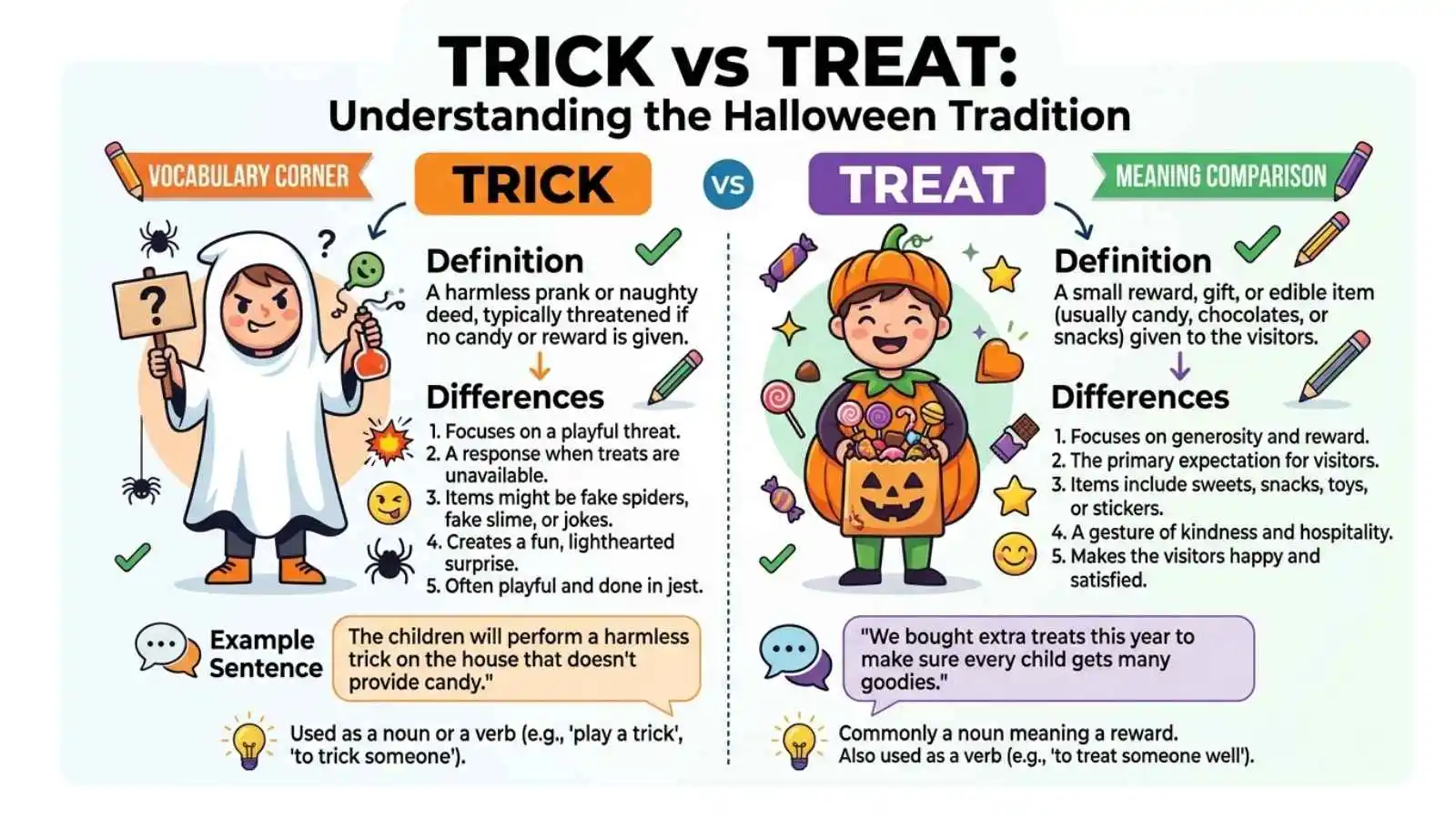
It is the night before Halloween. You are making a sign for your door. Or maybe you are writing a quick post online. You want to welcome the kids who come by for candy. You type the word. Then you stop. Is it “trick-or-treaters”? Or is it “trick or treators”? One looks a little odd, but you are not sure which one.
This mix-up happens every year at Halloween. The word is only used once a year. So a lot of people forget the right way to spell it between one October and the next. Since “treat” does not normally end in “-or,” it is an easy word to get wrong, even for people who spell well the rest of the year.
Here is the good news. There is only one right way to spell it. Once you see the easy reason why, you will not forget it again. This guide gives you the fast answer, shows where the word comes from, and gives you easy tips to help you remember it for good.
Trick-or-Treaters – Quick Answer
The right spelling is trick-or-treaters. It comes from the words “trick or treat,” plus “-ers.” We add “-ers” when we talk about people who do something.
“Treators” is not a real word. It is just a common mistake.
A few quick examples:
- “We bought extra candy for the trick-or-treaters this year.” ✅
- “The trick-or-treaters started showing up right after the sun went down.” ✅
- “We bought extra candy for the trick-or-treators this year.” ❌
Easy rule: think of someone who gives other people a “treat,” like candy. Add “-ers,” and you get “treaters.” Never “treators.”
Where Does This Word Come From?
“Trick or treat” started as words kids would say at the door on Halloween night. It gave people a fun choice: give me a treat, or I might play a small, silly trick on you. This tradition grew popular in North America in the early 1900s. It has stayed a big part of Halloween ever since, passed down from kids to kids for many years.
Over time, people needed one simple word for the kids doing all that trick-or-treating. English often builds words like this by taking a plain word, like “treat,” and adding “-er” or “-ers” to show who is doing that thing. Think of “teacher,” which comes from “teach.” Or “baker,” which comes from “bake.” The same easy pattern works here. “Treat” becomes “treater.” More than one becomes “treaters.”
So “trick-or-treaters” just joins the words “trick or treat” with that same “-er” ending. This gives us one clear word for the kids who go door to door each Halloween night, wearing costumes and holding bags for candy.
It helps to think about other Halloween words too, since many follow the same easy pattern. “Costume” stays the same no matter how you use it. “Candy” is spelled the same, whether you have one piece or a hundred pieces. “Pumpkin” never changes, even when you talk about many of them on porches. “Trick-or-treaters” is just one more word in that same Halloween word group. Once you know the small parts that build the word, the spelling stops feeling hard at all.
Is This a British vs. American Spelling Difference?
No, and this is worth saying clearly. This is not a British vs. American spelling case, like “colour” and “color.” Trick-or-treating is a much bigger custom in the US and Canada than in the UK. So the word “trick-or-treaters” is used less often across the ocean. But wherever the word is used, the spelling stays exactly the same.
| Feature | American English | British English |
| Spelling | trick-or-treaters | trick-or-treaters |
| How common | Very common | Less common (smaller custom there) |
| Wrong spelling | Trick-or-treators | Trick-or-treators |
So there is no country-based spelling rule behind this word. The only real job is to remember the right ending, no matter where you live or how you celebrate Halloween.
Which Spelling Should You Use?
Since there is no country-based split here, the answer stays the same everywhere: use “trick-or-treaters.”
Are you writing a Halloween sign for your door, a party invite, or a quick post online? “Trick-or-treaters” is always the right choice. Are you writing about the activity itself, not the kids doing it? Use “trick-or-treating” instead, with no “-ers” at the end. For example: “The kids went trick-or-treating around the block until it got dark.”
If you are ever stuck, picture the person giving out or getting treats. Add “-ers” the same way you would for “teachers” or “bakers.” That small picture in your head makes the right spelling easy to remember.
Common Mistakes with Trick-or-Treaters
Mistake 1: Writing “treators” instead of “treaters” This is the most common slip. “Treators” almost looks like it could be a real word, but it is not.
- ❌ “The trick-or-treators knocked on our door all evening.”
- ✅ “The trick-or-treaters knocked on our door all evening.”
Mistake 2: Dropping the small dashes completely The full phrase often keeps its small dashes when used in a full sentence.
- ❌ “We had so many trick or treaters this year.”
- ✅ “We had so many trick-or-treaters this year.” (though most people will still understand it without the dashes)
Mistake 3: Mixing up “trick-or-treaters” with “trick-or-treating” “Treaters” means the people doing the activity. “Treating” means the activity itself.
- “The trick-or-treaters arrived early this year.” (talking about the people)
- “We went trick-or-treating until 9 PM.” (talking about the activity)
Mistake 4: Only putting a dash on part of the phrase Since the phrase joins three small words, some people only add a dash to one part instead of the whole thing.
- ❌ “trick or-treaters”
- ✅ “trick-or-treaters”
Mistake 5: Typing too fast and missing a letter Fast typing can lead to small mistakes, like skipping a letter by accident.
- ❌ “trickor-treaters”
- ✅ “trick-or-treaters”
Trick-or-Treaters in Everyday Examples
A neighborhood group chat might say: “Reminder: trick-or-treaters usually show up around 6 PM here, so keep your porch light on.”
A local news story might say: “Police told drivers to watch closely for trick-or-treaters crossing the street after dark, especially near schools.”
A social media post might joke: “Ran out of candy an hour early, sorry to the last few trick-or-treaters who came by! “
A store sign might say: “Free candy for all trick-or-treaters, stop by our table before the parade!”
A text to a friend might say: “How many trick-or-treaters did you get tonight? We had way more than last year.”
Notice how the word almost always shows up in the same simple setting: talking about kids going door to door, dressed up, asking for candy on Halloween night.
Trick or Treaters – Search Trends and Usage
Search interest in “trick-or-treaters” jumps up a lot every year in the last two weeks of October, right before Halloween. Then it drops off almost completely once November begins. This yearly pattern is part of why the spelling trips people up so often. Since the word barely shows up the rest of the year, many people simply forget it by the time Halloween comes back around.
By place, most of the searches happen in the United States and Canada, where going door to door for candy is a huge part of Halloween. In the UK and Australia, Halloween is still celebrated, but the door-to-door custom is smaller there. So both the word and the searches for it stay lower in those places.
Interest also goes up around local news stories about trick-or-treating safety, like tips about wearing bright costumes, walking safe routes, and checking candy before eating it. These stories almost always use the word “trick-or-treaters,” which helps keep the right spelling in front of people each fall.
Comparison Table: Word Variations
| Word | Correct? | Meaning | Example |
| Trick-or-treaters | Yes | Kids going door to door for candy | “The trick-or-treaters loved the decorations.” |
| Trick-or-treators | No | Common spelling mistake | Do not use this in writing |
| Trick-or-treating | Yes | The activity itself | “We went trick-or-treating downtown.” |
| Trick or treat | Yes | The words said at the door | “Trick or treat!” |
FAQs:
Is “trick-or-treators” ever the right spelling? No. It is a common mistake, not a real word. The right spelling is always “trick-or-treaters.”
Why do people spell it “treators” by mistake? Since the word is only used once a year, many people forget the right spelling. They end up guessing based on how it sounds when spoken.
Is “trick-or-treaters” one word, or many words joined together? It is usually written as one term with small dashes, joining “trick,” “or,” and “treaters” together.
What is the real difference between “trick-or-treaters” and “trick-or-treating”? “Trick-or-treaters” means the people doing the activity. “Trick-or-treating” means the activity itself, not the people.
Do the small dashes really matter? They show the correct written form, though a lot of casual posts leave them out and are still easy to understand.
Is this a country-based spelling change, like British vs. American English? No. The spelling stays the exact same everywhere in the world. What changes is how often the word gets used, since going door to door for candy is bigger in places like the US and Canada.
What should I write on a Halloween sign to keep it correct? “Welcome, trick-or-treaters!” is the right, standard phrase to use for signs, invites, and Halloween posts online.
Are there other Halloween words people often spell wrong too? Yes. Words like “costume” and “cemetery” trip people up a lot too, mostly because they are also only used once a year, giving people less time to remember the right spelling.
Conclusion:
“Trick-or-treaters” trips people up mostly because it is only used once a year. This gives everyone plenty of time to forget the right spelling between each Halloween. But the rule behind it stays simple: it comes from “trick or treat” plus “-ers,” the exact same ending used in words like “teachers” or “bakers.” There is no real word called “treators.”
This is not a British vs. American spelling case at all. The word is spelled the exact same way everywhere in the world. It is just used more often in places where going door to door for candy is a big part of Halloween, like the United States and Canada.
Next time you are writing a sign, a post, or an invite for Halloween night, remember this one easy trick: think of someone who “treats” other people with candy, add “-ers” to the end, and you will always land on “trick-or-treaters.”

Ethan Carter is a language writer at Wordellect who helps readers understand word differences, grammar rules, and spelling variations through simple and accurate guides.







