You’re writing a note to your kid’s teacher. “Please excuse his absents last week.” Something feels off, but you’re not sure what. You stare at it a second longer. Is that even a real word?
This one trips up a lot of people, and it’s an easy mistake to miss, since “absents” almost looks correct at first glance. It’s got the right letters, just arranged in a way that doesn’t quite work the way you think it does.
Let’s clear this one up for good, in plain, simple terms.
Quick Answer:
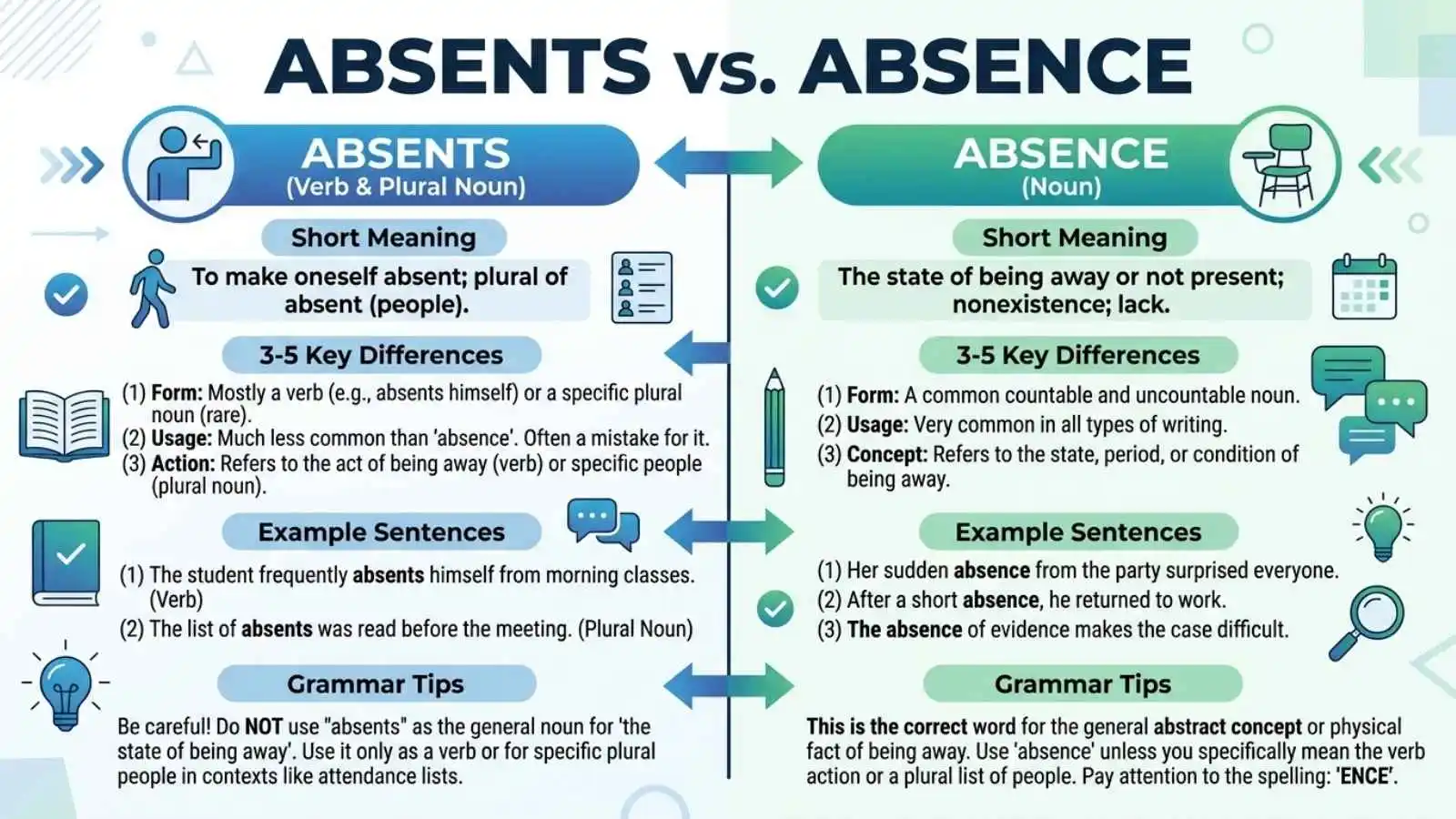
Absence is the word you almost always want. It means the state of being away or not present. Example: “His absence from class was noted.”
Absents is a real word too, but it’s a verb, and it’s used very differently than most people expect. It means someone is choosing to stay away or remove themselves from somewhere. Example: “He often absents himself from meetings.”
For nearly every school note, work email, or everyday sentence about someone being away, “absence” is the word you need. “Absents” shows up so rarely that most people go their whole lives without ever needing to use it correctly.
Why This Mix-Up Happens
Here’s the thing that makes this tricky. “Absents” isn’t a typo or a made-up word. It’s a real form of the verb “absent,” which means to deliberately stay away from somewhere. The problem is, almost nobody uses “absent” as a verb in daily life. Most people only know it as an adjective, like “an absent student.”
So when people need a noun to describe someone being away, their brain reaches for something that sounds close to “absent” plus an ending that feels noun-like, and “absents” slips out. It looks like it should work. It just doesn’t fit the sentence the way “absence” does.
This is really a case of two very different jobs, a noun and a verb, sharing almost the same spelling, which makes it easy to grab the wrong one without noticing.
Breaking Down the Difference
| Word | Job in the Sentence | Example |
| Absence | Noun, describes the state of being away | “Her absence surprised everyone.” |
| Absences | Plural noun, more than one instance of being away | “He’s had three absences this month.” |
| Absents | Verb, means to remove oneself on purpose | “She absents herself from office drama.” |
| Absent | Adjective, describes someone not present | “Three students were absent today.” |
Notice how “absence” and “absences” are the noun forms you’ll use constantly. “Absents” and “absent” serve completely different jobs, a verb and a describing word, and show up far less often in daily writing.
A Quick Way to Check Yourself
Ask this simple question: am I naming a state of being away, or describing an action someone is doing?
If you’re naming the state, the fact that someone wasn’t there, use “absence” (one instance) or “absences” (more than one).
If you’re describing someone actively choosing to stay away, right now or as a habit, you might want “absents,” but this is rare, and honestly, most writers can go their whole careers without needing it.
For almost every school, work, or casual situation, that first option, “absence,” is what you’re reaching for.
Try It Yourself
Guess the right word before checking the answer.
- “Please excuse his ___ from school on Monday.” → absence
- “She has had five ___ this semester.” → absences
- “He rarely ___ himself from important meetings.” → absents
- “Her ___ was the talk of the office.” → absence
- “Too many ___ can affect your final grade.” → absences
If most of these felt clear, you’ve got the core idea locked in already.
When Each Word Actually Fits
Writing a note to a school or teacher: Always “absence.” Example: “Please excuse my daughter’s absence yesterday due to illness.”
Talking about more than one missed day: Use “absences.” Example: “His attendance record shows four absences this month.”
Filling out a work form about time off: “Absence” again. Example: “Report any unplanned absence to your manager immediately.”
Describing someone who purposely avoids something, as an action: This is the rare spot for “absents.” Example: “The manager often absents himself from budget discussions.”
Everyday casual talk: Almost always “absence.” Real talk, most people will never naturally need “absents” in a normal conversation.
Where People Slip Up
Writing “absents” instead of “absence” in notes and emails. This is by far the most common mistake, and it happens because “absents” simply sounds like it could be a plural version of “absence,” even though that’s not how it actually works.
Forgetting the plural form is “absences,” not “absents.” If you’re talking about more than one missed day, the correct word adds an “-es,” not swaps in a “t.”
Trusting spellcheck to catch it. Since “absents” is a real, correctly spelled word, spellcheck has no reason to flag it, even when it’s the wrong choice for your sentence.
Mixing up “absent” the adjective with “absents” the verb. These look almost identical but serve very different roles. “He was absent” uses the adjective. “He absents himself” uses the verb.
Seeing It In Real Writing
A school excuse note: “Please excuse Sarah’s absence from school on Tuesday due to a doctor’s appointment.”
A work email: “I wanted to report my absence from tomorrow’s meeting, I have a scheduling conflict.”
A formal letter: “The committee noted his absence from the last three sessions.”
A report card comment: “Frequent absences have affected this student’s overall progress.”
A rare, correct use of “absents”: “The director absents himself from casting decisions to avoid any bias.”
Why People Search This So Often
Parents writing school notes make up a big chunk of this search, usually while typing quickly and second-guessing the spelling right before hitting send.
Students and office workers filling out attendance or leave forms search this too, especially when they’re being careful about sounding professional and correct.
The confusion isn’t tied to any one country or region. Since this comes down to grammar, not regional spelling habits, it shows up the same way everywhere English is written.
Similar Word Pairs Worth Knowing
| Pair | Meaning 1 | Meaning 2 |
| Absence / Absents | The state of being away | To deliberately stay away (verb) |
| Advice / Advise | A helpful tip (noun) | To give a tip (verb) |
| Practice / Practise | The noun form (US uses this for both) | The verb form (mainly British English) |
| Effect / Affect | A result (noun, mostly) | To influence something (verb, mostly) |
Common Questions:
Is “absents” ever correct? Yes, but only as a verb meaning someone is deliberately staying away from something. It’s rarely needed in everyday writing.
What’s the plural of “absence”? “Absences.” Just add “-es,” never swap the ending for a “t.”
Why doesn’t spellcheck catch this mistake? Because “absents” is a real, correctly spelled word on its own. Spellcheck only flags words that don’t exist, not words used in the wrong context.
Which word should I use for a school excuse note? Always “absence.” That’s the standard word for describing someone missing a day.
Is “absent” the same as “absents”? No. “Absent” is an adjective, describing someone not present, like “he was absent.” “Absents” is a verb showing an action, like “he absents himself.”
How can I remember the difference quickly? Think of “absence” as the everyday word, the one you almost always want. Save “absents” only for describing someone actively choosing to stay away, which is rare in daily writing.
Is this a British versus American English issue? No, this isn’t regional at all. Both words work the same way everywhere English is used. This is purely a grammar mix-up, not a spelling style difference.
Wrapping This Up:
“Absence” is the word you’ll need almost every single time you’re describing someone being away, whether it’s one day or several. “Absents” is a real word too, but it’s a verb with a very specific, much rarer use, describing someone actively choosing to stay away from something.
The quickest way to check yourself: if you’re naming a state of being away, reach for “absence” or “absences.” If you’re describing an action someone does on purpose, “absents” might fit, though you’ll rarely need it.
Once this distinction clicks, writing school notes, work emails, and everyday sentences about missed days gets a whole lot easier, and a lot more accurate too.

Ethan Carter is a language writer at Wordellect who helps readers understand word differences, grammar rules, and spelling variations through simple and accurate guides.