You are writing about a sports team, a law case, or a safety plan. Do you write “defences” or “defenses”? Both words look close. Both mean the same thing. This small stop trips up a lot of people.
People look this up a lot. Both words come from the same root. But one is spelled the British way, and one is spelled the American way. This makes people feel unsure, mostly when writing for work, school, or a website that many people read.
You may worry you picked the wrong spelling. You may just want a fast, clear answer. Good news. This is easy to fix once you know the small rule.
This guide will help. You will learn what “defences” means. You will learn what “defenses” means. They will see easy examples. You will get one simple rule to help you pick the right spelling, every time.
By the end, you will feel sure. Let’s go step by step, in easy words.
Quick Answer
Here is the short answer.
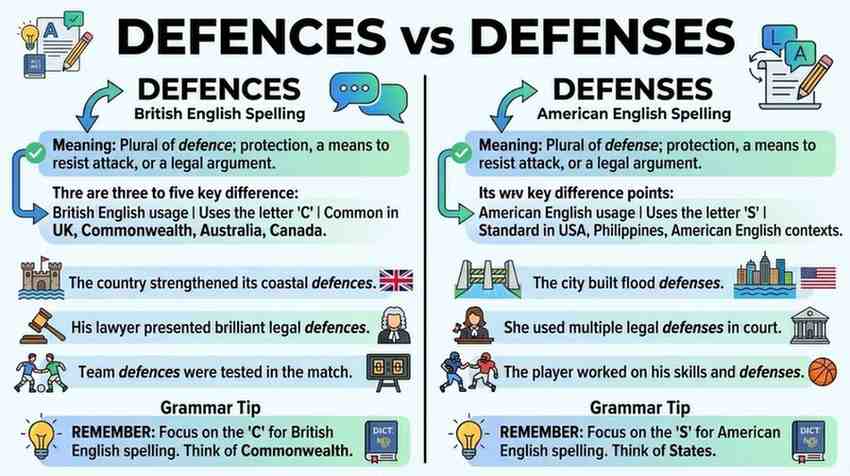
Defences is the British English spelling. It is used in the UK, and in many Commonwealth countries like Australia, Canada, and India.
Defenses is the American English spelling. It is used across the United States.
Easy examples:
- “The team improved its defences this season.” (British spelling)
- “The team improved its defenses this season.” (American spelling)
In short: both spellings are correct. Your pick depends only on which type of English you are writing in, not on the meaning of the word.
Where This Word Came From
Both spellings come from the same root word: “defense” or “defence,” from an old French word that meant “to guard” or “to keep safe.” This word came into English hundreds of years ago and has stayed close to its original form ever since.
The spelling split happened over time, as American English and British English slowly grew apart. Many English words that end in “-ce” in British spelling changed to end in “-se” in American spelling. This is not just true for “defence” and “defense.” You can see the same pattern in words like “licence” and “license,” or “offence” and “offense.”
This change is often linked to Noah Webster, an American writer who worked to make American English spelling simpler and more different from British spelling in the early 1800s. His work led to many small spelling changes that are still used across the US today, including the shift from “-ce” to “-se” in many words.
British English vs American English Spelling
This is a true British vs American spelling case, much like “colour” and “color,” or “centre” and “center.”
| Word | Region | Example Sentence |
| Defences | United Kingdom | “The city built strong defences long ago.” |
| Defenses | United States | “The city built strong defenses long ago.” |
| Defences | Australia, Canada, India | “The team’s defences held up well.” |
| Defenses | United States only | “The team’s defenses held up well.” |
As you can see, the meaning stays exactly the same. The spelling change simply follows the region you are writing for.
Which One Should You Use?
Your pick depends on your audience and where your writing is read.
If you’re writing for US readers: Use “defenses.” This spelling is expected and normal across all American writing.
If you’re writing for UK, Australian, Canadian, or other Commonwealth readers: Use “defences.” This spelling is expected and normal across British-style English.
You’re writing for a global audience: Pick one spelling and stay with it through the whole piece of writing, so it feels clean and steady for your reader.
If you’re not sure what to pick: Think about where most of your readers live.Since most are in the US, go with “defenses.” If most are in the UK or Commonwealth, go with “defences.”
Easy rule to remember: Defences = UK. Defenses = US. Pick based on your reader, and stay with it.
Common Mistakes with Defences or Defenses
People often mix these up without noticing. Here are common mistakes, with the fix.
Mistakes
1: Wrong: Using “defences” in an American news article. Fix: Use “defenses” in writing meant for US readers.
2: Wrong: Using “defenses” in a British school paper. Fix: Use “defences” in writing meant for UK readers.
3: Wrong: Switching between both spellings in the same piece of writing. Fix: Pick one spelling based on your audience, and stay with it the whole way through.
4: Wrong: Thinking one spelling is “more correct” than the other. Fix: Both spellings are fully correct. The right pick depends only on region, not correctness.
5: Wrong: Changing the spelling of related words, but not “defences” or “defenses,” like using “license” with “defences” in the same UK-style writing. Fix: Stay consistent across all similar words, like “defence,” “licence,” and “offence” together in British writing, or “defense,” “license,” and “offense” together in American writing.
Everyday Examples
In an email (UK sports club): “Our defences looked much stronger in last night’s match. Great work from the whole back line.”
In news writing (US style): “The team’s defenses struggled early in the season, but showed big improvement by the playoffs.”
On social media (UK style): “City’s defences held firm again this weekend. Clean sheet number three! “
In formal or school writing (US style): “This report studies how strong national defenses can affect a country’s long-term safety and growth.”
Search Trends & Usage Data
People search “defences or defenses” mostly to check spelling before sending work writing, news writing, or school papers.
- United States: Most searches want to check that “defenses” is the right spelling for American writing.
- United Kingdom, Australia, Canada: Most searches confirm “defences” as the expected, standard spelling.
Overall, both spellings stay common and correct, split clearly by region, much like many other British vs American spelling pairs.
Word Comparison Table
| Word | Region | Formality | Example |
| Defences | UK, Australia, Canada | Standard, formal and casual | “The team’s defences improved.” |
| Defenses | United States | Standard, formal and casual | “The team’s defenses improved.” |
| Defence | UK singular form | Standard | “A strong defence wins games.” |
| Defense | US singular form | Standard | “A strong defense wins games.” |
Frequently Asked Questions
1. Is “defences” wrong in American English? Yes, in American writing, “defenses” is the expected, standard spelling. “Defences” is seen as the British form there.
2. Is “defenses” wrong in British English? Yes, in British writing, “defences” is the standard, expected spelling. “Defenses” is seen as the American form there.
3. Which spelling should I use in a school paper? Use the spelling expected by your school or country. US schools expect “defenses,” and UK schools expect “defences.”
4. Do other words follow this same “-ce” to “-se” pattern? Yes. Words like “licence/license” and “offence/offense” follow the same British vs American spelling pattern.
5. Can I use both spellings in the same piece of writing? It’s best not to. Stick with one spelling, based on your reader, for a clean and steady writing style.
6. Does spell-check catch the wrong regional spelling? Sometimes, yes, if your spell-check is set to a specific region. But it’s always smart to double-check by hand too.
Conclusion:
Defences or defenses? Both spellings mean the exact same thing. The real difference comes down to region: “defences” is standard in British English, while “defenses” is standard in American English.
Just remember: pick “defences” for UK, Australian, or Commonwealth readers, and “defenses” for US readers. Stay consistent with other similar words too, like “licence” or “license,” within the same piece of writing.
Next time you write about safety, sports, or protection, you’ll know exactly which spelling fits your audience. This keeps your writing clear, correct, and easy to trust, every single time.

Ethan Carter is a language writer at Wordellect who helps readers understand word differences, grammar rules, and spelling variations through simple and accurate guides.







