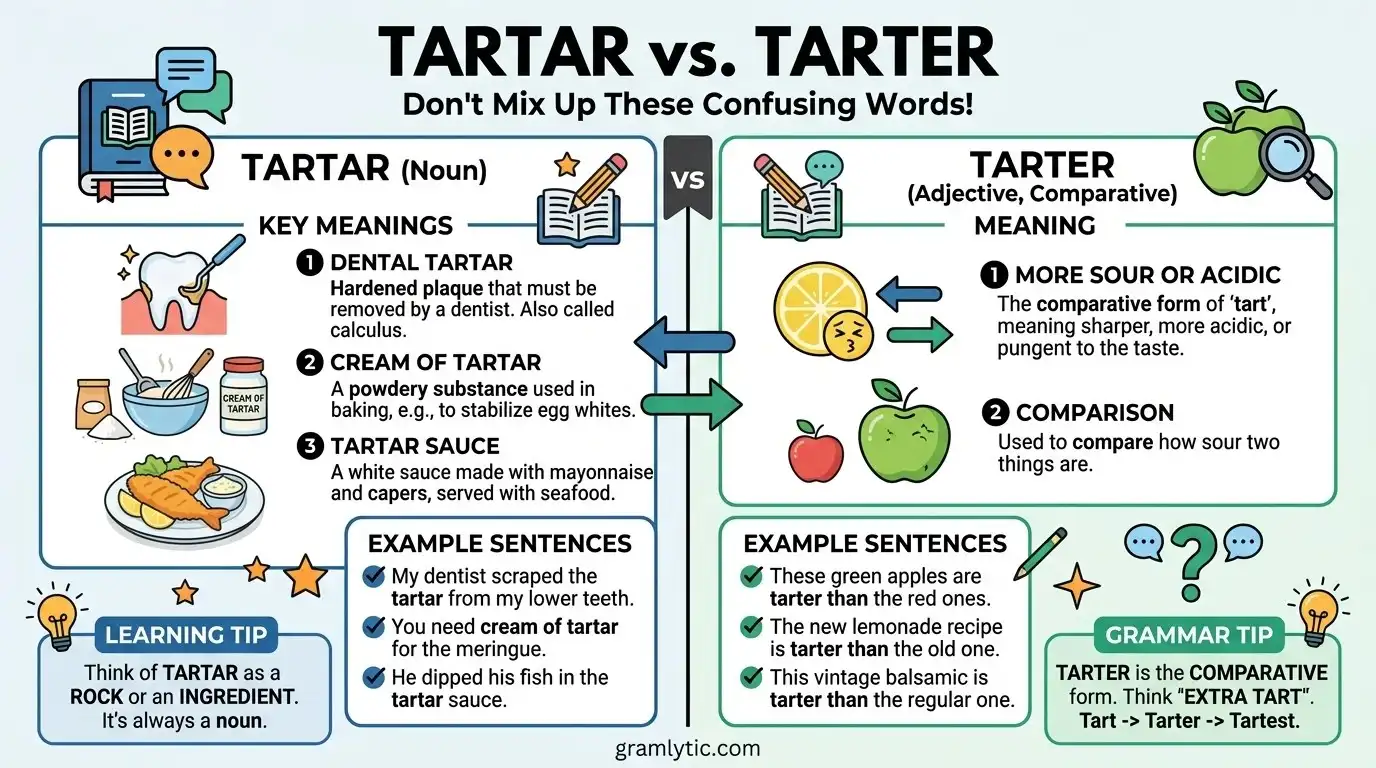
You’re at the dentist, or maybe reading a recipe, and this word comes up. Is it “tartar” or “tarter”? They sound close enough that most people just guess and move on. But they actually mean two very different things.
Here’s the short version. “Tartar” is a noun. It’s that hard, crusty stuff that builds up on teeth, or it’s part of “tartar sauce,” or “cream of tartar” in baking. “Tarter” is an adjective. It means “more tart,” as in more sour, like comparing two lemons.
Let’s break both of these down so you never second-guess this one again.
First, What Is “Tartar”?
“Tartar” shows up in a few different places, and all of them are nouns.
Dental tartar is the hard, yellowish buildup that forms on teeth when plaque isn’t cleaned off in time. It’s why your dentist scrapes your teeth at checkups.
Tartar sauce is that creamy, tangy sauce often served with fish and chips. It’s made from mayonnaise, pickles, and a few other ingredients.
Cream of tartar is a baking ingredient, a fine white powder often used in meringues and some baked goods to help stabilize egg whites.
Notice something? All three are things, not descriptions. That’s your clue that “tartar” is always a noun.
Now, What Is “Tarter”?
“Tarter” comes from the word “tart,” meaning sour or sharp-tasting. Add “-er” to compare two things, just like “faster” comes from “fast,” or “sweeter” comes from “sweet.”
So “tarter” simply means “more tart” or “more sour.”
Example: “This lemonade is tarter than the one I had yesterday.”
That’s it. No teeth, no sauce, no baking powder involved. Just a taste comparison.
Quick Side-by-Side
| Word | Type | Meaning | Example |
| Tartar | Noun | Buildup on teeth, a sauce, or a baking ingredient | “The dentist removed tartar from my teeth.” |
| Tarter | Adjective | More sour or tart | “This apple is tarter than that one.” |
Why These Two Get Mixed Up So Easily
They’re spelled almost the same. Just swap one letter, and the word type completely changes.
They sound alike when spoken. Say them both quickly, and the difference barely registers.
Autocorrect won’t save you. Since both are real words, your phone won’t flag either one as a typo.
Most people rarely use “tarter.” Since it’s a less common word, people often assume any mention of it must be a misspelling of “tartar.”
A Little Word History
“Tartar” actually has an interesting backstory. It originally came from a medieval Latin word, tartarum, which described a crusty substance that forms in wine barrels. Over time, that same idea, a hard, crusty buildup, got applied to the stuff that forms on teeth too. That’s also where “tartar sauce” and “cream of tartar” get their name, all tracing back to that same root idea of a crusty, deposited substance.
“Tart,” on the other hand, is a much simpler word, an old English term for something sharp or sour in taste. Add “-er,” and you’ve got a basic comparison word, just like thousands of other English adjectives.
So even though they look alike, “tartar” and “tarter” grew from two completely separate word families.
Common Mix-Ups to Watch For
- ❌ “This orange is more tartar than the last one.” ✅ “This orange is tarter than the last one.”
- ❌ “The dentist scraped off the tarter buildup.” ✅ “The dentist scraped off the tartar buildup.”
- ❌ “Add a spoon of cream of tarter to the egg whites.” ✅ “Add a spoon of cream of tartar to the egg whites.”
- ❌ “I love tarter sauce on my fish.” ✅ “I love tartar sauce on my fish.”
- ❌ “Her joke had a tartar edge to it.” (should describe a sharp tone, so it needs “tart” or “tarter,” not “tartar”) ✅ “Her joke had a tart edge to it.”
- ❌ “This yogurt tastes tartar than I expected.” ✅ “This yogurt tastes tarter than I expected.”
Where You’ll Actually Run Into These Words
At the dentist’s office: “You’ve got some tartar buildup, so we’ll do a deep cleaning today.”
In a recipe: “Whisk in a pinch of cream of tartar before beating the egg whites.”
At a seafood restaurant: “Can I get extra tartar sauce with my fish?”
Comparing flavors: “This green apple is way tarter than the red one.”
In a baking blog: “Cream of tartar helps your meringue hold its shape.”
An Easy Trick to Keep Them Straight
Here’s a simple way to lock this in.
Tartar has an “ar” ending, just like “sugar” and “dollar.” Nouns often end that way, and “tartar” is a thing, a noun, so it fits the pattern.
Tarter ends in “-er,” just like “faster” and “louder.” Comparison words almost always end in “-er,” and “tarter” is comparing how sour something is.
If you’re comparing tastes, go with “-er.” If you’re naming a thing, whether it’s on your teeth, in a sauce, or in a mixing bowl, go with “tartar.”
Quick Questions, Quick Answers
Is “tarter” even a real word? Yes, it’s the comparative form of “tart,” meaning more sour.
Is tartar sauce related to teeth tartar? Not directly in meaning, but both trace back to the same old word for a crusty, deposited substance.
What is cream of tartar used for? It’s a baking ingredient that helps stabilize whipped egg whites and adds a slight tang to some recipes.
Do British and American English spell these differently? No, both words are spelled the same everywhere.
Which word should I use when comparing sour flavors? Always “tarter,” since it’s the comparison word, like “sweeter” or “sourer.”
Why does my dentist mention “tartar” at checkups? Because it refers to the hardened plaque buildup on teeth that needs to be professionally cleaned off.
Wrapping This Up:
“Tartar” and “tarter” might look like near-twins, but they’re not related in meaning at all. “Tartar” is always a noun, whether it’s the buildup on your teeth, the sauce next to your fish, or the powder in your baking cabinet. “Tarter” is always a comparison, describing something more sour than something else.
A quick way to remember it: “tartar” is a thing, “tarter” is a comparison. Once that sticks, you’ll spell this one right every single time.








