Choosing between Stafford or Love can be confusing because both words can appear as names, surnames, or parts of a longer name. If you saw these two words online, you may wonder if they have different meanings, spellings, or uses.
The key point is that Stafford and Love are not two spellings of the same English word. They are different names. Stafford is mainly used as a surname and place name, while Love can be a surname, first name, or ordinary English word.
People may search for Stafford or Love when they are trying to identify a person, compare surnames, check a name spelling, or understand where a name comes from. The meaning also depends on the context where you saw it.
This guide explains the difference in simple terms. It covers the history of both names, their spelling, common mistakes, everyday use, and where each name is more common. By the end, you will know when to use Stafford and when to use Love.
Stafford or Love – Quick Answer
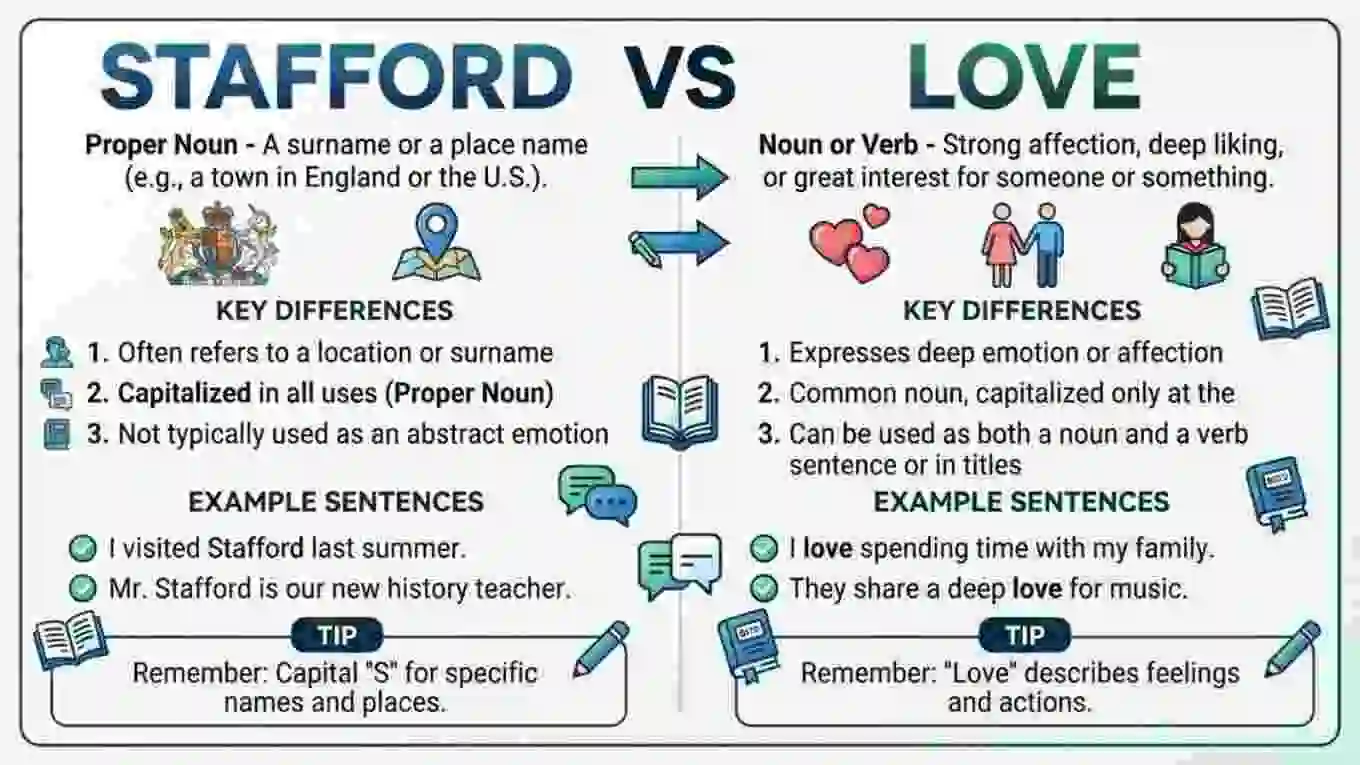
Stafford and Love are different names. Neither one is a standard spelling of the other.
- Stafford is a surname and a place name.
- Love is a surname and a first name. It is also a common English word.
- Stafford often has a connection to an English place.
- Love comes from an old word linked to affection or, in some surname histories, an old personal name.
Simple examples
- John Stafford → Stafford is his surname.
- Emma Love → Love is her surname.
- I love my family. → Here, love is an ordinary English word, not a surname.
- Stafford is a town in England. → Here, Stafford is a place name.
So, if you are asking “Is Stafford another spelling of Love?”, the answer is no.
The Origin of Stafford or Love
Origin of Stafford
Stafford is an old English name. It comes from a place name in England.
The name is linked to old English words. Staf referred to a staff or post, while ford meant a place where people could cross a river.
So, the basic idea behind the name is linked to a river crossing.
Stafford later became the name of a town in England. People who came from that place could use Stafford as a surname.
This is why Stafford can work as both a place name and a family name.
Origin of Love
Love has a different history.
As an English word, love refers to a strong feeling of care, affection, or deep liking.
It also became a surname. The surname may have developed from old personal names or from the word connected with love and affection.
Over time, families used Love as a surname, and it became a normal family name in English-speaking countries.
Why are Stafford and Love different?
They developed from different sources.
| Name | Main origin | Common use |
| Stafford | Old English place name | Surname, place name |
| Love | English and older personal-name roots | Word, first name, surname |
There is no spelling rule that changes Stafford into Love or Love into Stafford.
British English vs American English Spelling
There is no major British vs American spelling difference between Stafford and Love.
Both countries normally spell the names in the same way:
- Stafford
- Love
Proper names usually keep their established spelling. You should not change a person’s surname just because you are writing in British or American English.
Comparison table
| Name | British English | American English | Correct form |
| Stafford | Stafford | Stafford | Stafford |
| Love | Love | Love | Love |
For example:
British English:
“James Stafford lives in London.”
American English:
“James Stafford lives in Chicago.”
The surname stays Stafford.
The same applies to Love:
British English:
“Sarah Love sent the email.”
American English:
“Sarah Love sent the email.”
The spelling does not change.
Which Spelling Should You Use?
If you are choosing between Stafford and Love, first check what you are trying to write.
If it is a person’s name
Use the spelling that belongs to that person.
For example, if someone’s name is David Stafford, do not change it to David Love.
If someone’s name is David Love, do not change it to David Stafford.
Names are not interchangeable.
If you are writing about a place
Use Stafford when you mean the town or area named Stafford.
For example:
“Stafford is a town in England.”
Do not use Love for the place.
If you mean the feeling
Use love when you mean affection or strong care.
For example:
“I love this book.”
Here, love is a normal English word.
For US readers
Use the person’s real name or the correct place name. Do not change either spelling.
For UK and Commonwealth readers
The same rule applies. Stafford and Love keep their normal spellings.
For global readers
The safest choice is simple: check the context and use the exact name shown by the person, source, or place.
Common Mistakes with Stafford or Love
People can make mistakes when they see Stafford and Love without enough context.
Mistake 1: Treating them as spelling variants
Wrong idea: Stafford and Love are two spellings of the same word.
Correction: They are different names.
Mistake 2: Changing a person’s surname
If a person’s real surname is Stafford, do not replace it with Love.
Correct:
“Michael Stafford attended the meeting.”
Mistake 3: Using Love as a place name
If you mean the English town, use Stafford.
Correct:
“She lives near Stafford.”
Mistake 4: Using a capital letter for the normal word
When love means affection, it usually does not need a capital letter.
Correct:
“I love my dog.”
But when Love is a surname, it needs a capital letter.
Correct:
“Mr. Love joined the meeting.”
Mistake 5: Assuming every Love is a first name
Love can be a surname too.
For example:
“Anna Love wrote the report.”
Here, Love is the family name.
Stafford or Love in Everyday Examples
The context helps you understand which word you are seeing.
In emails
If Stafford is someone’s surname:
Dear Mr. Stafford,
Thank you for your message.
If Love is someone’s surname:
Dear Ms. Love,
Thank you for your reply.
Always copy the person’s name correctly.
In news
News reports may use either name as a surname:
“Stafford spoke to reporters after the event.”
or:
“Love said the team was ready for the next game.”
The exact meaning depends on the person being discussed.
On social media
People may use these names in usernames, profiles, posts, or comments.
For example:
“I met Stafford at the event.”
or:
“Love shared a new photo.”
Social media can make names harder to understand because people often use short names or usernames.
In formal writing
Use the exact spelling of the person’s name:
“Professor Stafford published the study.”
or:
“Dr. Love presented the results.”
Do not change a proper name to match your preferred spelling style.
Stafford or Love – Google Trends & Usage Data
Search interest for Stafford or Love can change a lot because both terms have more than one meaning.
Stafford searches may refer to:
- Stafford in England
- people with the surname Stafford
- famous people named Stafford
- sports figures
- businesses or places using the name
Love has an even wider range of meanings. People may search for it because of:
- the normal English word
- relationships
- songs and movies
- famous people with the surname Love
- first names
- books and other media
Because of this, search volume for the two terms does not give a simple spelling comparison.
Country and context
| Search term | Main search intent |
| Stafford | Place, surname, person |
| Love | Word, surname, first name, entertainment |
| Stafford surname | Family-name research |
| Love surname | Family-name research |
| Stafford England | Location |
| Love meaning | Word meaning |
Love generally has a much wider search meaning because it is also a very common English word.
Stafford is more often tied to names, places, and specific people.
Stafford or Love: Comparison Table
| Feature | Stafford | Love |
| Type | Surname, place name | Word, first name, surname |
| English word? | Not normally used as a common word | Yes |
| Place name? | Yes | Can appear in place names |
| Surname? | Yes | Yes |
| First name? | Rare | Yes |
| British spelling | Stafford | Love |
| American spelling | Stafford | Love |
| Capitalized as a surname | Yes | Yes |
| Main meaning | Place/name | Affection or name |
| Spelling variant of the other? | No | No |
FAQs About Stafford or Love
1. Is Stafford the same as Love?
No. Stafford and Love are different names. They are not different spellings of the same word.
2. Is Stafford a surname?
Yes. Stafford is a well-known English surname. It is also the name of a town in England.
3. Is Love a surname?
Yes. Love is used as a surname in English-speaking countries. It can also be a first name and a common English word.
4. Does Stafford have a different American spelling?
No. The normal spelling is Stafford in both British and American English.
5. Does Love have a British spelling and an American spelling?
No. Love is normally spelled the same way in both forms of English.
6. Why is Love sometimes capitalized?
When Love is a surname or another proper name, it uses a capital letter.
Example:
“Mr. Love called this morning.”
When it means affection, it is normally lowercase:
“I love this song.”
7. Which one should I use, Stafford or Love?
Use the one that matches the person, place, or meaning you want to describe. They are not interchangeable.
Conclusion
Stafford or Love can look like a simple spelling question, but the two words are actually different names. Stafford is mainly used as a surname and place name, while Love can be a common English word, a first name, or a surname.
The most important rule is to look at the context. If you are talking about a person, use that person’s exact surname. The person is named Stafford, write Stafford. If the person is named Love, write Love.
There is also no major British or American spelling difference between these names. Both forms keep the same spelling in standard English.
If you mean affection, use lowercase love. you mean the surname, use capital Love. If you mean the English town, use Stafford.
In short, Stafford and Love are not spelling variants. They have different histories, meanings, and uses. Checking the context will help you choose the correct form every time.

I explore and explain the difference between commonly confused English words to make writing clearer and more accurate. I provide simple, SEO-friendly explanations with examples to help you understand usage easily. I help improve grammar skills by making word differences easy to learn and remember.