You’re shopping for a pretty pin to wear on your coat. You type “broche” into the search box. Some results look right. Others look off. Then “brooch” shows up too. Now you’re stuck, not sure which one is right.
This mix-up is common, and it’s not your fault. This word comes from more than one language, and that’s why the spelling feels shaky, even to people who have worn one of these pins their whole life.
Quick Answer
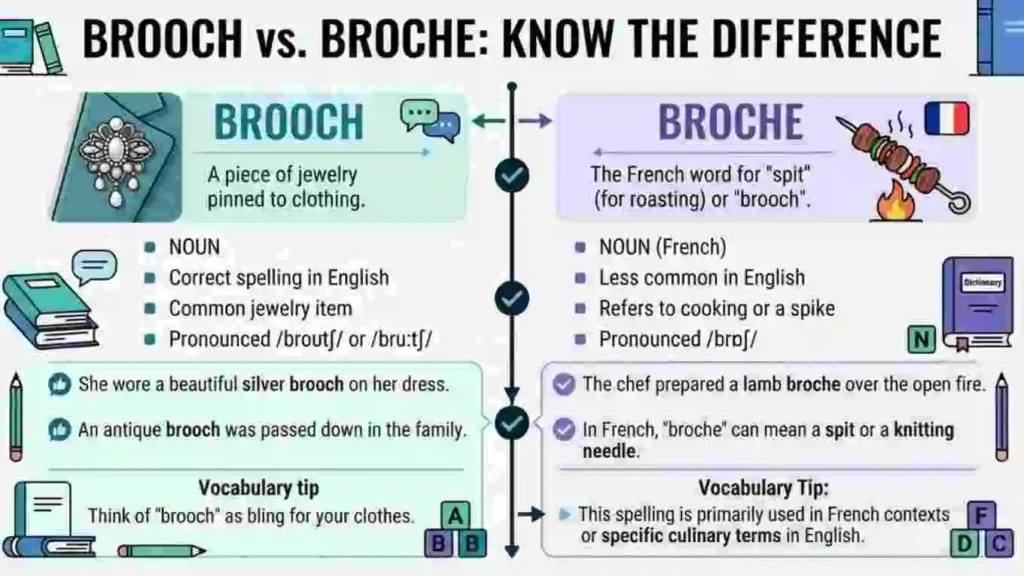
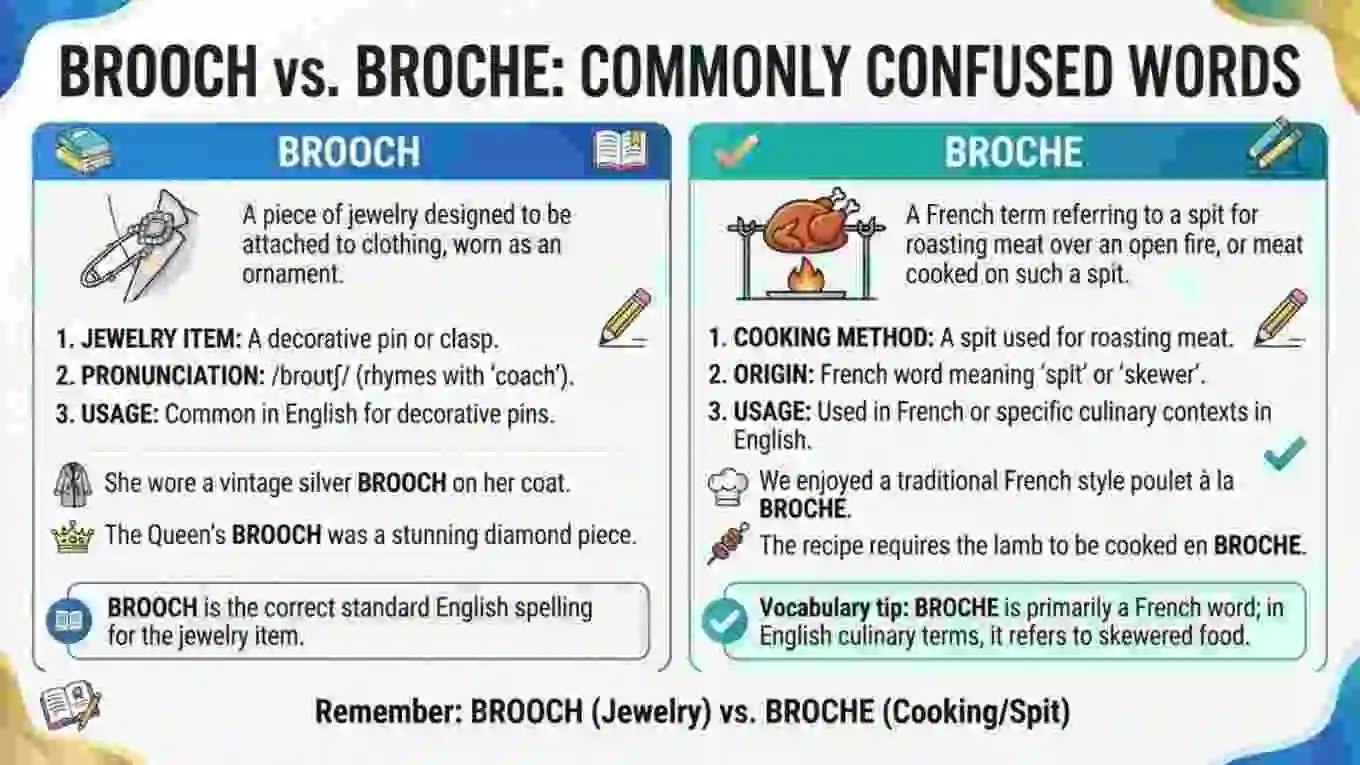
Brooch is the correct English spelling. It’s a small pin, often used to hold clothes together, or just worn as jewelry. Example: “She wore a gold brooch on her coat.”
Broche is not a normal English word. It shows up since French and Spanish use “broche” as their own correct word for a close item.
If you’re writing in English, “brooch” is what you want, almost every time.
Why This Word Feels So Shaky
This one’s a bit different from most spelling mix-ups. It’s not really two English forms splitting apart. English took the idea of this pin from French, but changed the spelling along the way. Meanwhile, French, Spanish, and a few other languages kept using “broche” for their own kind.
The word goes back to an old French word for a sharp tool, since early pins were simple, sharp fasteners. English took the word in long ago, but the spelling changed over time into “brooch,” partly to match how English speakers were already saying it out loud.
So when someone types “broche” while shopping in English, they’re often not making a random mistake. They’re likely slipping into the French or Spanish spelling without noticing, most of all since jewelry stores and store lists often use both spellings across their world sites.
Breaking Down the Difference
| Brooch | Broche | |
| Correct in | English | French, Spanish, and other languages |
| Meaning | A small decorative pin | Same idea, a pin or clip |
| Used like | “She pinned a brooch to her scarf.” | Used the same way, in French or Spanish |
| Normal in English writing? | Yes | No |
A Simple Way to Check Yourself
Ask this: am I writing in English, or in French or Spanish?
Writing in English? Always go with “brooch.” No other choice here.
Writing or talking in French or Spanish? “Broche” is right there too, just a different language doing its own thing.
Try It Yourself
Guess the right spelling before you check the answer.
- An English jewelry listing: “Old gold ___ with pearl detail.” → brooch
- A French sentence: “Elle porte une belle ___.” → broche
- An English wedding blog: “The bride wore her grandmother’s old ___.” → brooch
- A Spanish product page: “Este ___ es perfecto para cualquier ocasión.” → broche
- An English style headline: “Why the ___ is back in style this year.” → brooch
Which Spelling Should You Use?
Writing in English, for any reason: Always “brooch.” Store lists, blog posts, texts, all of it.
Writing or talking in French or Spanish: “Broche” is right here, since it’s just the correct word in those languages.
Shopping online and not finding what you want: Try both spellings, since sellers who work across many countries at times list items using either word.
Writing something formal, like a jewelry description: Stay strict with “brooch.” Using “broche” in English writing can look like a typo to most readers.
Common Mistakes People Make
Typing “broche” while shopping in English. This happens a lot, mostly since both spellings look and sound close, and world sites at times mix them with no warning.
Thinking “broche” is a short form of “brooch.” It’s not a short form at all. It’s a full, separate language’s correct word for something close.
Trusting spellcheck to catch it. Since “broche” is a real word, just in another language, English spellcheck at times lets it slide through anyway.
Getting thrown off by how it sounds. “Brooch” is said a bit like “broach,” which can make the spelling feel wrong even when it’s right.
Seeing These Words in Real Life
An English jewelry ad: “This old brooch has hand-set crystals.”
A French style post: “La nouvelle collection de broches est arrivée.”
A wedding blog: “Think about a brooch bouquet instead of real flowers.”
A Spanish store page: “Broche elegante para toda ocasión.”
An English style magazine: “Brooches are back in style this season.”
Why People Search This So Often
Online shoppers search both spellings a lot, most of all while looking at jewelry sites that pull in lists from sellers around the world, some in English, others in French or Spanish.
People learning English at times carry over spelling habits from their first language, most of all if that language uses “broche” for something close, which naturally leads to this mix-up.
Writers who cover style or jewelry topics search this pair too, wanting to check the correct English spelling before they post anything.
A Few Related Word Pairs Like This
| Pair | English Version | Other Language Version |
| Brooch / Broche | Brooch (English) | Broche (French, Spanish) |
| Ballet | Ballet (English, same spelling) | Ballet (French, same spelling) |
| Garage | Garage (English) | Garage (French, same spelling) |
| Café | Café (often kept) | Café (French, always kept) |
Common Questions
Is “broche” ever right in English? No, not in normal English writing. It’s a real word, just in French and Spanish, not English.
Why do English and French spell it so different if the word came from French? English at times changes borrowed words over time to match how English speakers really say and write them.
Is “brooch” said the way it looks? Not quite. It sounds close to “broach,” not like words such as “smooch,” which can throw people off when spelling it by sound alone.
Can I use “broche” while shopping from other countries? Try both spellings while you search, but for your own writing, “brooch” is the correct English choice.
Is there a real difference in the item itself? No, it’s the same kind of pin either way. The difference is only in the language, not in the item.
Why does this mix-up happen more with jewelry shopping? Jewelry markets are often world-wide, pulling in lists from many countries, so shoppers run into more than one language spelling here more than in most other topics.
How can I remember the correct English spelling? Try linking “brooch” with “broach,” since they sound close, and “broach” may already feel known to you as a word you’ve seen spelled that way.
Wrapping This Up
“Brooch” is the correct spelling in English, always. “Broche” isn’t wrong exactly, it’s just correct in a different language, most of all French and Spanish, for a close kind of pin.
Writing in English? Stick with “brooch,” no other choice needed. See “broche” while shopping from other countries? Know that it’s not a typo, just a different language doing its own thing with a close idea.
Once this clicks, you’ll spell it right every time, whether you’re shopping, writing, or just looking at someone else’s pretty pin.

Ethan Carter is a language writer at Wordellect who helps readers understand word differences, grammar rules, and spelling variations through simple and accurate guides.







