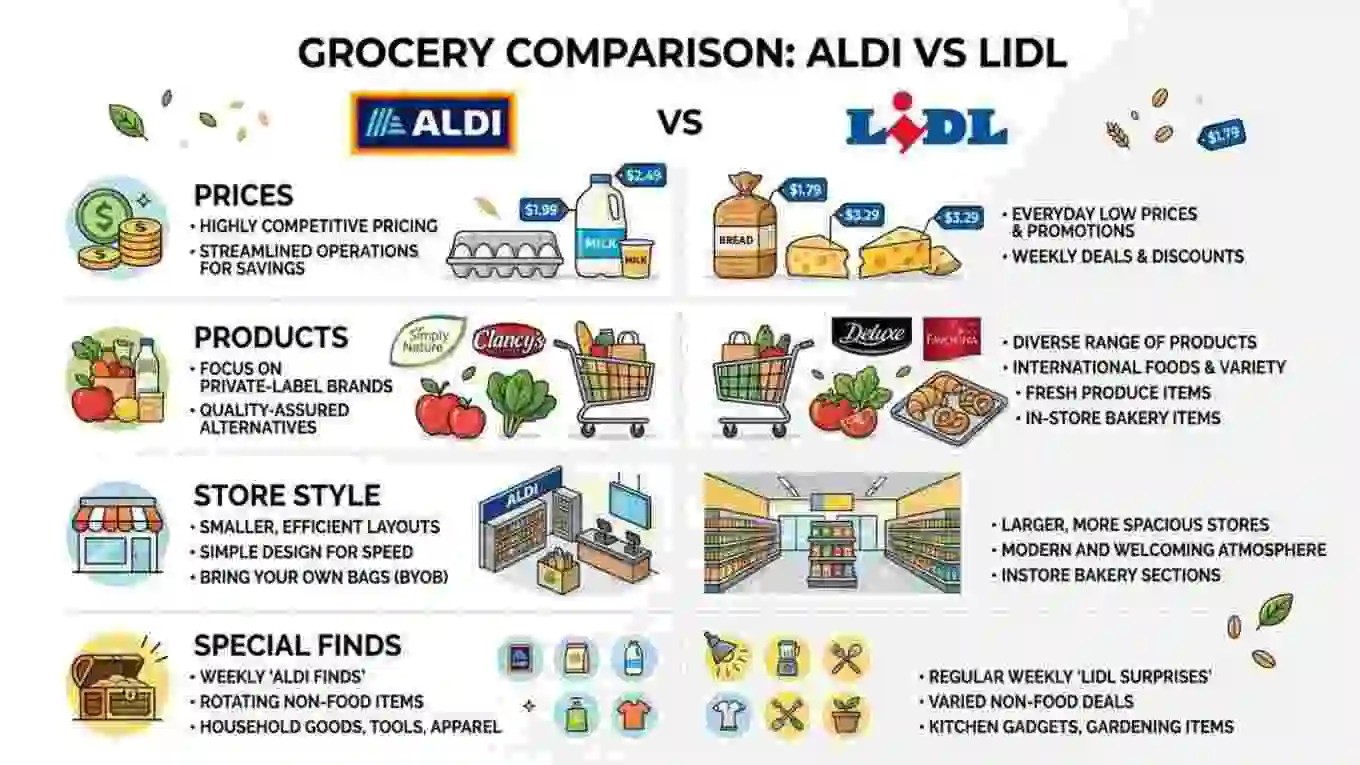
Choosing between Aldi or Lidl can feel harder than it should. Both are well-known discount grocery stores. these are started in Germany. Both focus on low prices, simple stores, private-label products, and a smaller range than many large supermarkets.
So, what is the real difference?
The answer depends on what you want to buy and how you like to shop. Aldi puts a strong focus on a simple store model, a smaller selection, and a very large share of exclusive brands. In the U.S., ALDI says more than 90% of its products are ALDI-exclusive brands.
Lidl also uses a curated product range and many private-label items. Its U.S. stores also focus on fresh food, imported products, bakery items, and weekly non-food offers.
This guide explains how the two stores differ, what they sell, how their store models work, and which one may fit different shopping needs.
Aldi or Lidl – Quick Answer
Aldi and Lidl are both German discount grocery chains, but they are separate companies with different store models and product mixes.
this is known for a simple, smaller-store approach, a focused product range, and a very high share of exclusive brands. ALDI says more than 90% of its U.S. products are ALDI-exclusive.
Lidl also keeps a curated range and uses many private-label products. Lidl US says around 80% of its products are private label and highlights fresh produce, bakery goods, imported foods, and changing weekly products.
A simple way to think about the difference is:
- Aldi: very simple shopping, focused selection, strong private-label model.
- Lidl: discount prices with a broader mix of fresh food, bakery items, imports, and changing special items.
- Both: German roots, discount pricing, private-label products, and efficient store layouts.
There is no single answer to which one is better. Your choice can depend on location, products, prices, and personal preference.
What Is the Difference Between Aldi and Lidl?
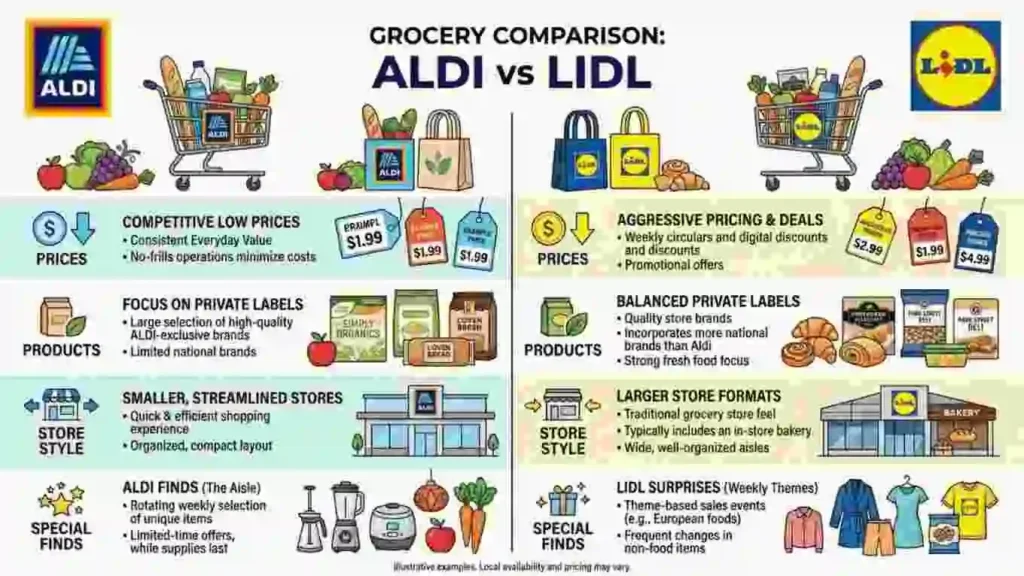
Aldi and Lidl compete in the same broad part of the grocery market, but they are not the same company.
Both use a discount model. This means they try to keep costs low and pass savings to shoppers.
They do this in different ways.
Aldi’s approach
ALDI says its U.S. stores use a smaller layout and focus on popular grocery items. Products may remain in their original shipping boxes to save time when stocking shelves.
ALDI also keeps a large share of its products under exclusive brands.
This can make the shopping trip simple because there are fewer brands to compare in many categories.
Lidl’s approach
Lidl also uses a curated selection instead of trying to offer every brand in a category.
Lidl US says it works with vendors to source products at competitive prices. It also highlights private-label products, fresh foods, imported specialties, and weekly non-food items.
Its stores can therefore feel like a mix of a discount supermarket and a place to discover changing products.
Main Differences Between Aldi and Lidl
| Feature | Aldi | Lidl |
| Origin | Germany | Germany |
| Main model | Discount grocery | Discount grocery |
| Private-label focus | Very high | High |
| Store style | Simple and compact | Curated and efficient |
| Fresh food | Strong focus | Strong focus |
| Bakery | Available in many markets | Strong bakery focus in Lidl US |
| Imported foods | Available | Strong focus on international products |
| Changing non-food items | ALDI Finds | Middle of Lidl |
| U.S. presence | Large national footprint | Mainly East Coast |
| Loyalty program | ALDI offers digital shopping tools and deals | Lidl Plus |
| Best fit depends on | Simple shopping and focused selection | Fresh food, bakery, imports, and changing finds |
Store ranges and services can vary by country and location. The table describes the general model, not every individual store.
Aldi vs Lidl: Prices
Price is one of the main reasons people compare these stores.
Both chains build their businesses around low-cost shopping. However, there is no single price winner for every product, every location, and every week.
A price comparison can change because of:
- Store location
- Product size
- Brand
- Sales
- Coupons
- Local pricing
- Seasonal offers
- Product availability
ALDI says its model focuses on simplicity, efficiency, and everyday low prices.
Lidl also says it keeps overhead low and uses efficient store operations to support low prices.
If price matters most, compare the same product size and type at both stores.
For example, do not compare a 12-ounce package with a 16-ounce package. Check the unit price when it is available.
Aldi vs Lidl for Groceries
Both stores sell common grocery items.
You can usually find categories such as:
- Fruit and vegetables
- Meat
- Dairy
- Bread
- Frozen food
- Snacks
- Drinks
- Pantry items
- Household products
- Pet products
The exact selection changes by country and store.
ALDI says it focuses on popular grocery items and also offers seasonal products through ALDI Finds.
Lidl US lists fresh produce, meat, seafood, cheese, dairy, bakery, pantry food, frozen products, snacks, drinks, household items, and pet supplies.
Aldi vs Lidl for Private-Label Products
Private-label products are a major part of both businesses.
A private-label product is made for a retailer and sold under the retailer’s own brand or an exclusive brand.
For example, shoppers may not see ten national brands of the same item. Instead, the store may offer one or a few store brands.
Aldi
ALDI says more than 90% of its products are ALDI-exclusive brands in the U.S.
This is a major part of its business model.
Lidl
Lidl US says around 80% of its products are private label. It also sells imported and national-brand products.
So both stores rely heavily on their own brands, but the exact mix can differ.
Aldi vs Lidl for Fresh Food
Fresh food is important at both chains.
ALDI highlights fresh produce, meat, and other grocery products. It also works with local farmers for some fresh produce.
Lidl US places a strong focus on fresh produce, meat, seafood, bakery items, and imported foods. Its official site also highlights fresh bakery products and international foods.
If fresh food is your main concern, check your local stores rather than relying only on the chain name.
One location may have a different range from another.
Aldi vs Lidl for Bakery Items
Bakery products can be a useful difference for shoppers.
Lidl US strongly promotes its fresh bakery selection, including breads and pastries baked and restocked during the day.
ALDI also sells bakery products, but its main store model focuses more broadly on a compact grocery range and exclusive brands.
If fresh bakery food matters to you, look at your local Lidl first and compare the actual bakery selection with your nearby ALDI.
Aldi vs Lidl for Special Finds
Both stores sell products outside normal groceries.
At ALDI, these are called ALDI Finds.
They can include:
- Seasonal food
- Kitchen items
- Home products
- Gardening products
- Outdoor items
- Small appliances
ALDI says new Finds arrive regularly and can include both food and non-food products.
Lidl has a similar idea called Middle of Lidl.
Lidl says this area contains general merchandise that changes regularly. Items can include cookware, gardening products, home items, fitness goods, and seasonal products.
This means both stores can offer more than basic groceries.
Origin and History
Aldi and Lidl both began in Germany, but they have different histories.
Aldi
ALDI’s roots go back to a food store started by Anna Albrecht in Germany in 1913, according to ALDI’s company history. Her sons later expanded the business. The name ALDI comes from Albrecht Discount.
In 1961, the Albrecht family established the discount grocery model that became ALDI. The first U.S. ALDI store opened in Iowa in 1976.
Today, ALDI operates as two related groups, ALDI Nord and ALDI Süd, in different markets. The official ALDI site lists both groups.
Lidl
Lidl’s modern store history began in Germany.
Lidl says its first modern location opened in Ludwigshafen in 1973, with three employees and about 500 products. It later expanded outside Germany, including into France and the United Kingdom.
Lidl opened its first U.S. stores in 2017.
Today, Lidl is part of the Schwarz Group.
Are Aldi and Lidl the Same Company?
No.
Aldi and Lidl are separate companies.
They are both German discount retailers, which is why people often compare them.
Aldi operates through the ALDI Nord and ALDI Süd groups in different markets.
Lidl is part of the Schwarz Group.
So, while their business models have some similarities, they are not two branches of the same company.
British English vs American English
There is no British or American spelling issue with Aldi or Lidl.
Both are brand names.
The spelling stays the same in:
- American English
- British English
- Australian English
- Canadian English
- Other English-language writing
The main difference is not language. It is the market and store location.
For example, Aldi’s product range and services can differ between the United States, the United Kingdom, Germany, and other countries.
The same applies to Lidl.
So, when reading an online comparison, always check which country the information covers.
Which One Should You Use?
If you mean which store should you shop at, there is no universal answer.
Your best choice depends on what matters most to you.
Choose Aldi if you prefer:
- A simple store layout
- A focused product range
- Many exclusive store brands
- Quick grocery shopping
- ALDI Finds
- A strong low-cost store model
ALDI says more than 90% of its U.S. products are exclusive brands and that its stores use a smaller, simple layout.
Consider Lidl if you prefer:
- Fresh bakery products
- Imported foods
- A curated grocery range
- Weekly changing non-food products
- Lidl Plus offers
- Fresh produce and specialty foods
Lidl US highlights its bakery, international foods, private-label products, and weekly changing merchandise.
If price is your main goal
Compare the actual products at your local stores.
Do not assume that every Aldi product costs less than the matching Lidl product, or the other way around.
Prices change by product, store, and time.
Common Mistakes When Comparing Aldi and Lidl
1. Thinking they are the same company
Wrong idea:
“Aldi and Lidl are two names for the same supermarket.”
Correct:
They are separate German retailers.
Example:
“Aldi and Lidl both use discount grocery models, but they are different companies.”
2. Comparing different product sizes
Wrong approach:
Comparing a 10-ounce product with a 16-ounce product.
Better approach:
Check the unit price.
3. Comparing different brands
An Aldi-exclusive product and a Lidl-exclusive product may not have the same ingredients, size, or recipe.
Check the label before comparing prices.
4. Assuming every store has the same products
Both chains change their ranges and special products.
A product at one store may not appear at another.
5. Assuming one chain is always cheaper
Prices can change.
Sales and local prices can also affect the result.
Compare the products you actually plan to buy.
6. Using U.S. information for another country
Aldi and Lidl operate in many markets.
Their products, services, apps, and store models can differ by country.
Always check the local version of the company website.
Aldi or Lidl: 10 Everyday Shopping Examples
- I usually shop at Aldi for basic groceries.
- Lidl has a bakery section that I like.
- We compared the unit prices before buying.
- Aldi has many of its own brands.
- Lidl sells many imported food products.
- I found a seasonal kitchen item at Aldi.
- Lidl’s weekly offers can change the products I buy.
- We checked both stores before buying a large grocery order.
- Aldi’s smaller store makes my shopping trip simple.
- I visit Lidl when I want to look for specialty foods.
These examples describe possible shopping choices. They do not mean that every Aldi or Lidl store offers the same products.
Real-Life Usage
In conversation
Someone might ask:
“Do you shop at Aldi or Lidl?”
A simple answer could be:
“I usually shop at Aldi, but I go to Lidl for bakery items.”
In an email
A work or family email might say:
“Can you check Aldi and Lidl prices before we place the order?”
For a grocery list
You might write:
“Check Aldi for milk, eggs, and vegetables.”
Or:
“Get the bread from Lidl.”
On social media
People may post about:
- New seasonal products
- Grocery prices
- Special finds
- Bakery products
- Store brands
- Weekly deals
In a product comparison
A useful comparison should show the:
- Product size
- Price
- Unit price
- Ingredients
- Brand
- Country
- Date checked
This gives readers a fairer comparison than simply saying one store is cheaper.
Which Has More Stores?
The answer depends on the country and the date.
Aldi has a large U.S. presence. ALDI’s current U.S. history page says it has more than 2,400 stores across 38 states.
Lidl has a much smaller U.S. footprint and is concentrated mainly along the East Coast. Lidl’s current U.S. information says it has more than 200 stores across nine East Coast states.
This difference matters if you are deciding where to shop in the United States.
A store may be excellent for your needs, but distance still matters.
Related Search Questions
Is Aldi cheaper than Lidl?
There is no single price rule that makes one cheaper for every product. Prices change by store, product, size, promotions, and location. The best way to compare them is to check the same or similar products and compare the unit price.
Is Lidl cheaper than Aldi?
Lidl can have very low prices, but that does not mean every item will cost less than the same or similar item at Aldi. Local prices and promotions matter. A fair comparison should use the same size and product type.
Are Aldi and Lidl owned by the same company?
No. They are separate businesses. Aldi operates through ALDI Nord and ALDI Süd in different markets, while Lidl is part of the Schwarz Group.
Are Aldi and Lidl German companies?
Yes. Both have German roots. ALDI traces its history to Germany, and Lidl’s first modern store opened there in 1973.
Does Lidl have better bakery products?
Lidl US places a strong focus on fresh bakery products, including bread and pastries baked during the day. However, the exact range depends on the store.
Does Aldi have mostly store brands?
Yes. ALDI says more than 90% of its U.S. products are ALDI-exclusive brands. This is a major part of its business model.
Usage and Search Trends
People who search for this comparison often want practical shopping information rather than a simple company history.
Common search needs include:
- Aldi vs Lidl prices
- Aldi vs Lidl quality
- Aldi vs Lidl products
- Aldi vs Lidl groceries
- Aldi vs Lidl bakery
- Aldi vs Lidl private labels
- Aldi vs Lidl locations
- Which store is cheaper?
- Which store has better food?
- Are Aldi and Lidl the same?
Search interest can also change by country.
That matters because Aldi and Lidl do not have identical store networks in every market. For example, Lidl’s U.S. stores are concentrated on the East Coast, while ALDI has a much wider U.S. footprint.
For a current shopping decision, local store information is more useful than a general worldwide comparison.
Comparison Table
| Category | Aldi | Lidl |
| Country of origin | Germany | Germany |
| Company | ALDI Nord / ALDI Süd groups | Schwarz Group |
| U.S. entry | 1976 | 2017 |
| Product model | Focused selection | Curated selection |
| Private-label share | More than 90% in U.S. | Around 80% in U.S. |
| Fresh produce | Yes | Yes |
| Bakery focus | Available | Strong focus in Lidl US |
| Imported foods | Available | Strong international selection |
| Special products | ALDI Finds | Middle of Lidl |
| U.S. store footprint | Broad | Mainly East Coast |
| Loyalty shopping | Digital deals and tools | Lidl Plus |
| Best comparison method | Check local prices | Check local prices |
The figures above reflect current official U.S. company information and can change as the chains expand.
FAQs
1. Which is better, Aldi or Lidl?
There is no single choice that works for every shopper. Aldi may suit people who like a very focused selection and a high share of exclusive brands. Lidl may suit shoppers who want fresh bakery products, imported foods, and changing non-food offers. Your local store, prices, and product needs should guide the choice.
2. Is Aldi owned by Lidl?
No. Aldi and Lidl are separate companies. Both started in Germany and both use discount grocery models, but they have different ownership structures and histories. Aldi operates through ALDI Nord and ALDI Süd groups in different markets, while Lidl is part of the Schwarz Group.
3. Why are Aldi and Lidl so cheap?
Both use efficient discount-store models. Aldi says it keeps costs down through simplicity, a focused range, smaller stores, and exclusive brands. Lidl also says it keeps overhead low and uses a curated selection and efficient store operations.
4. Does Aldi or Lidl have better quality?
Both companies say they focus on quality while keeping prices low. However, quality can vary by product. A better comparison looks at the specific item, ingredients, nutrition, price, and customer needs instead of judging the whole store by one product.
5. Which store has more products?
The exact number varies by country and store. Neither chain tries to offer the same huge range found at many traditional supermarkets. Both use a curated selection, although their product mixes differ. Lidl places strong emphasis on fresh food, bakery products, imports, and changing items, while Aldi focuses strongly on a streamlined range.
6. Are Aldi and Lidl available in the United States?
Yes. Aldi has a large U.S. network, while Lidl operates mainly along the East Coast. ALDI says it has more than 2,400 U.S. stores across 38 states, while Lidl US says it has more than 200 stores across nine East Coast states.
7. Can you shop at both Aldi and Lidl?
Yes. Many shoppers can use both stores for different needs. You can compare prices, products, special offers, bakery items, and store-brand products. Shopping at both can also help you learn which store has the products you buy most often.
Conclusion
Aldi and Lidl are two separate German discount grocery chains with many similarities. Both focus on low prices, efficient stores, private-label products, and a focused selection. But their product mix and shopping experience are not exactly the same.
Aldi has a very strong private-label model. In the U.S., more than 90% of its products are ALDI-exclusive brands. Its stores also use a simple format and focus on popular everyday items.
Lidl also relies heavily on private-label products, but it places strong attention on fresh bakery products, imported foods, fresh produce, and changing weekly merchandise.
So, the best choice depends on your needs.
If you like simple shopping and a focused range, Aldi may fit your routine. If you want bakery items, international foods, and changing special products, Lidl may be worth checking.
For the most useful comparison, visit both local stores, compare the products you actually buy, and check unit prices. That gives you a better answer than any general ranking.

Ethan Carter is a language writer at Wordellect who helps readers understand word differences, grammar rules, and spelling variations through simple and accurate guides.







