You’re looking into hair treatments, or maybe skin care, and you keep seeing two short terms: PRP and PRF. They sound close. They even use some of the same base idea. But your clinic brochure lists them as two different options, and now you’re not sure which one is which.
People search “PRP or PRF” a lot, since both terms show up in ads for hair loss treatments, skin care, and even some dental and joint care. Since both come from your own blood, it’s easy to think they’re just two names for the same thing. They are not.
Please note: This article gives general information only. It is not medical advice. Always talk to a licensed doctor or provider before choosing any treatment.
Here’s the simple version: PRP stands for Platelet-Rich Plasma. PRF stands for Platelet-Rich Fibrin. Both come from a sample of your own blood, spun in a machine to pull out helpful parts. But the way each one is made, and how each one works in the body, is different.
In this article, you’ll learn what each treatment is, how doctors make it, and what sets them apart, so you can talk with your doctor or provider more confidently.
PRP or PRF Quick Answer
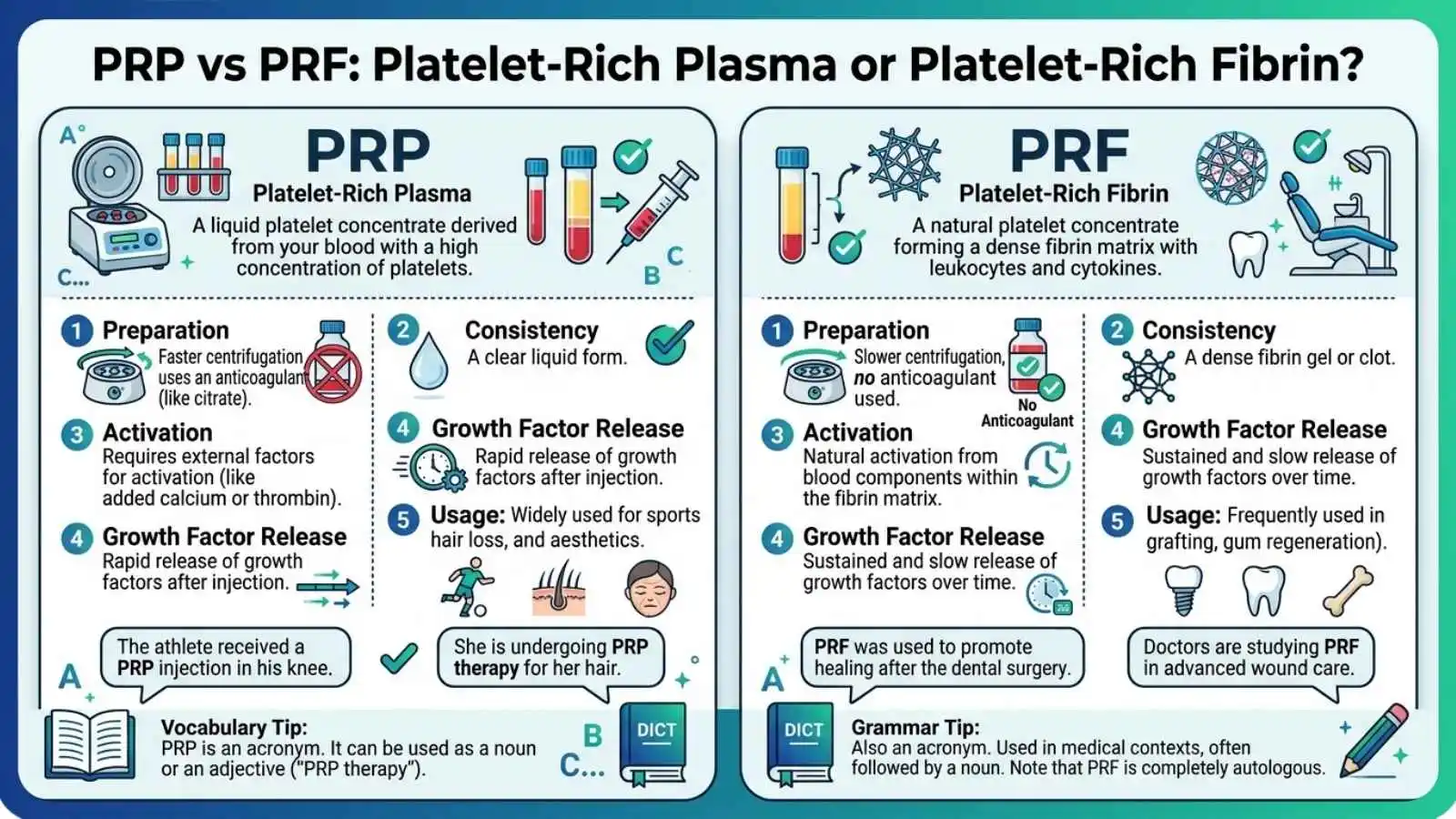
- PRP (Platelet-Rich Plasma) = blood spun fast to pull out a liquid full of platelets, often used right away
- PRF (Platelet-Rich Fibrin) = blood spun slower, forming a thicker, gel-like material that releases platelets over a longer time
Example: “My doctor used PRP for my scalp treatment.” “The dentist used PRF to help the gum area heal faster.”
What Is PRP?
PRP stands for Platelet-Rich Plasma. Doctors take a small blood sample and spin it in a machine called a centrifuge. The machine separates the blood into different parts. Doctors then collect the platelet-rich plasma and use it for treatment.
Platelets are tiny parts of your blood that help with healing and growth. PRP is often used in hair loss treatments, some skin care treatments, and joint or muscle care, since the platelets may help support healing and new tissue growth in the treated area.
What Is PRF?
PRF stands for Platelet-Rich Fibrin. It’s also made from a blood sample, but the blood is spun slower and without added chemicals that some PRP methods use. This slower spin creates a thicker, gel-like material, instead of a liquid.
Since PRF has a thicker form, it tends to release its platelets more slowly over time, instead of all at once. This is why some providers use PRF for treatments where they want a longer, steady release, such as some dental procedures, wound care, and certain skin treatments.
PRP vs PRF: Key Differences
This is not a spelling question. These are two different processes that create two different materials from the same starting point: your own blood.
| Feature | PRP | PRF |
| Full name | Platelet-Rich Plasma | Platelet-Rich Fibrin |
| Texture | Liquid | Thicker, gel-like |
| Spin speed | Faster spin | Slower spin |
| Release of platelets | Mostly all at once | Slower, over time |
| Common uses | Hair loss, skin care, joint care | Dental care, wound care, some skin treatments |
| Added chemicals | Sometimes uses an anti-clotting chemical | Usually made without added chemicals |
How Are They Alike?
Both PRP and PRF share some basic traits, since they both come from the same starting material: your own blood.
- Doctors take a small blood sample from the patient to prepare both treatments.Doctors spin both blood samples in a machine to separate the platelet-rich part.Doctors use both treatments to support healing in different areas of the body.Both treatments use the body’s own natural materials instead of outside substances.
- Both require a licensed provider to prepare and apply them safely.
Which One Might a Provider Choose?
Only a licensed doctor or provider can decide which one fits a specific treatment plan. In general, providers may lean toward:
PRP for treatments where:
- A liquid form is easier to inject into a specific spot, like the scalp or a joint.
- A faster, more immediate release of platelets is wanted.
PRF for treatments where:
- A slower release of platelets over time may support longer healing, such as in some dental work.
- A thicker material is needed to stay in place, such as filling a small area during a procedure.
This is general information only. The right choice always depends on the specific treatment, the area being treated, and the patient’s own health history. A licensed provider should always make this decision.
Common Wrong Ideas
Wrong idea 1: “PRP and PRF are just two names for the same treatment.” This is not true. They are made in different ways and have different textures and release patterns, even though both come from blood.
Wrong idea 2: “PRF is always better than PRP, since it’s newer.” This is not something to assume. Each one may work better for certain treatments, based on what the provider is trying to achieve.
Wrong idea 3: “These treatments always give guaranteed results.” Results can vary a lot from person to person. A provider should always explain realistic expectations before starting any treatment.
Wrong idea 4: “Since it comes from your own blood, there’s no risk at all.” While these treatments use your own blood, there can still be some risks, like any medical procedure, such as infection or discomfort at the treatment site. Always ask your provider about possible risks.
PRP and PRF in Everyday Examples
In a clinic brochure: “We offer both PRP and PRF treatments for hair restoration.”
In a patient conversation: “My dentist recommended PRF to help my gum area heal faster after the procedure.”
Skin care blog: “PRP facials have become popular for their use of the body’s own platelets.”
In social media: “Just got my first PRP treatment for hair thinning, excited to see the results over the next few months.”
In formal writing: “The clinic offers both PRP and PRF options, depending on the treatment area and patient needs.”
PRP or PRF Search Trends and Popularity
Search data shows steady interest in both terms, especially tied to hair restoration, skin care, and dental care. People search for PRP more often because doctors have used and discussed it longer, especially for hair loss and skin treatments. People search for PRF less often, but interest has grown in recent years, especially for dental care and certain wound care treatments.
This pattern stays fairly steady across the US, UK, Canada, Australia, and other English-speaking countries, since interest depends on the type of treatment someone is researching, not on region.
| Keyword Variation | Common Reason for Search | Typical Interest |
| PRP | Hair loss, skin care, joint care | Long-standing, well-known treatment |
| PRF | Dental care, wound care | Growing interest, newer awareness |
| PRP hair treatment | Hair restoration | People researching hair loss options |
| PRF dental | Dental healing | Patients researching gum or tooth procedures |
Frequently Asked Questions
1. Is PRP or PRF more effective? Neither one is always better. Each may work well for different treatments, and a licensed provider can help decide which fits your specific needs.
2. Do both PRP and PRF come from my own blood? Yes. Both are made using a small sample of your own blood, spun in a machine to separate out the platelet-rich part.
3. Is one more painful than the other? Both involve a small blood draw and an injection or application, similar to many other minor procedures. Ask your provider about what to expect for your specific treatment.
4-Can PRP and PRF be used together?
Some providers combine PRP and PRF, depending on the treatment plan. A licensed provider should always make this decision based on your needs.
5. How long do results typically last? This varies a lot depending on the treatment type, the person, and the area being treated. A provider can give you a more specific idea based on your situation.
Are PRP and PRF treatments safe?
Doctors generally consider both PRP and PRF safe because they use the patient’s own blood. However, every medical procedure carries some risk.. Always ask your provider about possible side effects.
7. Which one is used more for hair loss?
Doctors currently use and study PRP more often for hair loss treatments, although some providers also use PRF for this purpose.
Conclusion:
PRP and PRF are two different treatments, not two names for the same thing. Doctors make PRP (Platelet-Rich Plasma) by spinning blood at high speed, creating a liquid that quickly releases platelets.
PRF (Platelet-Rich Fibrin) is a thicker, gel-like material made by spinning blood more slowly, often used for a slower release over time.
Healthcare providers prepare both treatments from your own blood to promote healing in hair restoration, dental care, and more.
. The right choice between the two depends on the specific treatment and your own health needs.
This article gives general information only. It does not replace advice from a licensed doctor or provider. If you’re considering PRP or PRF for any treatment, please talk to a qualified professional who can explain your options and help you make the best choice for your situation.

Ethan Carter is a language writer at Wordellect who helps readers understand word differences, grammar rules, and spelling variations through simple and accurate guides.







