You are standing in a store. They have a stuffy nose and itchy eyes. You look at the medicine shelf. One box says “antihistamine.” Another box says “decongestant.” You are not sure which one you need. Do they do the same thing? Or are they different?
This mix-up happens a lot. Both words show up on cold and allergy medicine boxes. Both are used to help you feel better when you are sick or dealing with allergies. Because they are often sold near each other, and even mixed together in some products, people are not always sure what each one really does.
People look up “antihistamine vs decongestant” because they want to pick the right medicine for how they feel. Maybe their nose is blocked. Maybe their eyes are itchy and watery. Knowing the difference helps you choose better and feel better faster.
This guide gives you a simple answer first. Then it explains what each one does in your body, when to use each one, and how to tell them apart on a store shelf.
Antihistamine vs Decongestant – Quick Answer
Both types of medicine help with cold and allergy signs, but they work in different ways.
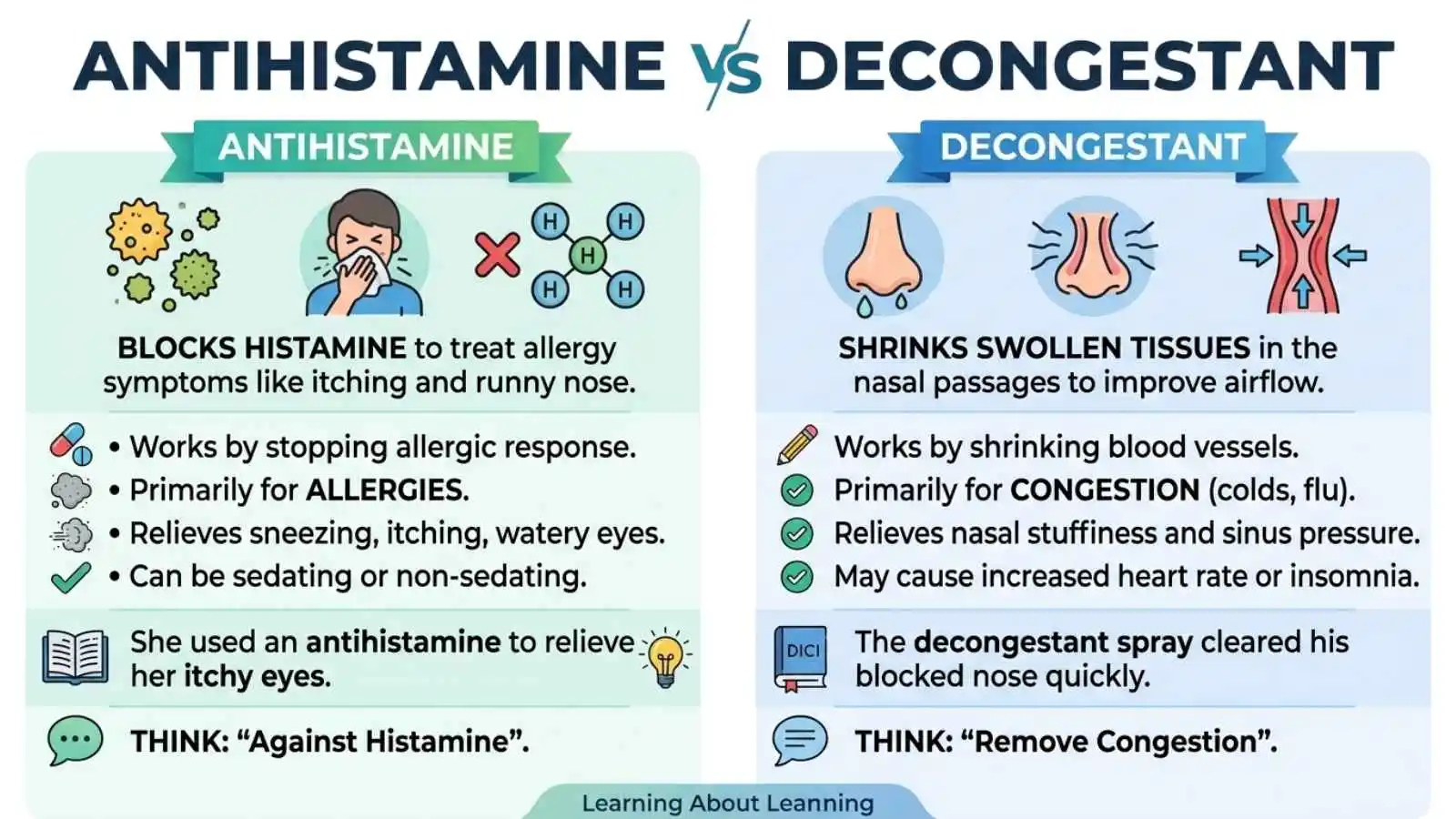
- Antihistamine = helps stop itching, sneezing, watery eyes, and a runny nose. It works by blocking a body chemical called histamine, which causes allergy signs.
- Decongestant = helps open up a blocked, stuffy nose. It works by making the blood vessels in your nose smaller, so you can breathe easier.
Simple examples:
- “I took an antihistamine because my eyes were itchy and I kept sneezing.”
- “I took a decongestant because my nose was completely blocked.”
- “Some medicines have both an antihistamine and a decongestant in one pill.”
In short: antihistamines calm down itching and sneezing. Decongestants clear a stuffy, blocked nose.
Where Do These Words Come From?
Antihistamine is made from two parts. “Anti-” means “against.” “Histamine” is the name of a chemical your body makes when it reacts to something like pollen, dust, or pet hair. So an antihistamine is a medicine that works against histamine, stopping it from causing itching, sneezing, and watery eyes.
Decongestant also comes from two parts. “De-” means “to remove” or “to take away.” “Congest” means to block or crowd something up, like a blocked road, or in this case, a blocked nose. So a decongestant is a medicine that removes the blocked, stuffy feeling in your nose.
Both words are built from science terms, but once you know what each part means, the words make a lot more sense.
When Should You Use Each One?
- Runny nose, sneezing, itchy or watery eyes, allergy signs? Reach for an antihistamine.
- Blocked, stuffy nose that makes it hard to breathe? Reach for a decongestant.
- Both a stuffy nose and sneezing or itchy eyes at the same time? Some medicines combine both an antihistamine and a decongestant in one product. Check the label to see what is inside.
If you are not sure which one you need, or if your signs do not go away after a few days, it is a good idea to check with a doctor or pharmacist. They can help you pick the safest option for you.
Common Mistakes with Antihistamine and Decongestant
Mistake 1: Thinking both medicines do the same thing They target different signs. An antihistamine will not clear a blocked nose very well, and a decongestant will not stop itching or sneezing.
Mistake 2: Using a decongestant for too many days in a row Some decongestant nose sprays should only be used for a short time. Using them for too long can actually make a blocked nose feel worse. Always check the label or ask a pharmacist.
Mistake 3: Not reading the label on combined products Many cold and allergy medicines contain both an antihistamine and a decongestant. If you take another medicine on top of that, you could take too much of one ingredient without knowing it. Always check the label first.
Mistake 4: Assuming one is always better than the other Neither one is “better” overall. They simply treat different signs. The best choice depends on how you feel.
Antihistamine and Decongestant – Everyday Examples
Talking to a friend: “My allergies are so bad today, I had to take an antihistamine before I could stop sneezing.”
At the pharmacy: “Can you tell me which of these has a decongestant in it? My nose is completely blocked.”
On a medicine label: “Contains an antihistamine and a decongestant to relieve sneezing, runny nose, and nasal congestion.”
In daily talk: “I feel a cold coming on, my nose is stuffy, so I’m grabbing a decongestant tonight.”
Comparison Table:
| Feature | Antihistamine | Decongestant |
| Main job | Stops itching, sneezing, watery eyes | Clears a blocked, stuffy nose |
| How it works | Blocks the histamine chemical | Shrinks blood vessels in the nose |
| Common signs it helps | Allergies, hay fever, itchy eyes | Stuffy nose from a cold or allergy |
| Found in | Allergy pills, some cold medicines | Cold medicines, nasal sprays |
| Can be combined? | Yes, often paired with a decongestant | Yes, often paired with an antihistamine |
FAQs:
1. Can I take an antihistamine and a decongestant together? Many products already combine both. If you are taking them separately, check with a pharmacist to make sure it’s safe for you and that you are not doubling up on ingredients.
2. Which one helps more with a stuffy nose? A decongestant is made to clear a blocked, stuffy nose. An antihistamine mainly helps with sneezing, itching, and watery eyes.
3. Which one helps more with sneezing and itchy eyes? An antihistamine is the better choice for sneezing, itching, and watery eyes.
4. Are decongestant nose sprays safe to use every day? Some decongestant sprays are only meant for short-term use, often just a few days. Using them too long can make your nose feel more blocked. Always check the label or ask a pharmacist.
5. Do antihistamines make you sleepy? Some older antihistamines can make you feel sleepy. Many newer ones do not cause much sleepiness. Check the label or ask a pharmacist if this matters to you.
6. Can children take these medicines? Some products are made for children, and some are not. Always check the label for age guidelines, and ask a doctor or pharmacist if you are unsure.
7. Should I ask a doctor before choosing one? If your signs are mild and you know what you are dealing with, over-the-counter options are often fine. But if signs last a long time, get worse, or you take other medicines, it’s a good idea to check with a doctor or pharmacist first.
Conclusion:
Antihistamines and decongestants both help you feel better when you have a cold or allergies, but they do different jobs. Antihistamines calm down itching, sneezing, and watery eyes by blocking a body chemical called histamine. Decongestants clear a stuffy, blocked nose by shrinking the blood vessels inside it.
Knowing this simple difference can help you pick the right medicine faster next time you are standing in front of a store shelf. If your nose is blocked, look for a decongestant. If you are sneezing and your eyes are itchy, look for an antihistamine. And if you have both signs at once, many products combine the two in a single medicine.
As always, check the label carefully, and if you are ever unsure, a pharmacist or doctor can help you choose safely.
This is general information, not medical advice. If you are dealing with ongoing symptoms or have questions about your specific situation, please check with a doctor or pharmacist.

Ethan Carter is a language writer at Wordellect who helps readers understand word differences, grammar rules, and spelling variations through simple and accurate guides.







