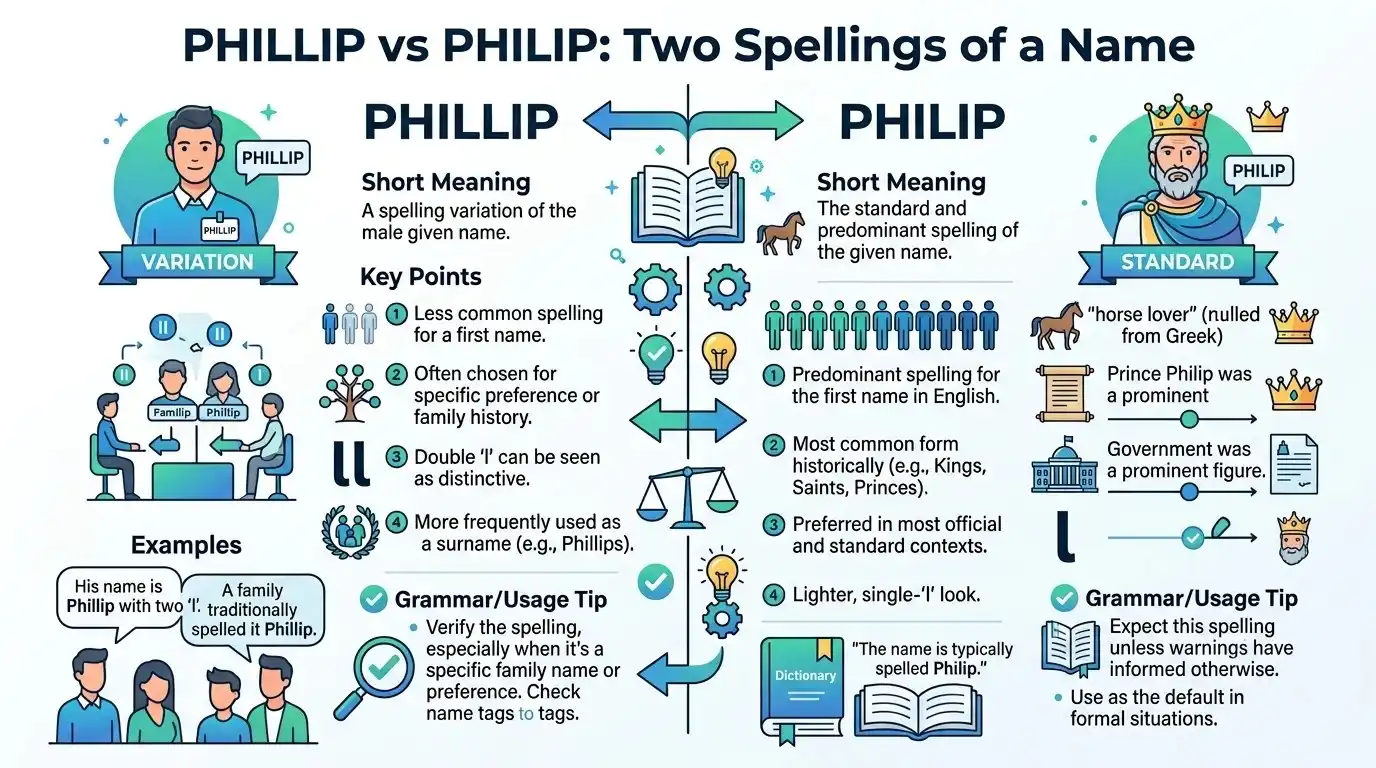
You meet someone new, or you’re filling out a form, and you need to spell this name. Is it “Philip” with one L, or “Phillip” with two? Both look right. Both sound the same. And here’s the twist: unlike a lot of word mix-ups, this one doesn’t have a single “correct” answer.
People search “Phillip or Philip” because this name shows up everywhere, in history books, movies, and daily life, and it’s spelled two different ways depending on the person. This isn’t like a typo, where one version is wrong. Both spellings are real and both are used by real people all over the world.
Here’s the simple truth: “Philip” is the older, more classic spelling, with just one L. “Phillip” is a common variant spelling, with two L’s, and it’s just as valid, just newer and less traditional.
This isn’t about British versus American English. Both spellings show up in every English-speaking country. It simply comes down to family choice, personal taste, or how a specific person’s name was spelled at birth.
In this article, you’ll learn where this name comes from, how the two spellings developed, and how to know which one to use for a specific person.
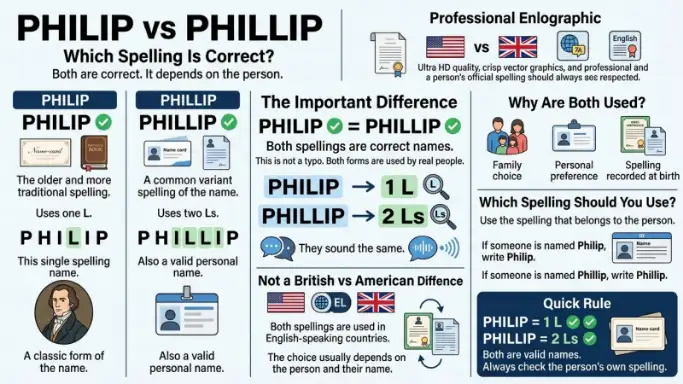
Phillip or Philip – Quick Answer
- Philip = the older, more traditional spelling, with one L Example: “Prince Philip served in the Royal Navy.”
- Phillip = a common variant spelling, with two L’s Example: “Phillip Schofield is a well-known TV host.”
Both are correct as personal names. The right one depends entirely on how that specific person spells their own name.
Where Does This Name Come From?
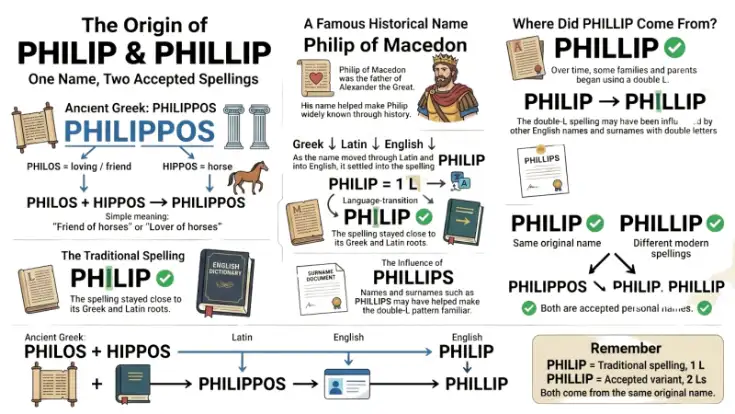
Both spellings come from the same original name. “Philip” comes from the Greek name Philippos, made up of two parts: philos, meaning “loving” or “friend,” and hippos, meaning “horse.” Put together, it roughly means “friend of horses” or “lover of horses.”
This name became very well known through history, especially through Philip of Macedon, the father of Alexander the Great. As the name moved through Latin and then into English, it settled into the spelling “Philip,” with just one L, matching its Greek and Latin roots closely.
Over time, some families and parents started spelling the name with a double L, “Phillip,” possibly influenced by other English names and surnames that use double letters, like “Phillips” as a last name. This gave us a second accepted spelling that many people now use.
Is This a British vs American Spelling Difference?
No, and this is an important point to clear up. Unlike words such as “colour/color” or “traveled/travelled,” this isn’t a regional spelling split. Both “Philip” and “Phillip” are used as personal names in the US, UK, Australia, Canada, and everywhere else English is spoken.
| Spelling | Status | Example Use |
| Philip | Classic, traditional spelling | Prince Philip, Philip of Macedon |
| Phillip | Common variant spelling | Phillip Schofield, many modern given names |
| Philips | Common last name (single L) | A well-known electronics company |
| Phillips | Common last name (double L) | A common surname, seen worldwide |
Which Spelling Should You Use?
Since this is a personal name, not a general word, the right answer depends on the actual person you’re writing about or talking to.
If you’re writing to or about a specific person: Always use the spelling that person uses for their own name. This is the single most important rule here. Check an email signature, an ID, or simply ask them directly.
If you’re naming a character in a story, or choosing a baby name: Either spelling works. “Philip” often feels more classic and historical, while “Phillip” can feel slightly more modern, though this is really just personal taste.
If you’re writing about a historical figure: Check the standard spelling used in history books, since well-known figures often have one commonly accepted version, like “Philip of Macedon” or “Prince Philip,” almost always spelled with one L.
Common Mistakes with Phillip and Philip
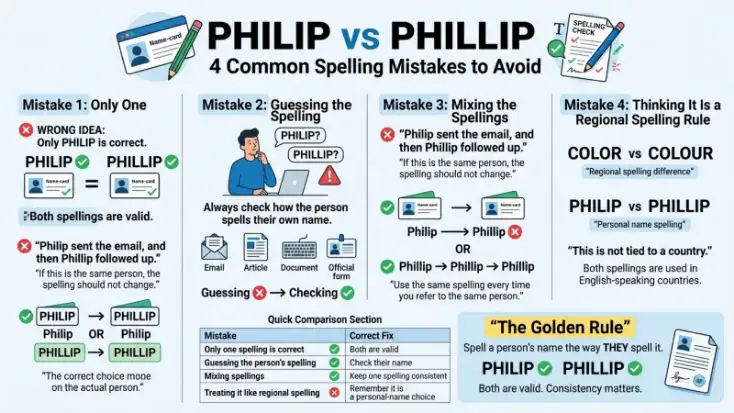
Mistake 1: Assuming there’s only one correct way to spell this name. Fix: Remember, both spellings are valid. The right one depends on the actual person.
Mistake 2: Misspelling a specific person’s name by guessing instead of checking. Fix: Always double check how that person spells their own name before writing it in an email, article, or document.
Mistake 3: Mixing up spellings within the same piece of writing. Wrong: “Philip sent the email, and then Phillip followed up.” (if referring to the same person) Right: Use the same spelling every time you refer to the same person.
Mistake 4: Assuming this follows the same rule as “color/colour” style regional spelling. Fix: This isn’t tied to any country. It’s simply two accepted forms of the same personal name.
Phillip and Philip in Everyday Examples
In emails: “Hi Philip, thanks for your quick reply.” “Hi Phillip, looking forward to our meeting.”
In news: “Prince Philip was known for his decades of public service.” “Phillip Schofield hosted the morning show for many years.”
In social media: “Happy birthday to my brother Philip! ” “Shoutout to my coworker Phillip for helping me today.”
In formal writing: “Philip of Macedon expanded his kingdom through strategic alliances.” “Mr. Phillip Anderson will be joining the board this year.”
Phillip or Philip – Google Trends & Usage Data
Search data shows steady interest in both spellings, often tied to specific famous people rather than the word itself. “Philip” tends to get strong search interest around historical topics and royal family news, since well-known figures like Prince Philip use this spelling. “Phillip” often gets searched alongside modern public figures, TV hosts, and everyday personal name searches.
Since this is a name, not a general vocabulary word, search interest depends heavily on which famous “Philip” or “Phillip” is currently in the news, rather than any steady pattern by country. Both spellings remain common as baby names and are used at fairly similar rates across English-speaking countries.
| Keyword Variation | Common Association | Notes |
| Philip | Historical figures, royalty | Classic, single L spelling |
| Phillip | Modern public figures, general names | Common variant, double L |
| Philips | Last name, brand name | Single L version |
| Phillips | Common last name | Double L version, widely used |
Frequently Asked Questions
1. Which spelling is more common, Philip or Phillip? Both are common, though “Philip” is often seen as the more traditional, classic version, especially for historical figures.
2. Is one spelling British and the other American? No. Both spellings are used across the US, UK, and other English-speaking countries. This is not a regional spelling difference.
3. How do I know which spelling to use for someone’s name? Always check how that specific person spells their own name, through an email signature, ID, or by simply asking.
4. Why does Prince Philip’s name have only one L? This follows the classic, traditional spelling of the name, closely tied to its Greek and Latin origin.
5. Can I choose either spelling for a baby name? Yes. Both spellings are widely accepted and used for naming children today.
6. What does the name Philip actually mean? It comes from Greek, meaning roughly “friend of horses” or “lover of horses.”
7. Is “Phillips” the same as “Philip’s”? No. “Phillips” (no apostrophe) is usually a last name. “Philip’s” (with an apostrophe) shows something belongs to someone named Philip, like “Philip’s book.”
A Simple Way to Remember the Difference
Here’s an easy trick. Think about the word “friend” hiding in the meaning of this name, since Philip means “friend of horses.” Now picture the classic, old version, “Philip,” as the one tied to old kings and old stories, like Philip of Macedon. That one keeps things simple, with just one L, matching its old Greek roots.
“Phillip,” with the extra L, feels newer, like a fresh take on an old name. Many parents today pick this version simply because they like the look of it, not for any deep reason. There’s no rule saying one version is smarter or more correct than the other. It’s really just a personal pick, passed down in families or chosen fresh for a new baby.
If you ever forget which one a person uses, the safest move is always to check. Look at how they sign their name, spell it on a form, or write it in an email. That one small check saves you from an awkward mix-up.
Famous People With Each Spelling
Seeing real names can help this stick in your mind.
People named Philip (one L):
- Prince Philip, Duke of Edinburgh
- Philip of Macedon, ancient king and father of Alexander the Great
- Philip Roth, well-known author
People named Phillip (two L’s):
- Phillip Schofield, TV host
- Phillip Island, a place name in Australia
- Many everyday people who go by this spelling as their given name
Notice how older historical names tend to lean toward “Philip,” while more modern names go either way. This isn’t a strict rule, just a general pattern you might notice.
Conclusion:
“Philip” and “Phillip” are both correct spellings of the same classic name. “Philip,” with one L, is the older, more traditional version, closely tied to its Greek roots. “Phillip,” with two L’s, is a common variant spelling that many people use today.
This isn’t a British versus American spelling issue. Both versions are used across every English-speaking country. The real rule here is simple: always use the spelling that the actual person prefers for their own name.
Whether you’re writing about a historical figure, a coworker, or naming a new baby, both spellings are valid choices. Just remember to stay consistent once you know which version fits the person you’re writing about.

Ethan Carter is a language writer at Wordellect who helps readers understand word differences, grammar rules, and spelling variations through simple and accurate guides.







