You see a nice place online. It looks great. Now you ask: should I rent this place? Or should I save up and buy a home instead? This is one of the biggest money choices people make in life.
People search “buying or renting” because both choices have good parts and hard parts. Buying can feel like a big, grown-up step. Renting can feel like you are not building anything for later. But neither choice is right for everyone. The best choice depends on your money, your life plans, and where you live.
This mix-up can cause stress. Some people feel pushed to buy a home, even if it is not the right time for them. Other people rent for years and never check if buying could actually save them money.
This guide will help make things clear. You will learn:
- The quick, easy answer
- A short history of renting and buying
- How housing words differ in the US and UK
- Which choice might fit your life
- Common mistakes people make
- Real examples and search trends
By the end, you will feel more sure about this big choice. Let’s start.
Buying or Renting – Quick Answer
Here is the short answer.
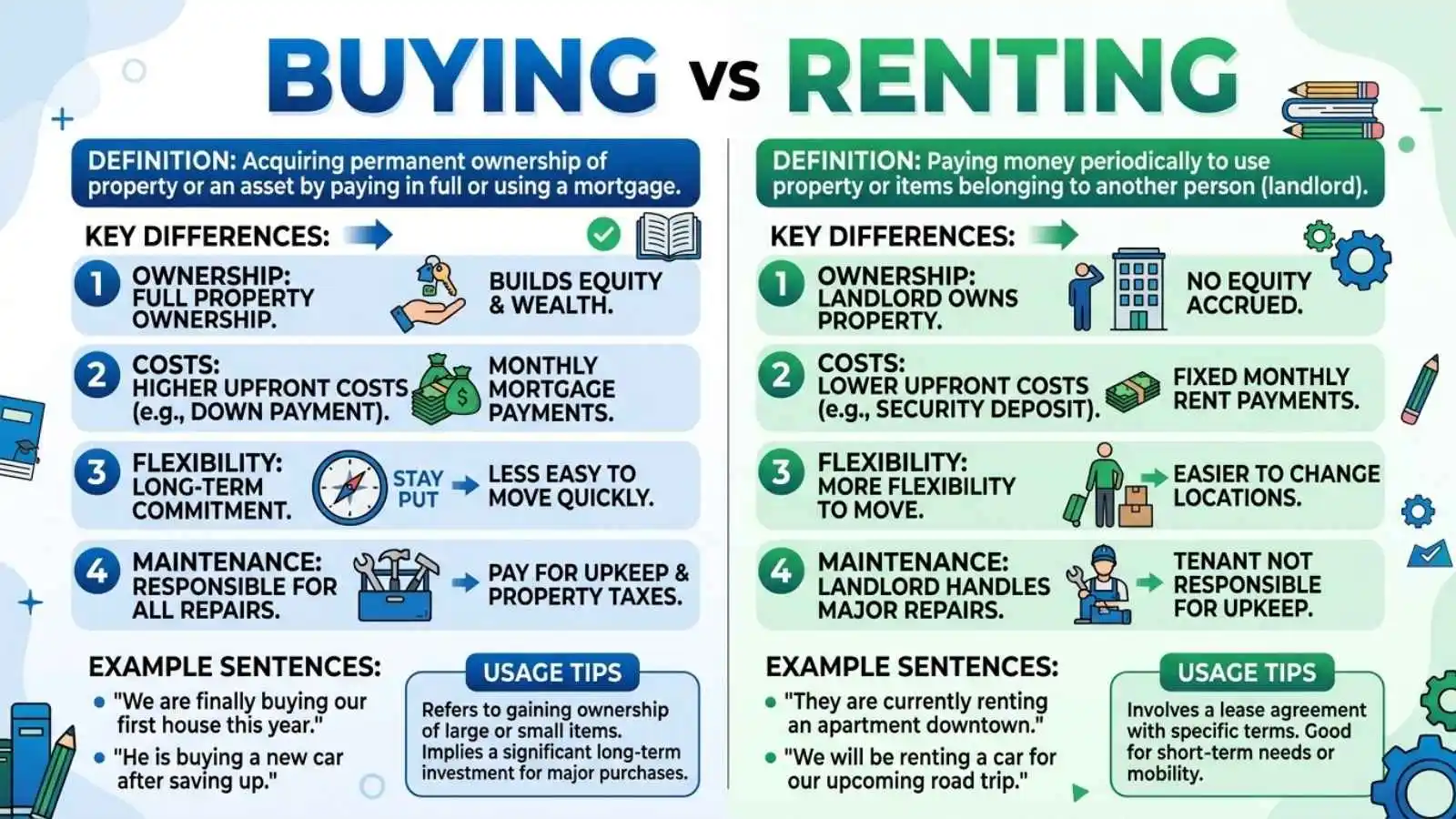
Renting means you pay an owner each month to live in a home. You do not own it. You can usually move out more easily when your lease ends.
Buying means you pay for a home, often using a loan called a mortgage. Over time, you build ownership. But you also take on more jobs, like fixing things and paying property taxes.
Example: “She kept renting her place, since she might move to a new city next year.”
Example: “After years of saving, he finally bought his first home.”
So the quick rule is:
- Want to move easily and skip repair costs? Renting may fit better.
- Want to build ownership and plan to stay for years? Buying may fit better.
There is no one right answer for everyone. It depends on your money, your goals, and your stage of life.
The Origin of Buying or Renting
Both renting and buying go back thousands of years. They started long before today’s homes and apartments existed.
Renting land is one of the oldest housing setups in history. Long ago, farmers often rented land from rich landowners. They paid with crops or coins. This setup kept going through the Middle Ages in Europe, where many people rented small homes or farmland from local lords.
Buying property, the way we know it today, grew as countries built stronger laws. Rules about land grew firmer in Europe and later in early America. Over time, banks began giving out loans, called mortgages, to help everyday people buy homes instead of paying the full price all at once.
The word “rent” comes from an old French word, “rente.” It meant a payment owed again and again. The word “buy” comes from Old English. It meant to pay for or trade for something. Both words have stayed close to their old meanings for a long time.
British English vs American English Terms
Buying and renting are not really a spelling issue, like “color” and “colour.” Both words are spelled the same in the US and UK. But the words used around housing often change a lot between the two countries. This can be confusing, especially when reading home listings from another place.
Here is a simple table to show some common differences:
| American Word | British Word | What It Means |
| Apartment | Flat | A home inside a bigger building |
| Renting agent | Letting agent | A person who helps you rent a home |
| Landlord | Landlord | The owner who rents out the home (same word in both) |
| Real estate agent | Estate agent | A person who helps you buy or sell a home |
| First floor | Ground floor | The floor at street level |
| Closing (on a home) | Completion | The last step of buying a home |
So while “buying” and “renting” stay the same everywhere, the words around housing can shift a lot, based on where you live. This is good to know when reading home listings from another country.
Which Choice Should You Make?
This is where your own life matters most. There is no one answer that works for everyone.
- If you live in the US: Loan rules, taxes, and home prices change a lot by state and city. Many money experts say to compare your monthly rent to what a loan payment would cost in your area, including taxes and insurance.
- If you live in the UK or other Commonwealth places: Renting (sometimes called “letting”) is common in big cities. Buying is often seen as a long-term goal, once someone feels settled with money. A tax called stamp duty also adds to the cost of buying in the UK.
- If you are looking at this from a global view: Look at local loan rates, home prices compared to local pay, and how long you plan to stay. Buying often makes more sense if you plan to stay in one home for many years. Renting often makes more sense if you might move soon, or if home prices are very high compared to rent in your area.
This article gives general facts only. It is not money advice made just for you. A financial advisor or housing helper can look at your own numbers and goals before you make a final choice.
Common Mistakes with Buying or Renting
Let’s look at common mistakes people make with this big choice.
- Thinking renting is always “wasting money.” This is not always true. Renting can be the smarter money choice in some cities, especially where home prices are very high compared to rent.
- Forgetting extra costs when buying. Many first-time buyers forget about property taxes, repair costs, insurance, and closing fees. These add up fast and should be planned for early.
- Rushing to buy because others say so. Some people buy a home just because friends or family say it is “time,” even if it does not fit their own money plan or life right now.
- Not thinking about how long you will stay. Buying usually only pays off if you plan to stay for several years. Moving again soon after buying can cause a money loss, due to selling costs and fees.
- Thinking renting means saving zero money. Many renters still save money each month, especially if rent costs less than a loan payment with taxes and insurance added in.
- Not learning local housing words before reading listings from other countries. If you look at homes in another country, words like “flat,” “letting agent,” or “completion” can be confusing if you do not know them yet.
Buying or Renting in Everyday Examples
Let’s look at how these words show up in daily life and writing.
In a casual text message: “Still can’t decide, buying or renting feels like such a big choice honestly.”
In a news headline: “More Young Adults Choosing Renting Over Buying as Home Prices Rise”
On social media: “Renting right now so I can save up for a home later. No shame in that “
In a formal email: “As we talked about, we suggest comparing local rent prices to loan estimates before making your final choice.”
In a money report: “This quarter’s numbers show more buyers aged 25 to 34 choosing to rent, likely due to higher loan rates.”
In a real estate listing: “This flat is open for renting now, with a chance to talk about buying later.”
In a personal blog post: “After three years of renting, we finally feel ready to start buying our first home.”
Notice how “buying” and “renting” stay spelled the same everywhere. But the words around them can shift, based on the setting and the country.
Buying or Renting – Google Trends & Usage Data
People search “buying or renting” a lot, especially when home prices or loan rates change fast.
In the United States, search interest often goes up when loan rates rise. Many people search this term while trying to figure out if renting makes more sense during times of high rates.
In the United Kingdom, search interest often ties to home costs in cities like London, where renting is very common due to high home prices. Many younger UK readers search this term while planning long-term savings goals.
In Australia, Canada, and other English-speaking places, this search term often spikes among young workers and new graduates trying to plan their first big housing choice.
Across all these places, the search data shows one clear pattern. People are not just looking for a fast answer. They want real guidance, since this choice affects savings, monthly budgets, and how they live.
Keyword Variation Comparison Table
| Word or Term | Common Region | What It Usually Means |
| Buying a home | Worldwide | Paying for a home, often with a loan |
| Renting | Worldwide | Paying each month to live in a home you do not own |
| Letting | UK, Ireland | British word, close in meaning to renting |
| Mortgage | US, UK, worldwide | A loan used to buy a home |
| Leasing | US | Often used for apartments or cars, close to renting |
| Down payment | US | Money paid upfront when buying a home |
| Deposit | UK | British word, close to a down payment or safety deposit |
FAQs:
1. Is buying always better than renting? No. It depends on your pay, local home prices, how long you plan to stay, and your own goals. Both choices can be smart, based on your life.
2. How long should I plan to stay in a home before buying makes sense? Many experts say to plan for at least five years. This helps cover the costs of buying and later selling. This can change based on the local market.
3. Is renting “wasting money”? Not always. Renting can be a smart choice if it helps you save money, stay free to move, or skip high home prices in your area.
4. What extra costs come with buying a home? Common extra costs are property taxes, home insurance, repair costs, and closing fees. Plan for these ahead of time.
5. Is “renting” the same as “letting” in the UK? Yes. “Letting” is the British word often used for renting out a home. “Renting” describes paying to live somewhere.
6. Should I talk to a money expert before deciding? Yes, especially for a choice this big. A financial advisor or housing helper can look at your full money picture and help you compare your choices clearly.
7. Does the right choice change based on the country I live in? Yes. Home costs, loan rules, taxes, and renting markets change a lot between countries, and even between cities in the same country.
8. Can I switch from renting to buying later? Yes. Many people rent for years while saving for a home, then switch to buying once they feel ready with their money.
Conclusion:
Let’s wrap up everything we learned today.
There is no single right answer between buying or renting. Both choices come with real good parts and real costs. Buying can help you build long-term ownership, but it comes with extra costs like taxes, repairs, and insurance. Renting gives you more freedom and fewer surprise costs, but it does not build ownership over time.
The right choice depends on your pay, your local housing market, and how long you plan to stay in one place. It also depends on where you live, since housing words and costs can change a lot between countries like the US and UK.
Before making a big choice like this, take time to look at your full money picture. Compare local rent prices to loan cost guesses, and think honestly about your future plans. Talking to a financial advisor or housing helper can also help you feel more sure about your final choice.








