You’re writing a text. “I’ll call you latter today.” Wait, that looks wrong. Or is it “later”? These two words look so close, it’s easy to type the wrong one without even noticing.
Let’s fix this one for good, in plain, easy words.
Quick Answer
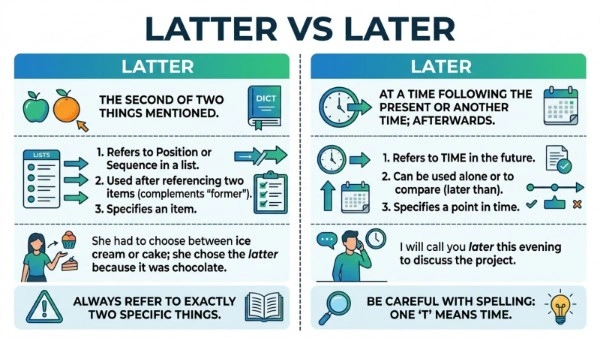
Later means at a time after now. Example: “I’ll call you later today.”
Latter means the second one of two things you just talked about. Example: “You can have pizza or salad, I’ll take the latter,” meaning salad, the second one you named.
Simple way to remember it: later is about time. Latter is about order, the second thing in a list of two.
Why These Two Words Look So Close
Both words come from the same old root, the word “late.” That’s really the whole reason they look and sound so similar.
“Later” is just the normal way to compare something in time, like “sooner” or “later,” the same way “fast” becomes “faster.” It always points to something happening after the moment you’re in now.
“Latter” grew from the same root too, but took on a different job over hundreds of years. Instead of talking about time, it settled into talking about order, specifically about the second of two things already named. It’s tied to an old word pattern where “the latter” simply meant “the later one of the two,” which slowly became its own fixed meaning about order, not time.
So while they share a family tree, these two words ended up doing two very different jobs in a sentence.
Breaking Down the Real Difference
| Later | Latter | |
| What it’s about | Time, something happening after now | Order, the second of two things named |
| Type of word | Adverb (tells you when) | Adjective or pronoun (points to the second item) |
| Example | “See you later tonight.” | “Between coffee and tea, I prefer the latter.” |
| Needs two things listed first? | No | Yes, almost always |
A Simple Way to Check Yourself
Ask this: am I talking about time, or am I pointing back to the second of two things I just named?
If it’s about time, something happening after now, you want “later.”
If you already listed two things, and you’re now pointing to the second one, you want “latter.”
Try It Yourself
Guess the right word before checking the answer.
- “I’ll finish this project ___ this week.” → later
- “Between the red shirt and the blue one, I like the ___ better.” → latter
- “Can we talk about this ___, I’m busy right now?” → later
- “She had two job offers, and chose the ___ one.” → latter
- “See you ___, I’m heading out now.” → later
If most of these felt clear, you already know this pair better than you thought.
When Each Word Actually Fits
Talking about something happening after now: Use “later.” Example: “We can grab lunch later, once I’m done with this call.”
Pointing to the second of two things you just named: Use “latter.” Example: “You could go for a walk or watch TV, I’d pick the latter.”
Ending a casual message or text: Almost always “later.” Example: “Talk to you later!”
Writing something more formal, comparing two options: “Latter” fits here, especially in writing that already named two clear choices. Example: “The two plans were solid, though the latter option saved more money.”
Trying to sound casual and friendly: Stick with “later.” “Latter” tends to sound more formal and is rarely used in relaxed, everyday talk.
Common Mistakes People Make
Typing “latter” when you actually mean “later.” This is the most common slip, mostly because the words look and sound so close, and it’s an easy typo to miss while writing fast.
Using “latter” without naming two things first. “Latter” only makes sense if you’ve already listed two clear options. Using it without that setup leaves the reader confused about what you’re even pointing to.
Trusting spellcheck to catch it. Since both words are spelled correctly on their own, spellcheck often won’t flag this mistake, even when it’s the wrong choice for your sentence.
Overusing “latter” in casual writing. It’s not wrong, but it can feel stiff or overly formal in texts or everyday chats, where “later” almost always fits the mood better.
Seeing These Words in Real Life
A text to a friend: “Can’t talk now, catch you later!”
A work email: “Between the two vendors, we’ve decided to go with the latter.”
Casual goodbye: “Alright, I’m heading out, talk later.”
A formal report: “Two plans were proposed, and the latter was approved by the board.”
A quick reminder: “Don’t forget, we’re meeting later this afternoon.”
Why People Search This So Often
Writers and students search “latter or later” a lot while typing quickly, pausing right before they commit to one spelling in an email, text, or paper.
People learning English search this pair too, since the two words look so close but do such different jobs in a sentence, which can feel confusing without a clear, simple explanation.
This mix-up shows up the same way everywhere English is written, since it comes down to spelling and meaning, not any regional style or accent.
A Few More Word Pairs Like This
| Pair | Meaning 1 | Meaning 2 |
| Latter / Later | The second of two things | A time after now |
| Former / Latter | The first of two things | The second of two things |
| Farther / Further | Physical distance | Extra amount or degree |
| Then / Than | Time or sequence | Comparing two things |
Common Questions
Can “latter” be used with more than two things? Not really. “Latter” is meant to point to the second of exactly two things. If you’re talking about three or more things, “last” is usually the better word instead.
Is “latter” used much in everyday talk? Not that often. It shows up more in writing, especially formal writing, than in casual, spoken conversation.
What’s the opposite of “latter”? “Former.” If “latter” points to the second of two things, “former” points to the first one.
Why does spellcheck never catch this mistake? Because both “later” and “latter” are real, correctly spelled words on their own. Spellcheck only flags words that don’t exist, not words used in the wrong spot.
Can “later” ever mean the same as “latter”? No, they stay separate in meaning. “Later” always deals with time, while “latter” always deals with pointing to the second of two named things.
How can I remember the difference quickly? Try this: “later” has one “t,” like a single point in time. “Latter” has two “t’s,” which can help remind you it’s about the second of two things.
Is this a British versus American English issue? No, not at all. Both words work the exact same way in British and American English. This is purely a spelling and meaning mix-up, not a regional difference.
Wrapping This Up;
“Later” and “latter” share the same root word, but they do very different jobs today. “Later” is all about time, something happening after right now. “Latter” is all about order, pointing to the second of two things you already named.
A quick way to check yourself: if you’re talking about when something happens, go with “later.” If you’ve listed two things and you’re now pointing back to the second one, “latter” is what you need.
Once this small difference clicks, you’ll stop second-guessing this one, whether you’re writing a quick text or something more formal.

Ethan Carter is a language writer at Wordellect who helps readers understand word differences, grammar rules, and spelling variations through simple and accurate guides.







