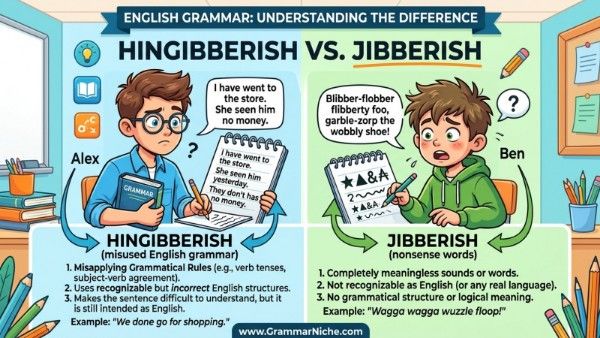
Have you ever seen the word gibberish and wondered if it should be spelled jibberish? This is a common spelling question. The two words look almost the same, and both may appear in casual writing. However, there is an important difference. Gibberish is the standard and accepted spelling. Jibberish is usually considered a misspelling or a nonstandard form.
The word gibberish describes speech or writing that is hard to understand or has no clear meaning. For example, if someone talks very fast and you cannot understand the words, you might say, “He was speaking gibberish.” It can also describe text that looks like words but does not make sense.
People often search for gibberish or jibberish because the sound of the word can make the spelling confusing. The first sound can sound like a soft “j,” which may lead people to write jibberish.
In this guide, we will explain the correct spelling, its history, common mistakes, everyday examples, and when to use the word.
Gibberish or Jibberish – Quick Answer
Gibberish is the correct standard spelling.
Jibberish is generally considered a misspelling and should be avoided in standard English.
Correct
I could not understand what he was saying. It sounded like gibberish.
Incorrect
I could not understand what he was saying. It sounded like jibberish.
The word gibberish means speech or writing that is difficult or impossible to understand. It can also mean meaningless or unintelligible language.
For example:
The child was talking gibberish.
This computer code looks like gibberish to me.
His message was complete gibberish.
The key point is simple:
Gibberish = correct
Jibberish = usually incorrect
Unlike some English word pairs, this is not mainly a British English versus American English difference. Gibberish is the standard form in both major varieties of English.
The Origin of Gibberish or Jibberish
The word gibberish has an interesting history.
The exact origin is not completely certain. One common theory connects the word with Geber, the name of a famous medieval alchemist. His Arabic name was associated with Jābir ibn Hayyān, who was known in Europe as Geber.
According to this theory, people began using a form of the name to describe mysterious or difficult language used in alchemy. However, this explanation is not certain. Major dictionaries note that the exact origin of gibberish is unclear.
Another possible connection is the verb gibber, which means to speak quickly in a way that is difficult to understand.
The verb gibber appeared before the noun gibberish became common. The word may have developed from the idea of making meaningless or unclear sounds.
The important point for spelling is that the standard English form became:
gibberish
There is no standard spelling change from g to j.
This is why jibberish is not normally used in formal English.
Why Do People Spell It “Jibberish”?
The mistake probably comes from pronunciation.
The g in gibberish has a soft sound, similar to the sound of j in words such as:
- giant
- gym
- general
- giraffe
Because of this pronunciation, some people naturally spell the word as jibberish.
English has many words where pronunciation does not make spelling easy. Gibberish is one of them.
British English vs American English Spelling
Unlike words such as colour/color or centre/center, gibberish does not have two standard regional spellings.
Both British English and American English normally use:
gibberish
The spelling jibberish is not the standard spelling in either variety.
| English variety | Standard spelling | Example |
| British English | gibberish | That sounds like gibberish. |
| American English | gibberish | That sounds like gibberish. |
| Canadian English | gibberish | The message was gibberish. |
| Australian English | gibberish | He was talking gibberish. |
| New Zealand English | gibberish | The text looks like gibberish. |
| Formal international English | gibberish | The document contains gibberish. |
Is Jibberish Ever Correct?
In normal English writing, jibberish is not the standard form.
You may sometimes see it in informal posts, comments, usernames, jokes, or other casual content. However, that does not make it the accepted spelling.
If you are writing an essay, email, article, report, or professional document, use gibberish.
Which Spelling Should You Use?
The answer is easy.
Use “gibberish”
Use gibberish in:
- School assignments
- University writing
- Business emails
- Websites
- News articles
- Formal documents
- Social media
- Everyday conversation
- Professional writing
Examples:
The instructions were complete gibberish.
I received a message full of gibberish.
The report contained several lines of gibberish.
What About US English?
American English uses gibberish.
Example:
I tried to read the note, but it was just gibberish.
What About UK English?
British English also uses gibberish.
Example:
I could not understand the letter because it was full of gibberish.
So, you do not need to choose based on the country.
Gibberish works in both British and American English.
Common Mistakes with Gibberish or Jibberish
Mistake 1: Writing “jibberish”
This is the most common spelling mistake.
Incorrect:
The message was complete jibberish.
Correct:
The message was complete gibberish.
Remember the first letter:
Gibberish starts with G.
Mistake 2: Thinking the spelling changes by country
Some English words have different British and American spellings.
For example:
colour / color
But gibberish is not one of them.
Both British and American English use gibberish.
Mistake 3: Confusing “gibberish” with “gibber”
The words are related, but they are used differently.
Gibber is usually a verb:
He began to gibber nervously.
Gibberish is usually a noun:
He was speaking gibberish.
Mistake 4: Using “gibberish” for every difficult word
Something can be difficult without being gibberish.
For example, a science book may contain hard words, but that does not mean it is gibberish.
Gibberish usually suggests that the words or message do not make sense or cannot be understood.
Gibberish or Jibberish in Everyday Examples
The word gibberish is common in everyday English.
1. In Emails
You might write:
The attachment opened as gibberish. Could you please send it again?
This can happen when a file uses the wrong format or encoding.
2. In News
A news report might say:
The document appeared to contain pages of gibberish.
This means the text could not be understood.
3. On Social Media
People often use gibberish in a casual way:
What are you even saying? This is gibberish
Here, the word means that something does not make sense.
4. In Formal Writing
You can also use gibberish in formal writing when it is suitable.
For example:
The damaged file contained several pages of unreadable gibberish.
5. When Talking About Speech
The baby was making happy sounds that sounded like gibberish.
He was so nervous that his answer came out as gibberish.
6. When Talking About Writing
I opened the file, but the text appeared as gibberish.
The note was written in a way that looked like gibberish.
Gibberish or Jibberish – Comparison Table
| Word | Correct? | Meaning | Usage |
| gibberish | Yes | Meaningless or hard-to-understand speech or writing | Standard English |
| jibberish | Usually no | Intended to mean gibberish | Common misspelling |
| gibber | Yes | Speak quickly or unclearly | Verb |
| gibbering | Yes | Speaking quickly or unclearly | Verb form |
| gibberish language | Yes | Language that is meaningless or unclear | Descriptive phrase |
The main spelling rule is easy:
Always choose gibberish in standard English.
Gibberish or Jibberish – Google Trends & Usage Data
People search for gibberish or jibberish because the incorrect spelling is easy to create from the way the word sounds.
The pronunciation can make the first letter confusing. The soft g sound in gibberish is similar to a j sound. This can lead people to type jibberish when searching online.
However, dictionary usage supports gibberish as the standard form.
Search interest can vary by country and by context. Gibberish is widely used in English-speaking countries, including the United States, United Kingdom, Canada, and Australia.
The word is also common online because people use it to describe:
- Random text
- Broken text
- Unclear messages
- Strange computer output
- Meaningless speech
- Confusing writing
- Nonsense
The spelling jibberish may appear in searches because people are checking whether it is correct. This makes gibberish or jibberish a useful search phrase for people who want a quick spelling answer.
For SEO, it is useful to mention both forms naturally. However, the correct form should remain the main keyword throughout the article.
Gibberish vs Nonsense
Gibberish and nonsense are close in meaning, but they are not always identical.
He was speaking gibberish.
Nonsense can describe an idea, statement, or claim that makes no sense.
That idea is nonsense.
You can also say:
The article was full of nonsense.
But:
The article was full of gibberish.
suggests that the actual language or text was difficult to understand or meaningless.
Gibberish vs Babble
Babble can mean talking quickly and without much meaning.
For example:
He started to babble when the teacher asked him a question.
Gibberish focuses more on speech or writing that cannot be understood.
For example:
The recording was mostly gibberish.
These words can overlap, but they are not always interchangeable.
Is Gibberish a Noun or an Adjective?
Gibberish is mainly used as a noun.
For example:
The message is gibberish.
I cannot understand this gibberish.
It can also appear before another noun:
gibberish text
gibberish language
But gibberish is not normally used as a standard adjective in the same way as words such as meaningless or unclear.
FAQs ;
1. Is it gibberish or jibberish?
Gibberish is the standard and correct spelling. Jibberish is usually a misspelling.
2. Is gibberish British or American?
Gibberish is used in both British and American English. There is no standard British spelling called jibberish.
3. What does gibberish mean?
Gibberish means speech or writing that is difficult or impossible to understand. It can also mean meaningless language.
4. Why do people spell gibberish with a J?
The mistake likely comes from pronunciation. The g in gibberish has a soft sound that is similar to the sound of j.
5. Is jibberish a real word?
You may find jibberish in informal writing, but it is not the standard spelling. In normal English, use gibberish.
6. Is gibberish a formal word?
Yes. Gibberish is a standard English word. It can be used in both casual and formal writing when its meaning fits.
7. What is the difference between gibberish and nonsense?
Gibberish often describes speech or writing that cannot be understood. Nonsense usually describes an idea, statement, or claim that makes no sense.
Conclusion;
When choosing between gibberish or jibberish, the answer is simple: use gibberish. It is the standard spelling in English. Jibberish is usually a spelling mistake, even though many people write it because of the way gibberish sounds.
The word gibberish describes speech or writing that is unclear, meaningless, or difficult to understand. It can be used for strange speech, broken text, confusing messages, or writing that makes no sense.
Unlike some English spelling differences, this word does not change between British and American English. Both use gibberish.
If you are writing an email, school assignment, article, report, or social media post, choose gibberish. You can remember the spelling with one simple rule:
Gibberish starts with G, not J.
Once you remember this, you will not need to worry about jibberish again. When in doubt, choose gibberish, the standard form accepted in modern English.

Ethan Carter is a language writer at Wordellect who helps readers understand word differences, grammar rules, and spelling variations through simple and accurate guides.







