You need to pick who goes first. Someone pulls out a coin and says, “Heads or tails?” You’ve said this a hundred times in your life. But do you know what “heads” and “tails” really mean, or why we even call it that?
Let’s slow down and look at this simple, everyday phrase.
Quick Answer
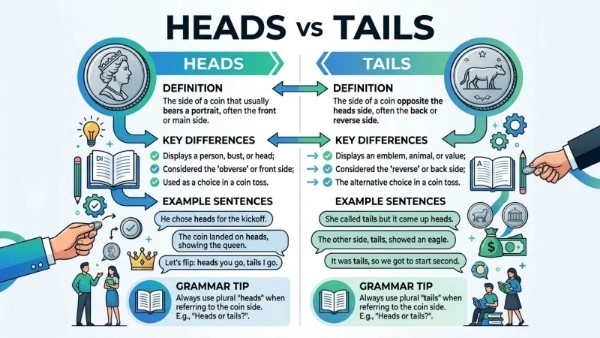
The head is the side of a coin that shows a person’s face, most times a leader or a famous person from the past.
Tails is the other side. It does not show a face. It often shows a building, a symbol, or some other picture, not a face at all.
Simple way to think about it: heads has a face on it. Tails does not.
Why We Call It “Heads” and “Tails”
This name is old, and it comes straight from what you actually see on the coin.
Long ago, coins were made with a king’s or leader’s face on one side. People just started calling that side “heads,” since, well, it shows a head. Simple as that.
The other side did not have a face at all. Early coins often had a picture of an animal on the back, and one old idea says people used to say “tails” because some coins showed an animal with a tail on that side. Over time, “tails” just became the name for the side with no face, no matter what picture was actually on it.
So this word pair is not fancy at all. It just describes exactly what people saw when they looked at old coins, and the names stuck around for hundreds of years.
Breaking Down the Difference
| Heads | Tails | |
| What’s shown | A person’s face | A building, symbol, or picture, no face |
| Why the name | Shows a “head” | Comes from old coins, no clear face side |
| Example (US coin) | George Washington’s face | An eagle or a building |
| Used in | Coin flips, games, quick choices | Coin flips, games, quick choices |
When People Use “Heads or Tails”
Picking who goes first in a game: This is the most common use. One person flips a coin, the other calls “heads” or “tails” before it lands.
Making a quick, fair choice between two options: When two people can’t agree, a coin flip feels fair to both sides, since no one can control which way it lands.
Sports and games: Many sports use a coin flip to decide who kicks off first, or who picks a side of the field.
Just for fun: Sometimes people flip a coin just because they can’t decide something small, like who picks the movie tonight.
Try It Yourself
See if you already know the answer before checking.
- Which side usually shows a leader’s face? → Heads
- Which side often shows a building or symbol? → Tails
- What do you call it when a coin is flipped to make a fair choice? → A coin flip, and you call “heads” or “tails”
- If a coin lands showing a face, what did it land on? → Heads
- If a coin lands showing no face at all, what did it land on? → Tails
If that felt easy, you already know this phrase better than you thought.
A Simple Way to Remember It
Just picture a real coin in your hand. Flip it over. One side has a person’s face looking back at you, that’s heads. Flip it again, and the other side shows something else, no face at all, that’s tails.
That’s really the whole trick. No need to memorize anything more than that.
Common Small Mix-Ups
Thinking every coin’s tails side looks the same. It doesn’t. Different coins and different countries put all kinds of pictures on the tails side, buildings, animals, symbols, and more. The only rule is, it’s not a face.
Forgetting some coins can be tricky to call. A few old or special coins have two different pictures, and neither one is a clear “head.” In these rare cases, people just agree beforehand which side counts as heads.
Thinking a coin flip is not truly fair. Most people agree a normal coin flip is close enough to fair for everyday use, even though a coin can, in very rare cases, land on its edge.
Seeing This Phrase in Everyday Life
Before a football game: “The referee flips a coin, heads or tails, to decide who kicks off.”
A quick decision between friends: “Let’s just flip a coin, heads or tails, to pick the restaurant.”
kid’s game: “Heads or tails, winner picks the next game.”
A saying about luck: “Life’s a coin flip sometimes, you never know if it’s heads or tails.”
A casual choice at home: “I can’t decide, let’s just go heads or tails on it.”
Why People Search This
Parents and teachers search “heads or tails” a lot while helping kids understand this common saying, especially before playing simple games together.
People learning English search this phrase too, since it’s used so often in everyday talk, but it’s not always clear at first what it actually means without seeing a real coin.
Sports fans and coaches also search this, mostly while explaining pre-game rules to newer fans who might not know why a coin flip happens before kickoff.
A Few Related Coin Words
| Word | What It Means |
| Heads | The side with a face on a coin |
| Tails | The side without a face on a coin |
| Coin flip | Tossing a coin in the air to make a fair choice |
| Call it | Saying “heads” or “tails” before the coin lands |
| Toss-up | Another way to say something is a fair, close choice |
Common Questions
Does every coin have a heads and tails side? Most coins do, yes. One side usually shows a face, and the other shows a different picture, like a building or symbol.
What happens if a coin lands on its edge? This is very rare, but if it happens, most people just agree to flip the coin again to get a clear result.
Is a coin flip really fair? Yes, in almost all normal cases. A coin has about the same chance of landing on either side, which is why it feels like a fair way to make a quick choice.
Why do sports use a coin flip before games start? It’s a simple, fast way to give both teams an equal, fair chance at picking a side or going first, without any argument.
Can you flip a coin more than once to be extra sure? Sure, some people do this for fun or to feel extra confident, though one flip is usually more than enough to make a fair choice.
Is “heads or tails” used the same way in every country? Mostly yes, though the exact pictures on coins change by country. The basic idea, face side versus no-face side, stays the same almost everywhere.
Why do we say “call it” before a coin flip? “Calling it” just means picking “heads” or “tails” out loud before the coin lands, so both people know what they agreed to before seeing the result.
Wrapping This Up;
“Heads or tails” comes from something as simple as looking at a coin. Heads is the side with a face. Tails is the side without one. That’s really the whole idea behind a phrase people use every single day without even thinking about where it came from.
Next time you flip a coin, you’ll know exactly why we call it that, and you can explain it just as easily to a kid, a friend, or anyone learning it for the first time.

Ethan Carter is a language writer at Wordellect who helps readers understand word differences, grammar rules, and spelling variations through simple and accurate guides.







