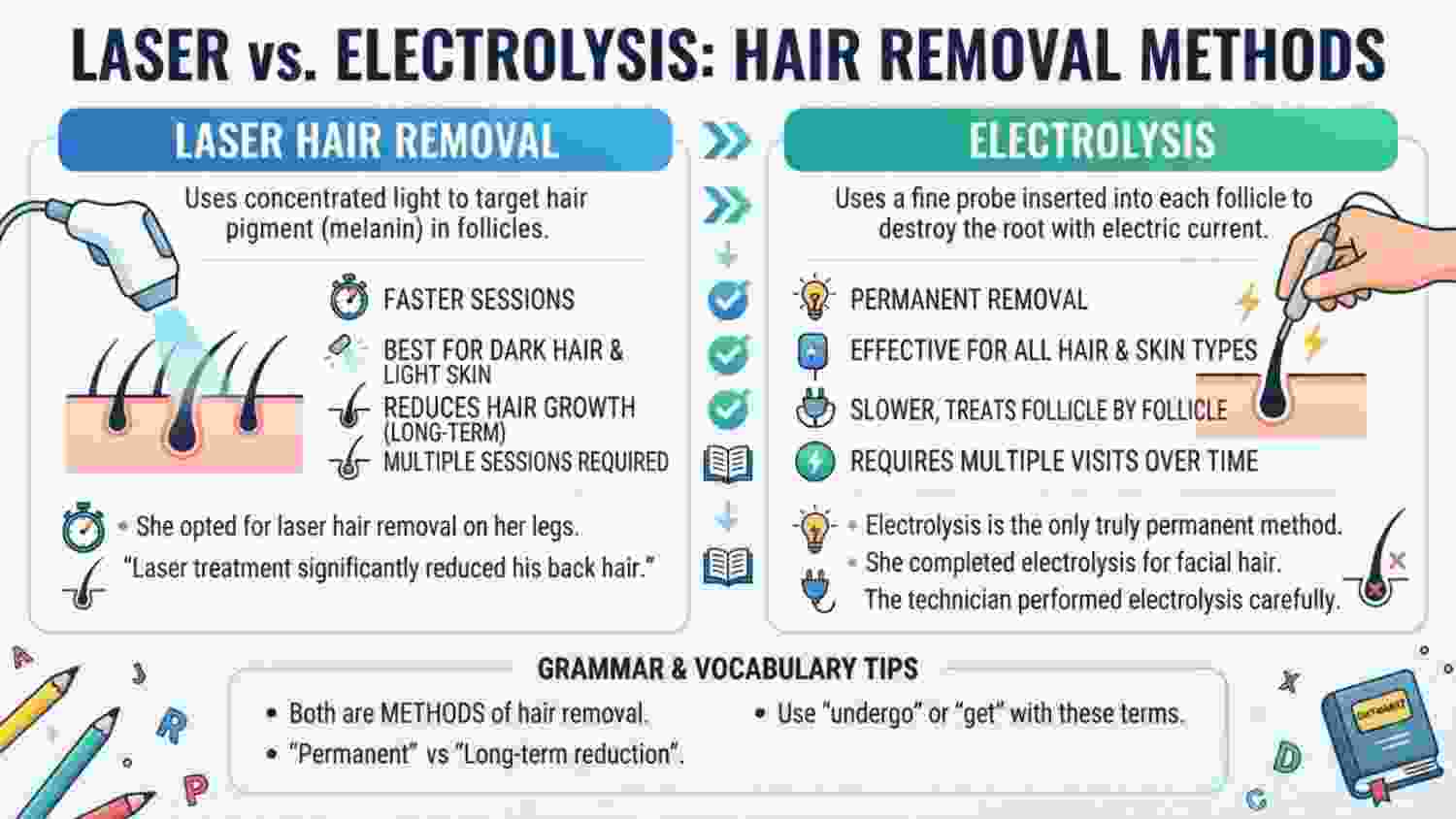
Choosing a hair removal method can be confusing. Two names that often come up are laser or electrolysis. Both methods can reduce unwanted hair, but they work in different ways.
People often search for laser or electrolysis because they want to know which method lasts longer, how each treatment works, how many sessions they may need, and which one may fit their needs. The right choice can also depend on hair color, skin type, the area being treated, and personal goals.
Laser hair removal uses light to target hair. It usually works best when there is a clear difference between the hair and the skin. Electrolysis uses a small amount of electrical energy to treat individual hair follicles.
Neither method is exactly the same. They also have different benefits, limits, costs, and treatment times.
In this guide, we will explain laser or electrolysis in simple terms. You will learn how both methods work, how they differ, what the terms mean, common mistakes, and what questions to ask before choosing a treatment.
Laser or Electrolysis – Quick Answer
Laser hair removal uses light energy to target hair follicles. It usually treats many hairs at once.
Electrolysis uses a tiny probe to treat individual hair follicles one at a time.
Simple difference
| Laser | Electrolysis |
| Uses light | Uses electrical energy |
| Treats many hairs at once | Treats one follicle at a time |
| Often used on larger areas | Useful for small areas and individual hairs |
| Works best when the laser can target the hair well | Can work on hair of different colors |
| Usually needs several sessions | Usually needs several sessions |
Simple example
If you want to treat a large area such as the legs, laser may be a practical option because it can treat many hairs during one session.
If you want to remove a few unwanted hairs from a small area, electrolysis may be useful because each follicle can be treated directly.
The best option depends on your hair, skin, treatment area, budget, and goals.
The Origin of Laser or Electrolysis
The words laser and electrolysis come from different scientific ideas.
Where does “laser” come from?
Laser is an acronym.
It comes from the words:
Light Amplification by Stimulated Emission of Radiation.
A laser produces a focused beam of light.
Laser technology has been used in many fields, including medicine, science, communication, and industry.
Laser hair removal uses a special type of light to target hair.
Where does “electrolysis” come from?
The word electrolysis is linked to electricity and chemical change.
The word combines ideas related to:
- electro = electricity
- lysis = breaking down or separating
Electrolysis has been used in hair removal for many years.
In hair removal, a small probe is placed into a hair follicle. Electrical energy is then used to damage the follicle.
Why are the names different?
There is no spelling dispute between these two words.
Laser names the type of light technology.
Electrolysis names a process that uses electrical energy.
So, laser or electrolysis is a comparison between two different hair removal methods, not two spellings of the same word.
British English vs American English Terminology
Unlike words such as colour/color or travelling/traveling, laser and electrolysis do not have a major British versus American spelling difference.
Both terms are widely understood in the US, UK, Canada, Australia, and other English-speaking countries.
Comparison table
| Term | American English | British English |
| Laser | Laser | Laser |
| Electrolysis | Electrolysis | Electrolysis |
| Laser hair removal | Common | Common |
| Electrolysis hair removal | Common | Common |
| Hair follicle | Common | Common |
| Permanent hair removal | Used | Used |
The main difference is not spelling.
You may see small differences in the words used by clinics. For example, one clinic may say laser hair removal, while another may use laser treatment.
The basic meaning is usually clear from the context.
Example
US:
I am considering laser hair removal.
UK:
I am considering laser hair removal.
The wording is the same.
Which Method Should You Use?
There is no single method that works best for every person.
Your choice may depend on several factors.
For large areas
Laser treatment may be useful when you want to treat a large area because it can target many hairs during a session.
Common areas include:
- legs
- arms
- back
- chest
- underarms
For small areas
Electrolysis may be useful when you want to treat individual hairs.
It is often used on areas such as:
- chin
- upper lip
- eyebrows
- small facial areas
For different hair colors
Laser treatment depends on the laser being able to target the hair.
Because of this, results can vary with hair color and skin tone.
Electrolysis does not depend on hair color in the same way because it treats the individual follicle.
For a long-term goal
Both methods usually require more than one treatment.
Hair grows in different stages. A treatment may not affect every hair at the same time.
This is why treatment plans often include several sessions.
Before starting either treatment, talk with a qualified professional about your skin, hair, and treatment area.
Common Mistakes with Laser or Electrolysis
People often mix up the two methods.
Here are some common mistakes.
1. Thinking laser and electrolysis are the same
They are not the same.
Laser uses light.
Electrolysis uses electrical energy delivered to individual follicles.
2. Thinking one session removes all hair
Neither method should be viewed as a one-session solution.
Hair grows in different stages, so several sessions are often needed.
3. Assuming laser works the same for everyone
Laser results can vary.
Hair color, skin tone, hair thickness, treatment area, and the type of laser can all matter.
4. Thinking electrolysis treats a large area very quickly
Electrolysis treats follicles one at a time.
This can make treatment slower when there are many hairs.
5. Confusing hair reduction with instant removal
Hair may not disappear immediately after treatment.
It can take time for treated hairs to shed or for results to become clear.
6. Choosing a treatment without asking questions
Do not choose a method only because a friend had good results.
Ask a qualified provider about:
- your skin type
- your hair type
- expected results
- number of sessions
- possible side effects
- aftercare
- total cost
Laser or Electrolysis in Everyday Examples
You may see these terms in many everyday situations.
In an email
Hello, I would like to know if you offer laser or electrolysis for facial hair.
In a clinic message
Please tell me how many sessions may be needed for this area.
On social media
Has anyone tried laser or electrolysis for facial hair?
In a beauty article
Laser and electrolysis are two common methods of hair removal.
In a formal document
The patient should follow the provider’s instructions before and after treatment.
In a news article
Advances in hair removal technology have increased interest in laser-based treatments.
In a conversation
Should I look into laser or electrolysis?
The words are easy to use once you know what each treatment means.
Laser or Electrolysis – Google Trends & Usage Data
People search for laser or electrolysis for different reasons.
Some people want to compare the two methods before booking a treatment. Others want to know which method may work for their hair or skin type.
Search interest can also vary by country and by the type of treatment people are looking for.
Laser searches often relate to:
- laser hair removal
- facial hair
- body hair
- treatment cost
- number of sessions
- results
- skin tone
- hair color
Electrolysis searches often relate to:
- permanent hair removal
- facial hair
- individual hairs
- small treatment areas
- treatment time
- cost
- number of sessions
The terms are also used by beauty clinics, dermatology practices, and hair removal professionals.
Exact Google Trends numbers can change over time. They also depend on the country and search period. For that reason, it is better to check Google Trends directly when you need current numbers rather than using made-up statistics.
Laser vs Electrolysis Comparison Table
| Feature | Laser Hair Removal | Electrolysis |
| Main technology | Light energy | Electrical energy |
| Treatment method | Targets hair in an area | Treats individual follicles |
| Treatment speed | Usually faster for large areas | Usually slower for large areas |
| Hair color | Results can vary by hair color | Can treat hair of different colors |
| Large areas | Often practical | Can take longer |
| Small areas | Can be used | Often useful |
| Number of sessions | Usually several | Usually several |
| Best choice | Depends on the person | Depends on the person |
Remember that treatment results can vary. A qualified provider can explain which option may suit your specific case.
Laser or Electrolysis: Key Differences
The easiest way to remember the difference is this:
Laser = light
Laser hair removal uses light energy.
Electrolysis = electrical energy
Electrolysis uses electrical energy to treat individual hair follicles.
Laser can treat many hairs
A laser device can cover an area and target many hairs during treatment.
Electrolysis treats follicles one at a time
The provider places a small probe into individual follicles.
Hair and skin can affect laser results
Laser treatment depends on how the light interacts with the hair and skin.
Electrolysis works differently
Electrolysis directly treats individual follicles, so it does not depend on hair color in the same way.
FAQs About Laser or Electrolysis
1. Is laser or electrolysis better?
There is no single answer for everyone. The right option depends on your hair, skin, treatment area, and goals.
2. Which is faster, laser or electrolysis?
Laser treatment can be faster for large areas because it can treat many hairs at once. Electrolysis treats individual follicles.
3. Can electrolysis remove all hair colors?
Electrolysis can treat hairs of different colors because it works directly on individual follicles rather than depending on hair pigment in the same way as laser.
4. Does laser work on every hair color?
No. Laser results can vary with hair color because the treatment targets the hair. A qualified provider can tell you whether a certain laser is suitable for your hair and skin.
5. How many sessions are needed?
The number of sessions varies from person to person. Hair growth, treatment area, hair type, and other factors can affect the treatment plan.
6. Can I use laser and electrolysis?
Some people may use both methods for different areas or hairs. A qualified professional can help you decide if combining treatments makes sense for you.
7. Which method should I choose?
Think about the size of the area, hair color, skin type, time, cost, and your long-term goal. A qualified provider can help you compare the options.
Conclusion
Laser or electrolysis are two different ways to deal with unwanted hair. Laser hair removal uses light energy and can treat many hairs in an area. Electrolysis uses electrical energy and treats individual hair follicles.
Laser may be useful for larger areas because treatment can cover many hairs at once. Electrolysis may be useful for small areas and individual hairs. Laser results can also depend on hair color and skin tone. Electrolysis works in a different way and can treat hairs of different colors.
Neither method is a one-size-fits-all choice. People can have different hair types, skin tones, treatment areas, and goals. The number of sessions and results can also vary.
If you are thinking about treatment, speak with a qualified professional. Ask about the method, expected results, treatment time, cost, and possible skin effects.
The simple rule is easy to remember: laser uses light, while electrolysis uses electrical energy to treat individual hair follicles.

Ethan Carter is a language writer at Wordellect who helps readers understand word differences, grammar rules, and spelling variations through simple and accurate guides.







