Pole or poll are two English words that sound almost the same, but they have very different meanings. This can make them easy to mix up when writing.
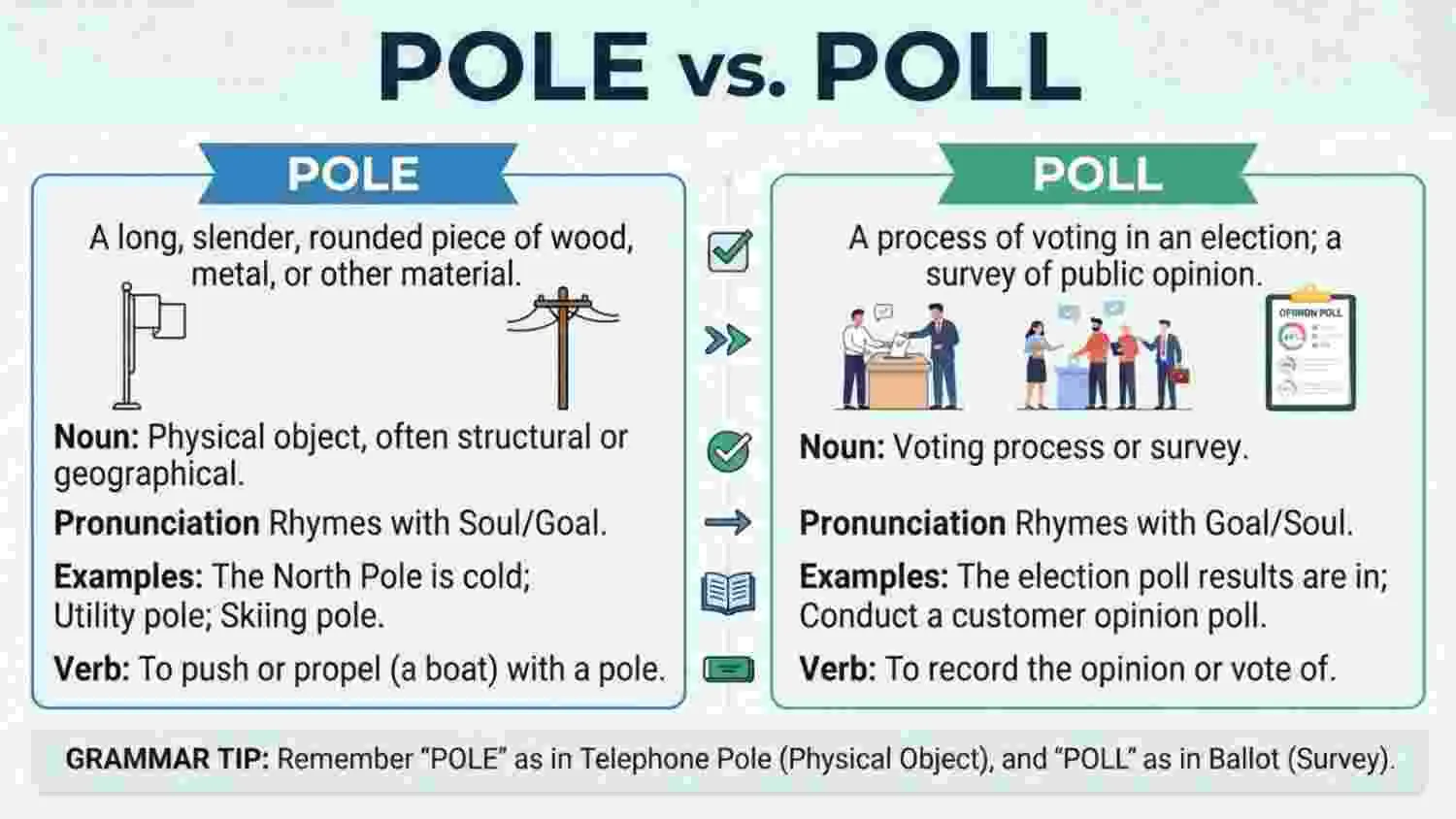
Pole can mean a long, thin object, such as a wooden or metal stick. It can also mean one of the two ends of Earth, such as the North Pole or South Pole.
Poll, on the other hand, is usually about asking people what they think. A poll can be a survey where people choose an answer. The word can also mean the process of voting in an election.
People often search for pole or poll because the words sound alike. They may know how to say the word but are not sure which spelling to use. This is especially common in phrases such as online poll, opinion poll, and North Pole.
The good news is that the difference is easy to learn. Once you know what each word means, it becomes much easier to choose the right one.
Pole or Poll – Quick Answer
The words pole and poll have different meanings.
Pole
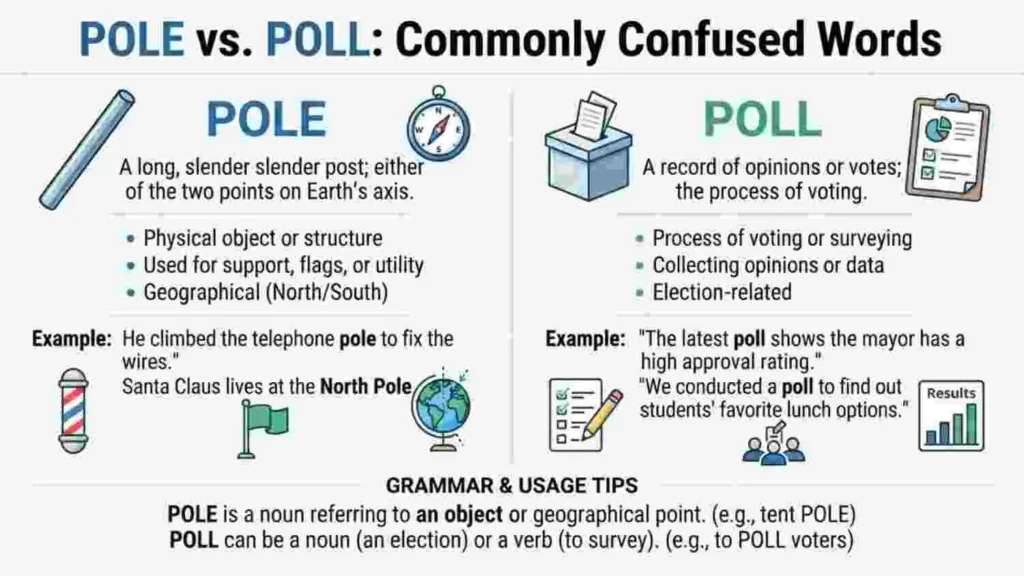
Pole can mean a long, thin object.
He used a metal pole to support the tent.
It can also mean one of Earth’s two farthest points:
Santa Claus is often linked with the North Pole.
Poll
Poll usually means a survey that asks people for their opinions.
We made a poll to find out which color people like.
It can also relate to voting:
The latest poll asked voters about the election.
Easy way to remember
Pole = stick or place
Poll = survey or vote
For example:
The flag is on a pole.
The website has a poll.
The Origin of Pole or Poll
The words pole and poll have different histories. Even though they look and sound similar, they did not develop from the same word.
The origin of pole
The word pole has a long history.
The word used for the Earth’s North and South Poles comes from an old Greek word linked to an axis or turning point. It later passed through Latin and French before becoming part of English.
The word pole also came to mean a long stick or rod.
Today, we use pole in many ways.
Examples include:
- flagpole
- telephone pole
- fishing pole
- tent pole
- pole vault
- North Pole
- South Pole
The origin of poll
The word poll has a different history.
It was once used for the head or top of the body. Later, it became linked with counting people’s heads or votes.
This helped give poll its modern meaning.
Today, a poll is often a question or survey that collects people’s views.
For example:
The news site posted a poll about the new law.
The word is also used in elections:
Voters went to the polls.
Why do they look similar?
English has many words that sound alike but have different meanings and spellings.
These words are called homophones when they have the same pronunciation but different meanings or spellings.
Pole and poll are commonly treated as homophones in many forms of English.
British English vs American English Spelling
There is no major British versus American spelling difference between pole and poll.
Both words are spelled the same way in American English and British English.
| Meaning | American English | British English |
| Long stick or rod | pole | pole |
| North or South Pole | pole | pole |
| Survey | poll | poll |
| Voting place/process | poll | poll |
| Opinion survey | poll | poll |
So you do not need to change the spelling based on your audience.
American English example
The company posted an online poll.
British English example
The company posted an online poll.
The spelling stays the same.
One useful difference
British English often uses the phrase:
go to the polls
This means going to vote.
American English also uses this phrase.
So the word poll works in both forms of English.
Which Spelling Should You Use?
The correct spelling depends on the meaning.
Use “pole” for a stick or rod
Use pole when you mean a long, thin object.
Examples:
The tent pole broke.
He climbed the pole.
The flag is flying from a pole.
Use “pole” for Earth’s ends
Use pole for the North and South Poles.
Examples:
The North Pole is very cold.
The expedition traveled toward the South Pole.
Use “poll” for a survey
Use poll when people answer questions.
Examples:
We created an online poll.
The poll asked people about their favorite movie.
Use “poll” for voting
Use poll when talking about voting.
Examples:
Voters went to the polls.
The election polls closed at 8 p.m.
Use “poll” for public opinion
You may also see opinion poll.
The newspaper published an opinion poll.
This means a survey that asks people what they think.
Common Mistakes with Pole or Poll
Because these words sound alike, people often use the wrong spelling.
Mistake 1: Writing “poll” for a stick
Wrong:
The flag is attached to a poll.
Correct:
The flag is attached to a pole.
A flag goes on a pole.
Mistake 2: Writing “pole” for a survey
Wrong:
We created a pole about the new product.
Correct:
We created a poll about the new product.
A survey is a poll.
Mistake 3: Mixing up North Pole and poll
Wrong:
Santa lives at the North Poll.
Correct:
Santa lives at the North Pole.
Remember that the North Pole is a place.
Mistake 4: Writing “pole” for voting
Wrong:
Voters went to the poles.
Correct:
Voters went to the polls.
The place where people vote is called a polling place or polling station.
Mistake 5: Confusing polling with poles
Polling comes from poll.
The company is polling its customers.
Pole has a different meaning.
The worker lifted the pole.
Pole or Poll in Everyday Examples
You can see both words in daily life.
Pole in an email
Please move the sign away from the telephone pole.
Pole in a message
We need a stronger pole for the tent.
Pole in social media
I finally visited the North Pole!
Pole in news
The climber used a long pole during the trip.
Pole in formal writing
The flag shall be displayed on the designated pole.
Poll in an email
Please complete the short poll before Friday.
Poll in social media
Vote in our new poll!
Poll in a message
I made a poll so everyone can choose a date.
Poll in news
A new poll shows changing public opinion.
Poll in formal writing
The research team conducted a public opinion poll.
Pole or Poll – Google Trends & Usage Data
The words pole and poll are both common English words, but people search for them in different contexts.
Searches for pole may relate to:
- North Pole
- South Pole
- flagpole
- telephone pole
- fishing pole
- tent pole
- pole dancing
- pole vault
Searches for poll may relate to:
- online polls
- opinion polls
- election polls
- polling
- polling stations
- public opinion
- survey questions
This means search interest can change based on news, sports, elections, weather, entertainment, and other topics.
For example, searches for poll may increase when an election or major survey is receiving attention. Searches for North Pole may increase around Christmas.
Exact Google Trends numbers also change over time and depend on the country and search period. It is better to check Google Trends directly when current data is needed rather than using made-up numbers.
Pole vs Poll Comparison Table
| Feature | Pole | Poll |
| Pronunciation | Usually sounds like “poll” | Usually sounds like “pole” |
| Main meaning | Long stick or rod | Survey or vote |
| Can mean a place? | Yes, North/South Pole | No |
| Used for surveys? | No | Yes |
| Used for voting? | No | Yes |
| Example | Flagpole | Opinion poll |
| Easy memory | Stick or place | Survey or vote |
Pole and Poll: Simple Examples
Here are some examples that make the difference clear.
Pole
The flag is attached to a pole.
We need a tent pole.
The fisherman carried his fishing pole.
The North Pole is very cold.
The worker painted the telephone pole.
Poll
The website created a poll.
I answered an online poll.
The poll asked five questions.
The newspaper published a new poll.
Voters went to the polls.
A Simple Trick to Remember Pole or Poll
Use this easy trick:
Pole has one “l”
Think of a pole as one long stick.
P-O-L-E = pole
Examples:
- flagpole
- tent pole
- fishing pole
- North Pole
Poll has two “l”s
Think of the two L’s as two people standing in a survey line.
P-O-L-L = poll
Examples:
- online poll
- opinion poll
- election poll
- polling station
You can also remember:
Pole = object or place
Poll = people
This simple rule can help you choose the right spelling quickly.
FAQs About Pole or Poll
1. What is the difference between pole and poll?
Pole usually means a long stick, rod, or one of Earth’s two ends. Poll usually means a survey or voting process.
2. Are pole and poll pronounced the same?
Yes, in standard English they are usually pronounced the same. Their meanings and spellings are different.
3. Is it North Pole or North Poll?
The correct phrase is North Pole.
Santa Claus is associated with the North Pole.
4. Is it opinion pole or opinion poll?
The correct phrase is opinion poll.
The newspaper published an opinion poll.
5. Is it a voting pole or voting poll?
The correct word is poll.
For example:
Voters went to the polls.
You can also say polling place or polling station.
6. What is an online poll?
An online poll is a question or group of questions posted on the internet. People choose an answer.
For example:
Which phone do you prefer?
The website may give users two or more choices.
7. How can I remember pole or poll?
Remember:
Pole = stick or place
Poll = survey or vote
If you can replace the word with survey, use poll. If you mean a stick or the North/South end of Earth, use pole.
Conclusion
The difference between pole or poll is simple once you know what each word means.
Pole is used for a long, thin object, such as a flagpole, tent pole, or fishing pole. It is also used for the two ends of Earth, called the North Pole and South Pole.
Poll is mainly used for a survey or a vote. You may see it in phrases such as online poll, opinion poll, and election poll. The word also appears in polling station and polling place.
The two words usually sound the same, which is why they are easy to confuse. Their spellings are different, but the good news is that there is no major US or UK spelling difference.
A simple memory trick can help. Think pole = stick or place and poll = survey or vote.
Once you learn this small difference, you can use both words correctly in emails, school work, social media, news writing, and formal writing.

Ethan Carter is a language writer at Wordellect who helps readers understand word differences, grammar rules, and spelling variations through simple and accurate guides.