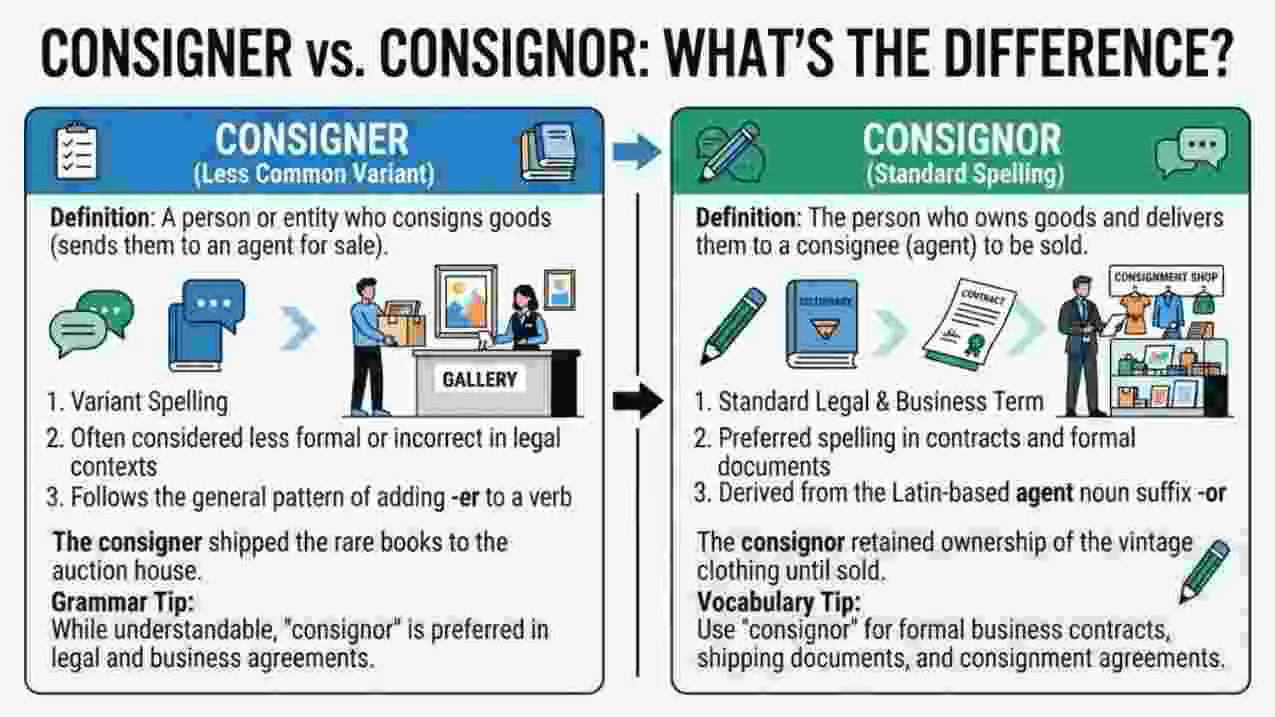
Have you ever seen consigner and consignor and wondered which word is correct? You are not alone. These two words look almost the same, and both are linked to the verb consign.
The word consign means to send goods to another person or business. The goods may be sent for sale, storage, or delivery. The person who sends those goods is called a consignor.
But what about consigner? This form can also be found in English. It follows the normal pattern of adding -er to a verb. However, consignor is the more common and standard term in business, shipping, trade, and legal writing.
This small spelling difference can cause problems when you write invoices, contracts, shipping papers, or business emails. Using the usual term can make your writing clearer and more professional.
In this guide, we will explain consigner or consignor, what each word means, where the words came from, and which form you should use.
Consigner or Consignor – Quick Answer
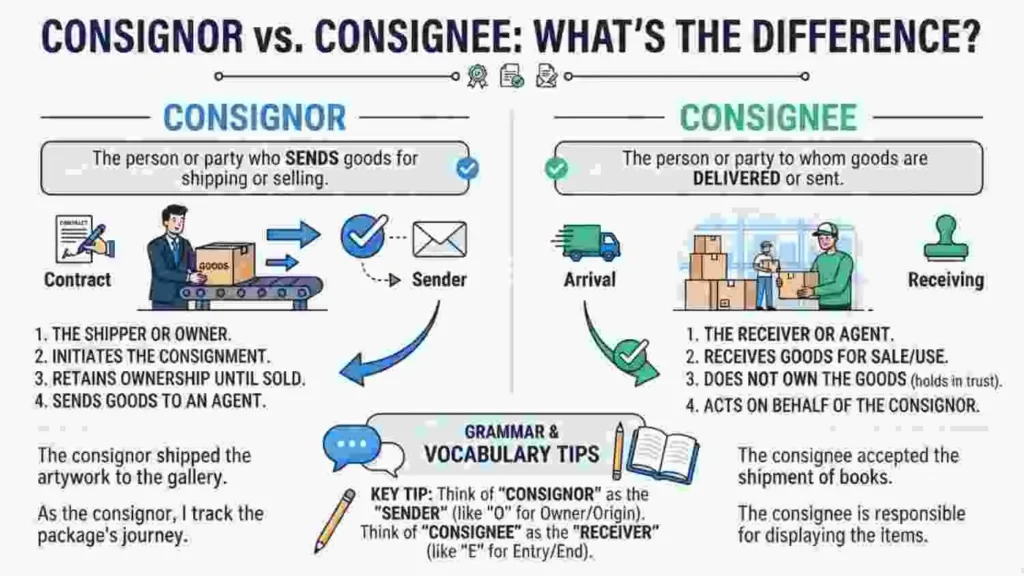
Consignor is the standard and most common word for a person or company that sends goods to another person or business.
Consigner can also be used, but it is much less common.
Simple answer:
- Consignor = the person or business that sends goods.
- Consigner = a less common form with the same basic idea.
- Consignee = the person or business that receives the goods.
Example
The consignor sent 50 shirts to the store.
The seller or owner sends the shirts, so that person is the consignor.
Another example:
The consignee received the shipment on Monday.
The consignee is the person or business that receives the goods.
Which one should you use?
For most business, shipping, and formal writing, use consignor.
It is the form most readers will expect.
The Origin of Consigner or Consignor
The words consigner and consignor come from the verb consign.
The word consign comes from Latin. It is linked to the Latin word consignare, which means to mark, seal, or hand over.
Over time, the word entered English and developed its modern business meaning.
Today, consign often means to send goods to someone else.
For example, a clothing company may consign clothes to a shop. The shop then sells the clothes for the owner.
The person who sends the goods is the consignor.
The person or business that receives the goods is the consignee.
Why does “consignor” look different?
Many English nouns use -er to show the person who does an action.
For example:
- teach → teacher
- sell → seller
- write → writer
- drive → driver
Because of this pattern, consigner may look natural.
However, business English has long used consignor as the standard term.
The ending -or is also common in words connected with formal or business actions.
Examples include:
- donor
- creditor
- operator
- investor
- distributor
So consignor became the usual form in trade and shipping.
British English vs American English Spelling
Unlike some spelling differences, consigner and consignor are not mainly a British English versus American English issue.
This is important.
You should not think that:
Consignor = British English
Consigner = American English
That is not the main difference.
Consignor is widely used in both American and British English, especially in business, shipping, retail, and legal contexts.
Comparison table
| Word | Main use | American English | British English |
| Consignor | Person who sends goods | Common | Common |
| Consigner | Less common alternative | Possible but uncommon | Possible but uncommon |
| Consignee | Person who receives goods | Common | Common |
| Consign | Send or hand over goods | Common | Common |
| Consignment | Goods sent for sale or handling | Common | Common |
The key point is that consignor is not limited to one type of English.
It works well in both US and UK writing.
Example in American English
The consignor must provide the shipping details.
Example in British English
The consignor must provide the shipping details.
The sentence stays the same.
Which Spelling Should You Use?
For most readers, consignor is the best form to use.
If you write for a US audience
Use consignor.
It is a normal business and shipping term.
Example:
The consignor is responsible for the goods until delivery.
If you write for a UK audience
Use consignor.
It is also widely understood and used in British business writing.
Example:
The consignor sent the goods to the retailer.
If you write for a global audience
Consignor is the safest choice.
It is clear and strongly linked with shipping, trade, and consignment.
What about consigner?
You may see consigner in some dictionaries, documents, or general writing.
It is not necessarily a spelling mistake.
However, it is much less common than consignor.
If you are writing a business contract, invoice, shipping document, or professional email, consignor is the clearer choice.
Common Mistakes with Consigner or Consignor
These words are easy to mix up. Here are some common mistakes.
1. Using consigner in formal business writing
Less common:
The consigner must sign the form.
Better:
The consignor must sign the form.
2. Confusing consignor with consignee
These two words describe different people.
Consignor sends the goods.
Consignee receives the goods.
Think of it this way:
Consignor → sends
Consignee → receives
Example:
The consignor shipped the products to the consignee.
3. Writing “consignor” when you mean the receiver
This is a common error.
Wrong meaning:
The consignor received the package.
If the person received the goods, they are normally the consignee.
Better:
The consignee received the package.
4. Adding an extra letter
Some people write forms such as:
Consignnor
This is incorrect.
The correct spelling is:
Consignor
5. Using “consignor” as the name of the goods
The goods are not the consignor.
The person or business is the consignor.
The goods are called a consignment.
Example:
The consignor sent a new consignment of shoes.
6. Confusing consignor with seller
A consignor can be the owner or seller of goods, but the two words do not always mean exactly the same thing.
Seller is a broad word.
Consignor is a more specific business term for someone who sends goods under a consignment arrangement.
Consigner or Consignor in Everyday Examples
The word consignor is most common in business and trade. You may see it in emails, shipping records, contracts, and store documents.
In an email
Hello,
Please confirm the consignor’s address before we ship the order.
In a business message
The consignor has sent the products to our warehouse.
In shipping
The consignor must provide the correct shipping information.
In a contract
The consignor remains responsible for the goods until the agreed point of delivery.
In a retail store
The consignor receives payment after the item is sold.
In a news story
The consignor sent the artwork to the auction house.
On social media
We are looking for consignors who want to sell their used clothing through our store.
In an online store
Please enter the consignor’s name and contact details.
In formal writing
The consignor must keep records of all items placed on consignment.
Consignor vs Consignee
Understanding consignor becomes much easier when you learn consignee too.
| Word | Meaning | Simple way to remember |
| Consignor | Sends the goods | Sends |
| Consignee | Receives the goods | Receives |
| Consignment | The goods sent | Goods |
| Consign | To send goods | Send |
Easy example
Imagine that Sarah owns 20 dresses.
She gives the dresses to a shop to sell for her.
Sarah is the consignor.
The shop is the consignee.
The dresses are the consignment.
The action of sending the dresses is to consign them.
This simple example can help you remember all four words.
Consigner or Consignor – Google Trends & Usage Data
There is a clear difference in normal usage between these two forms.
Consignor is the form you are more likely to see in professional writing about:
- shipping
- retail
- auctions
- trade
- logistics
- contracts
- consignment stores
- freight
- business records
Consigner appears much less often.
The difference is not mainly about US versus UK spelling. Instead, it is about the established business term used in trade and shipping.
For this reason, people searching for the correct business word will usually benefit from learning consignor first.
Search results can also vary by country and industry. A legal document, shipping company, auction house, and clothing store may use the word in slightly different ways.
Because search interest changes over time, exact Google Trends numbers should be checked directly when current data is needed. It is better not to use made-up numbers.
Usage by context
| Context | More natural word |
| Shipping | Consignor |
| Logistics | Consignor |
| Retail | Consignor |
| Auctions | Consignor |
| Business contracts | Consignor |
| General writing | Consignor |
| Less common alternative | Consigner |
Consigner or Consignor: Comparison Table
| Feature | Consigner | Consignor |
| Spelling | Correctly formed alternative | Standard common form |
| Meaning | Person who consigns goods | Person who consigns goods |
| Common in business | Less common | Very common |
| Common in shipping | Less common | Common |
| US English | Used rarely | Standard choice |
| UK English | Used rarely | Standard choice |
| Formal writing | Possible | Preferred |
| Best choice for most writing | No | Yes |
The biggest difference is usage, not meaning.
In most cases, consignor is the word you should choose.
FAQs About Consigner or Consignor
1. Is consignor the correct spelling?
Yes. Consignor is the standard and widely used spelling. It means a person or business that sends goods to another person or business.
2. Is consigner a real word?
Yes, consigner can be found in English. However, it is much less common than consignor.
3. What is the difference between consignor and consignee?
The consignor sends the goods. The consignee receives the goods.
4. Is consignor used in American English?
Yes. Consignor is commonly used in American English, especially in shipping, trade, retail, and business writing.
5. Is consignor used in British English?
Yes. Consignor is also used in British English. It is not simply an American spelling.
6. Should I use consigner or consignor in a contract?
Consignor is usually the better choice for a formal contract because it is the standard business term.
7. How can I remember consignor?
Think:
Consignor = sends
Consignee = receives
The consignor sends the goods to the consignee.
Conclusion
The choice between consigner or consignor can be confusing because both forms look correct. The good news is that the answer is simple.
Consignor is the standard and more common word. It means a person or business that sends goods to another person or business. You will often see it in shipping, retail, auctions, trade, and business documents.
Consigner can be found in English, but it is much less common. It is not mainly a British versus American spelling difference. Both US and UK English commonly use consignor.
It is also important to remember the word consignee. The consignor sends the goods, while the consignee receives them. The goods themselves are called a consignment.
If you are writing an email, contract, shipping document, business page, or formal report, consignor is the clearest choice. It is familiar to readers and matches common business usage.

Ethan Carter is a language writer at Wordellect who helps readers understand word differences, grammar rules, and spelling variations through simple and accurate guides.







