Have you ever wondered whether to write preventative or preventive? You may have seen both words in books, websites, medical articles, and everyday writing. This can make the choice seem harder than it really is.
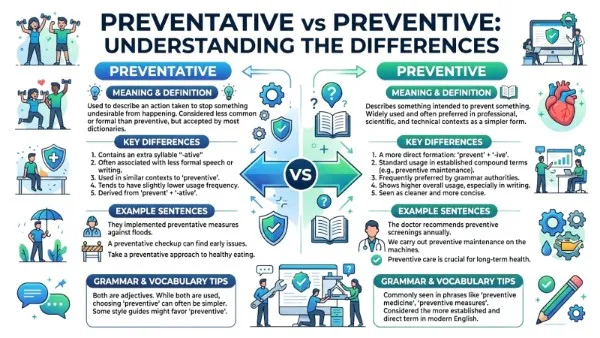
The good news is simple: both preventative and preventive are correct. They have the same basic meaning. Both words describe something that helps stop a problem before it happens.
For example, you can say:
Regular exercise can be a preventive measure.
You can also say:
Regular exercise can be a preventative measure.
Both sentences are correct.
People often search for preventative or preventive because one form may sound more natural to them. Others want to know which word is better for formal writing, medical writing, or professional documents.
The main difference is usage, not meaning. Preventive is shorter and is often preferred in formal and professional writing. Preventative is also standard English and is common in everyday use.
In this guide, we will explain both forms, where they came from, how they are used, and which one you should choose.
Preventative or Preventive – Quick Answer
Preventive and preventative are both correct.
Both mean intended to prevent something from happening.
Preventive
Preventive is the shorter form.
The doctor recommended preventive care.
We took preventive action.
Preventative
Preventative has the same meaning.
The doctor recommended preventative care.
We took preventative action.
There is no major difference in meaning.
However, preventive is often more common in formal, technical, medical, and professional writing.
Easy rule
If you are unsure, choose preventive.
It is short, clear, and widely accepted.
But remember that preventative is not wrong.
The Origin of Preventative or Preventive
Both words come from the verb prevent.
The verb prevent comes from Latin roots. It entered English through Old French and Latin forms connected with the idea of coming before something or stopping something from happening.
From prevent, English developed the adjective preventive.
The ending -ive is common in English adjectives.
For example:
- act → active
- protect → protective
- defend → defensive
- prevent → preventive
The longer form preventative developed later.
It uses the ending -ative, which appears in many English words. Over time, preventative became an accepted English adjective alongside preventive.
Both words have been used for a long time.
The difference is mainly about style and frequency.
Preventive often feels more direct because it uses fewer letters.
Preventative can sound slightly longer or more formal to some readers, but it is still a standard word.
Examples
preventive medicine
preventative medicine
preventive measures
preventative measures
preventive action
preventative action
All of these forms can be correct.
British English vs American English Spelling
Unlike some British and American spelling pairs, preventive and preventative are not separated by a strict US-versus-UK spelling rule.
Both forms are used in British English and American English.
However, their popularity can differ by context.
Preventive is widely used in American professional and medical writing.
Preventative is also used in American English, especially in general writing.
British English uses both forms too.
Here is a simple comparison:
| Feature | Preventive | Preventative |
| Meaning | Intended to prevent | Intended to prevent |
| British English | Common | Used |
| American English | Very common | Used |
| Formal writing | Very common | Correct |
| Medical writing | Very common | Correct |
| Professional writing | Common | Correct |
| Length | Shorter | Longer |
British English examples
The government introduced preventive measures.
Or:
The government introduced preventative measures.
Both are possible.
American English examples
Regular screening can be a preventive measure.
Or:
Regular screening can be a preventative measure.
Again, both forms are correct.
The important difference is not nationality. It is often a matter of style and preference.
Which Spelling Should You Use?
If you are choosing between preventive and preventative, think about your audience and the type of writing.
For American English
Preventive is usually the safest choice.
It is common in:
- medicine
- business
- government
- science
- education
- technical writing
For example:
The company created a preventive maintenance plan.
For British English
Both forms are accepted.
If you want a short and widely recognized form, choose preventive.
For example:
The school introduced preventive safety measures.
Preventative is also correct.
For formal writing
Preventive is often the better choice because it is concise.
For example:
The new policy focuses on preventive action.
This sounds clear and professional.
For global readers
Choose preventive if you want the simplest option.
It is easy to understand and widely used.
When should you use preventative?
Use preventative if it fits the style of your organization, publication, or existing document.
Consistency is important.
If a report uses preventative throughout, you do not need to replace every example with preventive.
Common Mistakes with Preventative or Preventive
The biggest mistake is believing that one form is completely wrong.
Mistake 1: Saying preventative is incorrect
Incorrect idea:
“Preventative is not a real word.”
This is false.
Preventative is a standard English word.
Mistake 2: Saying preventive is the only correct form
This is also incorrect.
Preventive is correct, but preventative is correct too.
Mistake 3: Thinking the two words have different meanings
They normally have the same meaning.
preventive care
and
preventative care
both refer to care designed to prevent a problem.
Mistake 4: Mixing styles without a reason
Try to stay consistent.
For example, if your article mainly uses preventive, do not switch randomly to preventative.
Better:
The program uses preventive care. These preventive steps can reduce risk.
Mistake 5: Confusing prevent with preventative
Prevent is a verb.
We want to prevent problems.
Preventive and preventative are adjectives.
We need preventive measures.
We need preventative measures.
Preventative or Preventive in Everyday Examples
Both forms can appear in many types of writing.
In emails
We are taking preventive steps to avoid delays.
Or:
We are taking preventative steps to avoid delays.
Both are correct.
In news writing
Officials announced new preventive measures.
News organizations may choose preventive because it is shorter and common in formal writing.
On social media
Simple preventive steps can help protect your home.
You may also see:
These preventative steps can save time later.
In medical writing
Both forms are used.
Preventive care can help detect health problems early.
You may also see:
Preventative care can help reduce health risks.
In medical and scientific writing, preventive is especially common.
In business writing
The company uses preventive maintenance to reduce equipment problems.
Preventive maintenance is a common professional term.
In formal writing
The policy focuses on preventive measures.
This is concise and clear.
Preventative or Preventive Google Trends & Usage Data
Search interest for preventive and preventative changes by country, topic, and time.
Preventive tends to have broader use in professional and technical contexts. It is especially common in medical, scientific, business, and government writing.
Preventative also receives search interest because people often want to know whether it is correct.
The word can appear in searches about:
- preventive care
- preventative care
- preventive medicine
- preventative medicine
- preventive measures
- preventative measures
- preventive maintenance
- preventative maintenance
Google Trends measures relative search interest, not exact search volume. Search patterns can also change over time.
For SEO, both forms can be useful when they match the search intent.
If your main keyword is preventative or preventive, explain clearly that both forms are correct. This directly answers what searchers want to know.
Do not force both words into every sentence. Use them naturally and focus on clear information.
Preventive
Preventive is an adjective.
The doctor suggested preventive care.
Preventative
Preventative is also an adjective.
The doctor suggested preventative care.
Prevention
Prevention can reduce future problems.
These words are related, but they have different grammatical roles.
FAQs;
1. Is preventative or preventive correct?
Both are correct. They have the same basic meaning.
2. Is preventative a real word?
Yes. Preventative is a standard English word.
3. Which is more common, preventive or preventative?
Preventive is often more common, especially in medical, scientific, technical, and professional writing.
4. Is preventive American English?
Preventive is very common in American English, but it is also used in British English and other varieties of English.
5. Is preventative British English?
Preventative is used in British English, but it is not limited to Britain. American English also uses it.
6. Which should I use in formal writing?
Preventive is usually a strong choice for formal writing because it is concise and widely used.
7. Do preventive and preventative mean the same thing?
Yes. In normal use, they mean the same thing: something intended to prevent a problem or event.
Conclusion;
When choosing between preventative or preventive, you do not need to worry about choosing a completely wrong word. Both are correct English words, and both describe something that helps prevent a problem.
The main difference is usage and style. Preventive is the shorter form and is especially common in medical, scientific, technical, business, and formal writing. Preventative is also standard and has the same basic meaning.
If you are unsure which one to use, preventive is often the safest choice. It is concise, clear, and widely accepted in many types of English writing. However, you should not mark preventative as an error simply because another writer prefers preventive.
British and American English both use the two forms, so this is not a strict spelling difference between the two varieties.
The most important rule is consistency. Choose the form that fits your audience, field, style guide, or organization. If you are writing for a broad global audience, preventive is a simple choice.
In short, remember: preventive and preventative mean the same thing, but preventive is often preferred for concise professional writing.

Ethan Carter is a language writer at Wordellect who helps readers understand word differences, grammar rules, and spelling variations through simple and accurate guides.







