Have you noticed a white, gray, or dark patch on a wall and wondered, “Is this efflorescence or mold?” You are not alone. These two problems can look similar, especially when they appear on damp walls, basements, brick, concrete, or other building surfaces. But they are very different.
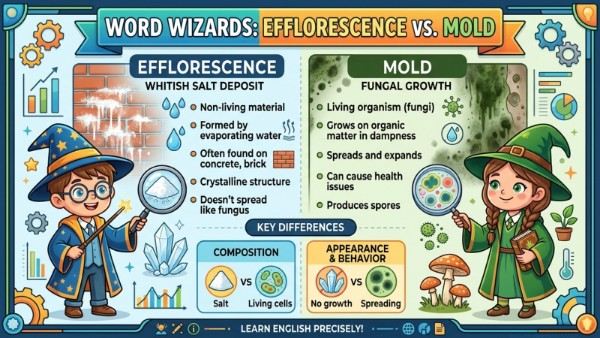
Efflorescence is a white, powdery salt deposit that forms when water moves through masonry and carries dissolved salts to the surface. When the water dries, the salts remain behind. The National Park Service describes efflorescence as a whitish haze of soluble salts on masonry.
Mold, on the other hand, is a living fungus. Mold grows when spores land on a damp surface and have enough moisture to grow. The U.S. Environmental Protection Agency says that controlling moisture is the key to controlling indoor mold.
Knowing the difference matters. Efflorescence may point to a water problem, while mold can damage materials and may affect indoor air quality. This guide will show you the key differences, causes, signs, and simple ways to tell them apart.
Efflorescence or Mold – Quick Answer
The short answer is:
Efflorescence is a salt deposit. Mold is a fungus.
They may both appear when there is moisture, but they are not the same thing.
What does efflorescence look like?
Efflorescence is usually:
- White
- Gray or pale
- Powdery
- Chalky
- Crystalline
- Dry to the touch
It often appears on:
- Brick
- Concrete
- Stone
- Mortar
- Basement walls
- Foundation walls
The National Park Service explains that water can carry soluble salts through masonry and leave them on the surface as the water moves out and evaporates.
What does mold look like?
Mold can appear in many colors. It may be:
- Black
- Green
- Gray
- White
- Brown
- Yellow
It may look fuzzy, slimy, spotted, or patchy.
Unlike efflorescence, mold is a living organism. The EPA explains that mold needs moisture to grow indoors.
The easiest rule
Remember this:
White and powdery often suggests efflorescence.
Fuzzy, stained, or spreading growth may suggest mold.
However, appearance alone cannot always give you a definite answer. If you are unsure, especially when there is a large moisture problem, consider getting professional advice.
The Origin of Efflorescence or Mold
The words efflorescence and mold come from very different histories.
The origin of efflorescence
Efflorescence comes from Latin roots connected with flowering or blossoming.
Merriam-Webster traces the word to Latin efflorescere, meaning “to begin to blossom.” The word entered English in the 17th century, with a first known use in 1626.
The connection may seem strange at first.
Why would a word linked to flowers describe white salt on a wall?
The idea is that something appears or “blooms” out from a surface. In masonry, salts can move to the surface and form visible crystals.
Efflorescence also has other meanings. In chemistry, it can describe a process in which a substance loses water and forms a powder or crystalline material.
The origin of mold
Mold has a much simpler everyday history.
In American English, mold refers to fungi that grow on damp materials. British English commonly uses mould for the same thing.
The word has also had other meanings over time, including meanings related to form, shape, and soil.
The spelling difference between mold and mould is a British and American English difference.
This is important because efflorescence or mold is not a pair of alternative spellings. These are two different substances.
British English vs American English Spelling
There is an important spelling difference in this topic.
Efflorescence is spelled the same in British and American English.
However, mold is usually spelled mould in British English.
| Meaning | British English | American English |
| Salt deposit on masonry | efflorescence | efflorescence |
| Fungal growth | mould | mold |
| Plural | moulds | molds |
| Example | There is mould on the wall. | There is mold on the wall. |
Efflorescence
There is normally no British versus American spelling difference:
British: efflorescence
American: efflorescence
Mold or Mould
Here, the spelling changes:
British: mould
American: mold
Both forms mean the same thing when referring to fungal growth.
For an article aimed at American readers, efflorescence or mold is the natural keyword.
For British readers, you may also want to discuss efflorescence or mould.
Which Spelling Should You Use?
Your choice depends on your audience.
For American readers
Use:
efflorescence
and:
mold
Example:
The basement wall has white efflorescence, not mold.
For British readers
Use:
efflorescence
and:
mould
Example:
The basement wall has white efflorescence, not mould.
For Canadian, Australian, and other readers
English spelling can vary by country and publication style. If your website follows British English, mould is usually the better choice. If it follows American English, use mold.
The most important rule is consistency.
Do not write mold in one section and mould in another unless you are explaining the spelling difference.
Common Mistakes with Efflorescence or Mold
Mistakes
1: Thinking efflorescence is mold
This is one of the most common mistakes.
White material on a wall does not automatically mean mold.
Efflorescence is usually a salt deposit. The National Park Service notes that it forms when soluble salts move through masonry and appear on the surface.
2: Thinking all white growth is harmless
White material can have different causes.
Some mold can also appear white. So, color alone is not enough to identify it.
If a wall is damp and you see unusual growth, look at the texture, location, and moisture source.
3: Ignoring the water problem
Even if you identify efflorescence, you should not simply ignore it.
Efflorescence can show that water is moving through masonry. The National Park Service notes that it can serve as a warning that water has entered a structure.
4: Cleaning mold without fixing moisture
Cleaning mold but leaving the moisture problem can allow it to return.
The EPA states that mold control depends on moisture control.
5: Assuming black means dangerous mold
People often use color to judge mold.
However, mold comes in many colors. The EPA notes that molds can be found in many colors.
So, black color alone does not tell you exactly what type of mold you have.
Efflorescence or Mold in Everyday Examples
These terms appear in many real-world situations.
1. In Emails
You might write:
We noticed white efflorescence on the basement wall. Could someone check the moisture source?
For mold:
We found mold near the window after the water leak.
2. In News
A building report might say:
White efflorescence appeared on the brick after repeated moisture exposure.
A health or housing report might say:
Mold was found in several areas affected by water damage.
3. On Social Media
Someone might post:
Is this efflorescence or mold? It appeared on my basement wall.
Another person might ask:
Why is there white powder on my brick wall?
These are common reasons people search for the difference.
4. In Formal Writing
A building inspection report may say:
White crystalline deposits consistent with efflorescence were observed on the masonry.
A moisture report may say:
Visible mold growth was observed in areas with elevated moisture.
5. In Home Improvement
You might see:
Efflorescence can appear when moisture carries salts through brick or concrete.
Or:
Mold can grow on damp building materials when moisture remains present.
How to Tell Efflorescence and Mold Apart
There are several signs that can help you compare them.
| Sign | Efflorescence | Mold |
| What is it? | Salt deposit | Fungus |
| Common color | White or pale | Many colors |
| Texture | Powdery or crystalline | Fuzzy, slimy, or patchy |
| Common surface | Masonry | Many damp materials |
| Needs moisture to form? | Usually involves water movement | Yes |
| Living organism? | No | Yes |
| Can return? | Yes, if moisture and salts remain | Yes, if moisture remains |
| Main concern | Moisture and masonry condition | Moisture, material damage, indoor air |
The table gives a useful first comparison, but it should not be treated as a laboratory test.
Efflorescence or Mold – Google Trends & Usage Data
Search interest for efflorescence or mold is closely linked to home repair, building maintenance, moisture, basements, brick walls, and water damage.
The two words also have very different levels of everyday use.
Mold is a common everyday word. People search for it when they notice growth in homes, bathrooms, basements, kitchens, or other damp places. The EPA provides extensive guidance on indoor mold because moisture-related mold is a common building concern.
Efflorescence is a more technical word. People often discover it when searching for a white powder or crust on brick, concrete, stone, or basement walls.
This means the search intent is often different:
- mold → health, cleaning, moisture, home problems
- efflorescence → masonry, white powder, brick, concrete, water movement
- efflorescence or mold → identification and comparison
Google search interest can also vary by country because British users may search mould, while American users normally search mold.
For SEO, this makes it useful to include related terms such as:
- efflorescence vs mold
- white powder on basement wall
- white stuff on brick
- efflorescence or mould
- white mold vs efflorescence
- how to tell efflorescence from mold
- efflorescence on concrete
- mold on concrete
- salt deposits on brick
Efflorescence vs Mold: Key Comparison
| Feature | Efflorescence | Mold |
| Basic meaning | Salt deposits on a surface | Fungal growth |
| Usually seen on | Brick, concrete, stone, mortar | Wood, paper, drywall, carpet, and other materials |
| Typical appearance | White, powdery, crystalline | Fuzzy, spotted, slimy, or patchy |
| Main cause | Water moves through material and leaves salts | Moisture allows spores to grow |
| Living organism | No | Yes |
| Can damage materials? | Can indicate or contribute to masonry problems | Yes |
| Main action | Find and address moisture source | Remove mold and fix moisture source |
| British spelling | efflorescence / mould | mould |
| American spelling | efflorescence / mold | mold |
The EPA says mold can grow on materials such as wood, paper, carpet, food, and insulation when moisture is present.
Is Efflorescence Harmful?
Efflorescence itself is usually a cosmetic salt deposit, but it should not always be ignored.
The National Park Service says efflorescence may be more unsightly than harmful, but it can also warn that water is entering masonry. It may also point to salt buildup below the surface, which can damage masonry.
So, the white powder may be the visible sign of a bigger moisture problem.
The important question is not only:
“How do I remove the white powder?”
It is also:
“Why is water reaching this wall?”
Finding and fixing the moisture source can help prevent the problem from returning.
Is Mold More Serious Than Efflorescence?
They are different problems, so it is not useful to treat them as two levels of the same problem.
Mold is a biological growth that needs moisture. The EPA says indoor mold can cause allergic reactions and other health effects in some people, and recommends controlling moisture to prevent growth.
Efflorescence is a mineral or salt deposit. It does not grow like mold.
If you are unsure what you are seeing, do not rely only on color. Consider the surface, texture, moisture conditions, and history of the building.
FAQs;
1. What is the main difference between efflorescence and mold?
Efflorescence is a salt deposit. Mold is a fungus. Efflorescence often looks white and powdery, while mold can have many colors and textures.
2. Can efflorescence look like mold?
Yes. White efflorescence can look like white mold, especially on brick, concrete, and basement walls. However, the two substances are different.
3. Is white powder on a wall always efflorescence?
No. White powder may have several causes. Efflorescence is one possibility, but appearance alone cannot always confirm the cause.
4. Can mold grow on concrete?
Yes. Mold can grow on damp building materials. The EPA explains that mold needs moisture and can grow on several types of materials.
5. Does efflorescence mean there is a water problem?
It can. Efflorescence forms when water moves through masonry and carries salts to the surface. Its presence can therefore point to moisture entering or moving through the material.
6. Is efflorescence the same as white mold?
No. Efflorescence is made of salts. Mold is a living fungus.
7. What should I do if I cannot tell the difference?
If the area is large, keeps returning, smells musty, or is connected to a serious moisture problem, consider getting a qualified building or mold professional to inspect it. Fixing the moisture source is important in either case.
Conclusion;
Knowing the difference between efflorescence or mold can save you from treating the wrong problem. Efflorescence is a salt deposit that often appears as a white, powdery, or crystalline layer on brick, concrete, stone, or mortar. It forms when water moves through masonry and leaves soluble salts behind.
Mold is completely different. It is a fungus that can grow on damp materials when moisture is present. The EPA explains that moisture control is the key to preventing and controlling indoor mold.
A simple visual check can give you a clue. White and powdery material on masonry may be efflorescence. Fuzzy, stained, or spreading growth may be mold. But color alone cannot give you a certain answer.
Remember that efflorescence can also be a sign that water is moving into a building. Mold also points to a moisture problem. So, in both cases, finding the source of the moisture is important.
If you are writing about this topic, use efflorescence or mold for American English and efflorescence or mould when targeting British English readers.

Ethan Carter is a language writer at Wordellect who helps readers understand word differences, grammar rules, and spelling variations through simple and accurate guides.