Many English learners get confused between “fewer” and “less” because both words show a smaller amount. At first, they look the same, and many people even use them in the wrong way in daily writing. This small grammar mistake is very common in emails, exams, social media posts, and even professional writing. That is why people often search for “fewer vs less” on Google to understand the correct rule in a simple way.
The confusion happens because both words mean “not many” or “not much,” but they are used in different situations. One is used for things you can count, and the other is used for things you cannot count. This difference is small but very important in English grammar. If you use them correctly, your English sounds more natural and professional. If you use them wrong, it may look like a basic mistake.
In this article, you will learn the simple rule, origin, examples, common mistakes, and real usage of “fewer vs less” in everyday English. Everything is explained in very easy language so anyone can understand it quickly.
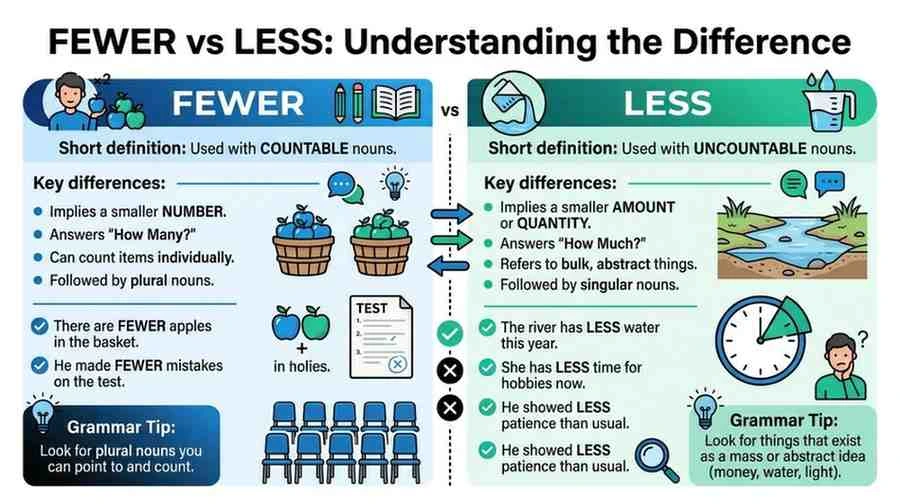
Fewer vs Less – Quick Answer
The main difference is simple:
- Fewer is used for things you can count (countable nouns)
- Less is used for things you cannot count (uncountable nouns)
Easy Examples:
- Fewer apples (you can count apples)
- Fewer students (you can count students)
- Less water (you cannot count water easily)
- Less sugar (you cannot count sugar grains in daily use)
Simple Rule:
If you can count it → use fewer
If you cannot count it → use less
The Origin of Fewer and Less
Both words come from old forms of the English language.
- Less comes from the Old English word “læssa”, meaning smaller amount or lower degree. It has been used for many centuries to describe quantities that cannot be counted easily.
- Fewer comes from the Old English word “fēawer”, which means a smaller number of items. It developed later to clearly separate countable items from uncountable ones.
Over time, English speakers felt the need to separate “number” and “amount.” That is why “fewer” became common for countable nouns, while “less” stayed for uncountable nouns.
This change helped make English grammar more structured and easier to understand.
British English vs American English Spelling
In this case, both British and American English follow the same grammar rule for “fewer” and “less.” There is no major spelling difference, but usage habits can vary slightly.
Key Difference in Usage Style:
| Situation | British English | American English |
| Countable nouns | Fewer students | Fewer students |
| Uncountable nouns | Less water | Less water |
| Informal speech | Sometimes “less people” used loosely | Same informal usage |
| Formal writing | Strict rule followed | Strict rule followed |
Important Note:
Both UK and US English prefer correct grammar in formal writing. However, in casual speech, people sometimes break the rule and say “less people,” even though it is not correct.
Which Should You Use?
Your choice depends on what you are talking about:
Use “Fewer” when:
- You can count items one by one
- You are talking about numbers
Examples:
- Fewer cars on the road
- Fewer mistakes in homework
- Fewer emails today
Use “Less” when:
- You cannot count individual units easily
- You are talking about quantity or amount
Examples:
- Less time
- Less money
- Less water
- Less noise
Simple Trick:
Think “numbers = fewer”
Think “amount = less”
Common Mistakes with Fewer vs Less
Many learners make simple mistakes with these words.
Mistake 1:
❌ Less people are coming
✔ Fewer people are coming
Mistake 2:
❌ Fewer water in the bottle
✔ Less water in the bottle
Mistake 3:
❌ Less apples on the table
✔ Fewer apples on the table
Mistake 4:
❌ I have less friends than before
✔ I have fewer friends than before
Why these mistakes happen:
People mix countable and uncountable nouns. In fast speech or writing, the rule is often ignored, but in proper English, it matters.
Fewer vs Less in Everyday Examples
1. Emails and Formal Writing
- We received fewer complaints this month.
- There is less delay in the process now.
2. Social Media Posts
- Less drama, more peace.
- Fewer followers but better engagement.
3. News Reports
- Fewer accidents were reported this year.
- Less pollution in the city after new rules.
4. Office Communication
- We need fewer meetings this week.
- There is less workload today.
These examples show how both words are used in real life depending on the situation.
Fewer vs Less – Google Trends & Usage
Search interest shows that “fewer vs less” is a very popular grammar query worldwide.
Why people search this:
- Students preparing for exams
- English learners improving grammar
- Writers checking correct usage
- Job applicants improving CVs and emails
High search regions:
- United States
- India
- Pakistan
- United Kingdom
- Canada
Common pattern:
- “fewer vs less difference”
- “when to use fewer or less”
- “less vs fewer examples”
This shows that the keyword has a strong evergreen SEO value because learners always search for it.
Comparison Table:
| Feature | Fewer | Less |
| Type of noun | Countable | Uncountable |
| Meaning | Smaller number | Smaller amount |
| Example | Fewer books | Less water |
| Usage | Items you can count | Things you cannot count |
| Grammar rule | Strict in formal English | Strict in formal English |
FAQs:
1. What is the main difference between fewer and less?
Fewer is used for countable things, and less is used for uncountable things.
2. Can I say less people?
No, correct form is fewer people.
3. Is less time or fewer time correct?
Less time is correct because time is uncountable.
4. Is fewer always correct for plural nouns?
Yes, if the noun is countable and plural, use fewer.
5. Why do people confuse fewer and less?
Because in casual speech, people often ignore grammar rules.
6. Is this rule strict in English exams?
Yes, exams usually require correct usage.
7. Can less ever be used with countable nouns?
In informal English, yes, but it is grammatically incorrect in formal writing.
Conclusion:
Understanding the difference between “fewer” and “less” is very important for clear and correct English. Even though both words show a smaller amount, they are used in different situations. Fewer is used for things you can count, while less is used for things you cannot count. This simple rule helps you avoid one of the most common grammar mistakes in English writing and speaking.
If you use these words correctly, your English looks more natural, professional, and confident. Many people make mistakes like “less people” or “fewer water,” but now you know the correct usage with clear examples. The key is to always check if the noun is countable or not before choosing the word.
By practicing these rules in daily writing, emails, and conversations, you will quickly master the difference. This small grammar improvement can make a big difference in your overall communication skills. Keep practicing, and soon it will become automatic for you to choose the right word every time.

Ethan Carter is a language writer at Wordellect who helps readers understand word differences, grammar rules, and spelling variations through simple and accurate guides.







