Many people get confused about farther vs further. The two words look almost the same. They also sound very similar. Because of this, writers, students, and English learners often do not know which one to use.
You may have seen sentences like “The school is farther away” and “For further information, call us.” Both words seem to mean “more” or “a greater distance.” This is why many people search for the difference between them.
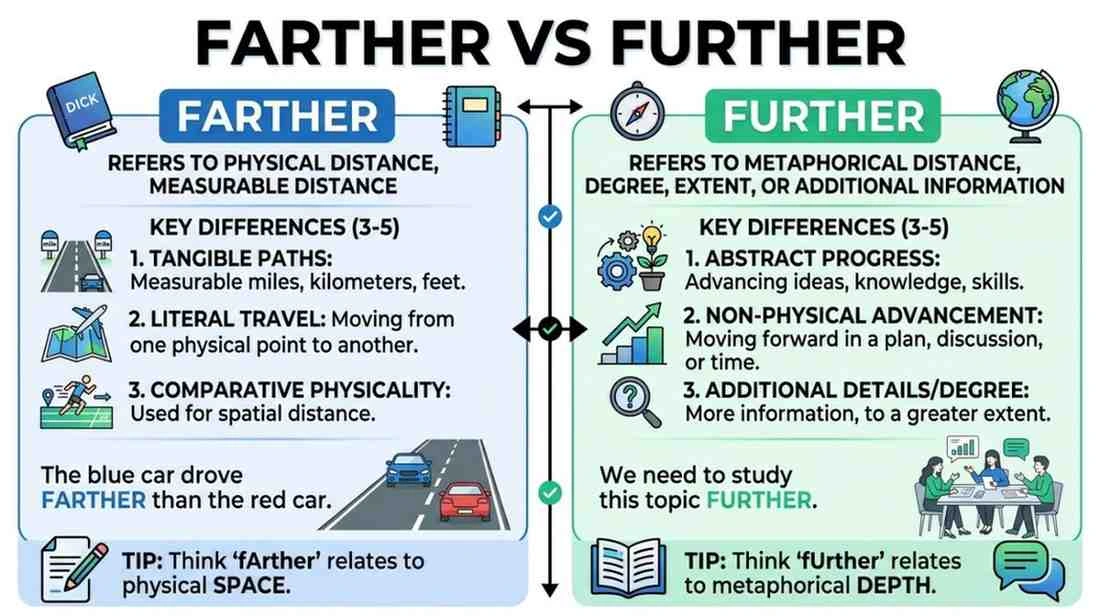
The good news is that understanding farther vs further is not hard. In most cases, farther is used for a real distance that you can measure. Further is used when talking about more information, more work, more progress, or something that is not a physical distance.
By the end, you will feel confident using both words correctly in your writing and speech.
Farther vs Further – Quick Answer
The easiest way to remember the difference is this:
- Farther = physical distance
- Further = more information, more progress, or more discussion
Examples
✅ The park is farther than the library.
✅ We walked farther down the road.
✅ For further details, visit our website.
✅ We need further discussion before making a decision.
Quick Table
| Word | Meaning | Example |
| Farther | A greater physical distance | The beach is farther away. |
| Further | More or additional | Further information is available online. |
The Origin of Farther vs Further
The words farther and further come from an old English word that meant “far away.”
Hundreds of years ago, people used different spellings of the same word. Over time, English changed. New spellings appeared. Two of those spellings became farther and further.
For many years, people used both words in the same way. There was no clear rule. Later, grammar experts suggested a simple difference.
They said:
- Use farther for real distance.
- Use further for ideas, progress, and extra information.
Today, many people follow this rule because it makes writing clearer.
Origin Comparison Table
| Word | Early Meaning |
| Farther | More distant |
| Further | More distant or more advanced |
Even now, some people still use the words interchangeably. However, following the modern rule is usually the best choice.
British English vs American English Spelling
When talking about farther vs further, there is not a major spelling difference between British English and American English.
Both countries use both words.
The difference is mainly in preference.
American English
In the United States, writers often follow the traditional rule.
Examples:
- New York is farther from here.
- We need further information.
British English
In the United Kingdom, many writers use further for both meanings.
Examples:
- The station is further down the road.
- Further details will follow.
Comparison Table
| Situation | American English | British English |
| Physical distance | Farther preferred | Further often used |
| Extra information | Further | Further |
| Progress | Further | Further |
| Formal writing | Both used | Both used |
Because of this, you may see different usage depending on the country.
Which Spelling Should You Use?
The answer depends on who will read your writing.
For American Readers
Use:
- Farther for physical distance.
- Further for extra information.
Examples:
- The hotel is farther away.
- Further details are below.
For British Readers
You can usually use further for both meanings.
Examples:
- The shop is further down the street.
- Further action is needed.
For International Readers
The safest choice is to follow the traditional rule.
Use:
- Farther = physical distance
- Further = additional information
This helps everyone understand your meaning quickly.
Easy Tip
Think about the word far.
If you are talking about something that is physically far away, choose farther.
If you are talking about more information or progress, choose further.
Common Mistakes with Farther vs Further
Many people make mistakes because the words are very similar.
Here are some common errors.
Mistake 1
❌ We need farther information.
✅ We need further information.
Why?
Information is not a physical distance.
Mistake 2
❌ Please read farther before deciding.
✅ Please read further before deciding.
Why?
You mean “read more.”
Mistake 3
❌ We need to discuss this farther.
✅ We need to discuss this further.
Why?
Discussion is not a measurable distance.
Mistake 4
❌ The mountain is further than the lake.
The mountain is farther than the lake.
Why?
The sentence talks about physical distance.
Mistake 5
❌ Further and farther always mean exactly the same thing.
✅ They are similar, but they often have different uses.
Why?
Modern English usually separates the meanings.
Farther vs Further in Everyday Examples
Learning from real examples makes grammar easier.
In Emails
- Please contact us for further assistance.
- Further details are attached.
- We will discuss this further tomorrow.
In News Articles
- The fire spread farther than expected.
- Further investigation is underway.
- Officials will provide further updates soon.
On Social Media
- We traveled farther than planned today.
- Stay tuned for further news.
- We need to look into this further.
At School
- The library is farther from my house.
- Further study can improve your grades.
- The teacher gave further instructions.
At Work
- The office is farther from the city center.
- Further training is available.
- We need further discussion before approval.
In Daily Conversation
- Can we walk farther?
- Tell me further details.
- The next town is farther away.
These examples show how often both words appear in everyday life.
Farther vs Further – Google Trends & Usage Data
People search for farther vs further every month because it is a common grammar question.
Search data shows that many students and writers want a simple answer.
What Usage Data Shows
- Further is used much more often.
- Farther appears less frequently.
- Many style guides recommend using the traditional rule.
Countries Where People Search This Topic
Many searches come from:
- United States
- United Kingdom
- Canada
- Australia
- India
These countries use English every day, so people often want to improve their grammar skills.
Why Further Is More Popular
The word further can mean many things:
- More
- Additional
- Extra
- Advanced
- Continued
Because it has several meanings, it appears more often in books, websites, newspapers, and business documents.
Common Contexts
| Context | More Common Word |
| Business writing | Further |
| School writing | Further |
| Physical travel | Farther |
| Directions | Farther |
| Research | Further |
| News reports | Further |
Comparison Table
This table gives a quick overview.
| Feature | Farther | Further |
| Physical distance | Yes | Sometimes |
| Extra information | No | Yes |
| Progress | No | Yes |
| Discussion | No | Yes |
| Travel directions | Yes | Sometimes |
| Business writing | Rare | Common |
| Academic writing | Rare | Common |
| Everyday use | Less common | More common |
FAQs:
1. What is the main difference between farther and further?
Farther usually refers to physical distance. Further usually refers to additional information or progress.
2. Which word is more common?
Further is more common because it has more meanings and uses.
3. Can I use further for distance?
Yes. Many people, especially in British English, use further for distance.
4. Can I use farther for information?
No. Standard English prefers further information.
5. Is farther correct in American English?
Yes. It is commonly used when talking about measurable distance.
6. Is further correct in formal writing?
Yes. It is very common in business, academic, and professional writing.
7. How can I remember the difference?
Use farther for something physically far away. Use further for everything else.
8. Are farther and further interchangeable?
Sometimes they are, but following the traditional rule makes writing clearer.
Conclusion:
Understanding farther vs further can improve your English writing and speaking. Although the words look similar and have related meanings, they are often used in different ways.
The simplest rule is to use farther when talking about physical distance. If you can measure the distance with miles, kilometers, or steps, farther is usually the correct choice. American English often follows this distinction closely. British English sometimes uses further for both meanings. Even so, using farther for distance and further for everything else is the clearest approach for most readers.
Whenever you are unsure, ask yourself a simple question: “Am I talking about a real distance?” If the answer is yes, use farther. If the answer is no, use further.
By remembering this easy rule and practicing with examples, you can avoid common mistakes and write with confidence. The more you use these words correctly, the more natural they will become in your everyday English.

Ethan Carter is a language writer at Wordellect who helps readers understand word differences, grammar rules, and spelling variations through simple and accurate guides.







