You’re measuring something. Maybe a shelf, a room, or how tall your kid grew this year. You grab a tape measure, and then you pause. Do you say it in feet? Or inches? It sounds like a small thing, but picking the wrong one can make a measurement confusing fast.
Here’s the good news. This one is easy once you know the simple rule behind it.
The Fast Answer
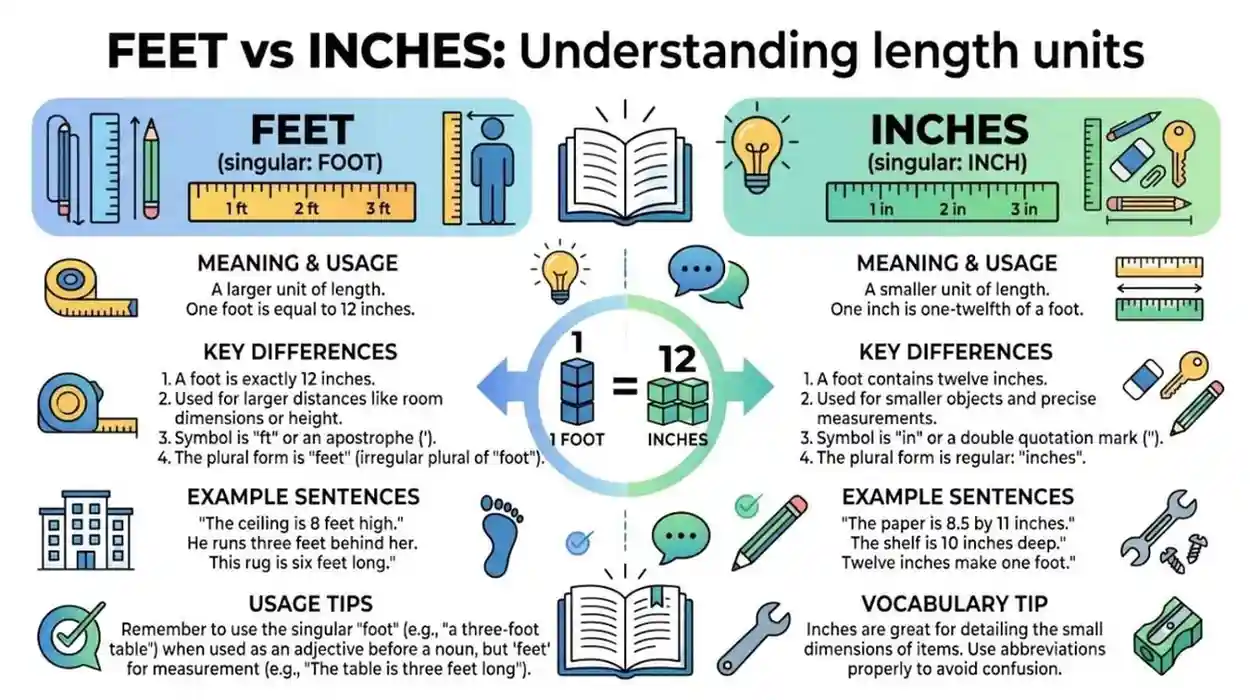
Feet work best for bigger things. Think rooms, walls, or how tall a person is.
Inches work best for smaller things. Think a phone screen, a picture frame, or a small gap between two items.
- “The room is 10 feet wide.” (a bigger space)
- “The gap under the door is 2 inches.” (a small space)
Both are units of length. The only real question is: how big is the thing you’re measuring?
Why People Mix These Up
Both units measure the same basic thing: length. So it’s easy to grab whichever one comes to mind first, even if it’s not the best fit.
The mix-up also happens since feet and inches work together, not apart. One foot equals twelve inches. So the line between “big enough for feet” and “small enough for inches” can feel a little blurry at first.
Where These Units Came From
Both units go back a long way, tied to old ways people used their own bodies to measure things. A “foot” was once based on, well, an actual human foot. An “inch” came from an old word tied to the width of a thumb.
Over time, these rough, body-based measurements turned into fixed, standard units. Twelve inches became locked in as one foot, and this system stuck around in the US long after many other countries moved to the metric system instead.
This is part of why the US still uses feet and inches every day, while much of the world uses meters and centimeters instead.
A Closer Look at Each Unit
Feet are the natural choice once something gets past a foot or two in length. Think about the height of a door, the width of a room, or how far you’d walk to get somewhere close by. Feet keep the numbers small and easy to picture.
Inches shine when things get small. Think about the size of a phone, the length of a pencil, or the space between two shelves. Using feet here would mean dealing with awkward little fractions, like “0.3 feet,” which just isn’t as clear as saying “4 inches.”
Side-by-Side Table
| Feet | Inches | |
| Best for | Bigger things | Smaller things |
| Common use | Rooms, height, distance | Screens, gaps, small objects |
| One foot equals | 12 inches | — |
| Example | “The wall is 8 feet tall.” | “The book is 9 inches wide.” |
A Simple Way to Remember
Try this trick: if you could comfortably measure it by walking heel to toe a few times, use feet. If you’d need a small ruler and careful, tiny steps to measure it, use inches.
Easy rule: big and roomy, go with feet. Small and precise, go with inches.
Common Mistakes People Make
MISTAKES
1: Wrong: “The room is 120 inches wide.” Fix: “The room is 10 feet wide.” (Big spaces read easier in feet.)
2: Wrong: “The phone screen is 0.5 feet long.” Fix: “The phone screen is 6 inches long.” (Small items read easier in inches.)
3: Wrong: Mixing feet and inches without labeling clearly, like writing “5 10” instead of “5 feet 10 inches.” Fix: Always label both units clearly to avoid confusion, especially when writing someone’s height.
4: Wrong: Forgetting that 12 inches equals 1 foot when converting between the two. Fix: Always double-check your math. A common slip is dividing or multiplying by the wrong number.
Everyday Examples
In a text message: “Can you grab a shelf that’s about 3 feet long?”
In a product listing: “This laptop screen measures 15.6 inches diagonally.”
On social media: “My son is officially 4 feet 8 inches now. Growing way too fast!”
In a home improvement guide: “Leave a 2 inch gap between the cabinet and the wall for ventilation.”
Search Trends and Usage Data
People search “feet or inches” for a few clear reasons.
- Home improvement and DIY: Many people search this while measuring for furniture, shelves, or renovation projects, wanting to pick the clearer unit.
- Parents: A lot of searches come from tracking a child’s height, unsure whether to write it in feet and inches together, or just one unit.
- Online shoppers: People often check product listings, comparing sizes in inches for smaller items like phones, laptops, and picture frames.
Both units stay in steady, everyday use, especially in the US, where the metric system isn’t the default.
Frequently Asked Questions
1. How many inches are in a foot? There are always 12 inches in one foot. This never changes.
2. Should height always be written in feet and inches together? Yes, typically. Most people write height as both together, like “5 feet 6 inches,” rather than picking just one.
3. Is there a rule for when a measurement is “too small” for feet? Not an official rule, but once a measurement drops under a foot, inches almost always read more clearly.
4. Do other countries use feet and inches too? A few do in specific contexts, like the UK sometimes using feet and inches for height, but most countries rely on meters and centimeters instead.
5. Can you mix feet and inches in one measurement? Yes, this is common, especially for height or furniture, like saying “6 feet 2 inches.”
6. Why does the US still use feet and inches instead of the metric system? It’s mostly due to history and habit. The US never fully switched to the metric system the way most other countries did.
7. Is there an easy way to convert between the two? Yes. Multiply feet by 12 to get inches, or divide inches by 12 to get feet.
The Bottom Line:
Feet or inches? Both measure length, but they work best at different sizes. Feet are the natural pick for bigger things, like rooms, height, and distance. Inches are the natural pick for smaller things, like screens, gaps, and small objects.
Next time you’re not sure which one to use, just think about the size of what you’re measuring. Big and roomy, go with feet. Small and precise, go with inches. That one quick check will keep your measurements clear every time.

Ethan Carter is a language writer at Wordellect who helps readers understand word differences, grammar rules, and spelling variations through simple and accurate guides.







