You’re getting dressed for a cold day. You open your closet and grab something warm. Was that a coat you just put on? Or was it a jacket? Most of us use these words without thinking twice, but they actually mean two different things.
Here’s the good news. Once you know the small rule, you’ll never mix them up again.
The Fast Answer
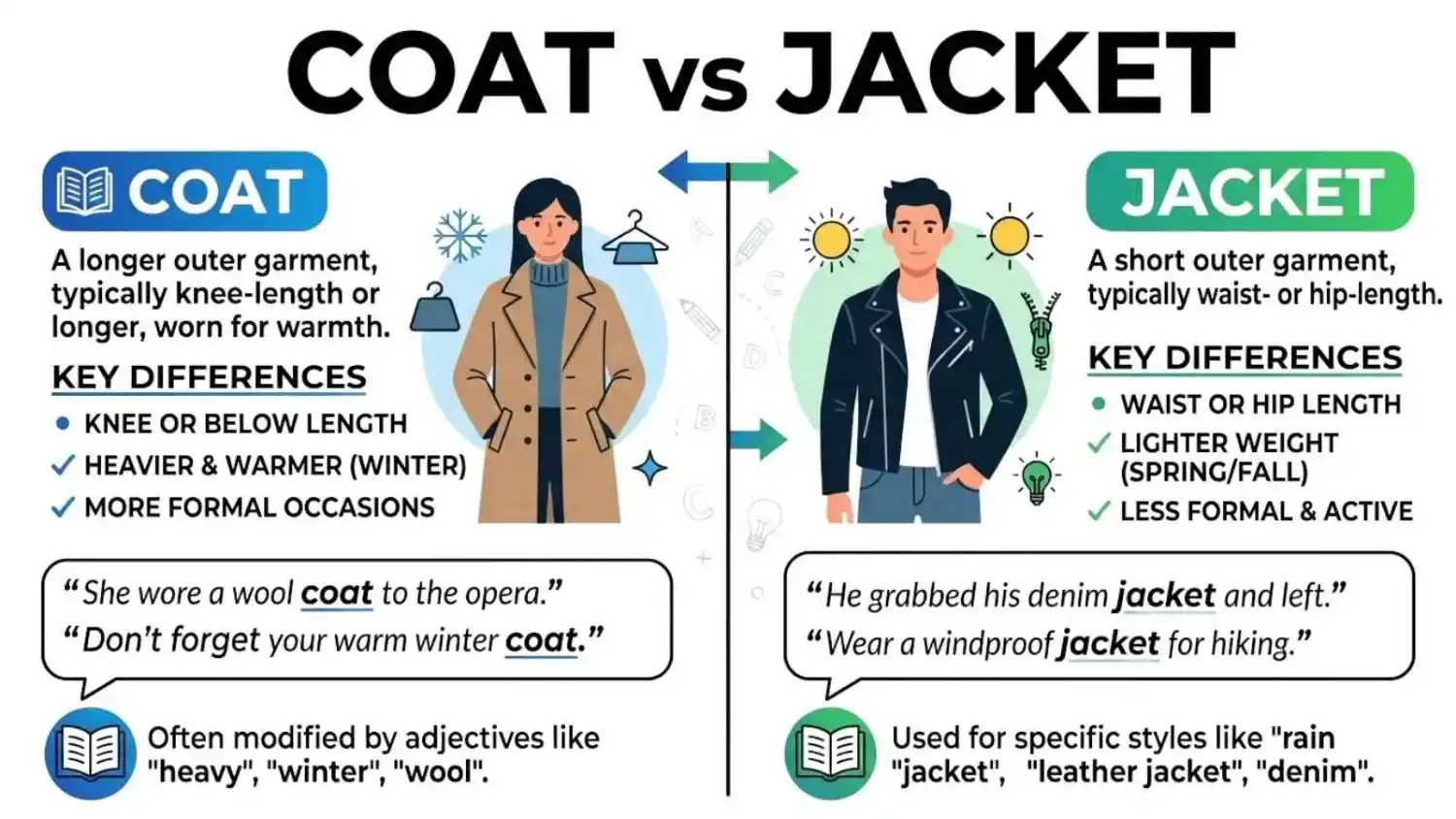
Coats are usually longer, heavier, and made for real cold weather. They often go past your hips.
Jackets are usually shorter and lighter. They often stop around your waist.
- “I wore my thick winter coat to walk through the snow.” (long, heavy, warm)
- “I grabbed a light jacket since it was just a bit chilly out.” (short, light)
Both keep you warm. But size and weight are what really set them apart.
Why People Mix These Up
Both words point to something you wear over your regular clothes to stay warm. Since they do such a similar job, a lot of people use them like they’re the same word, without thinking about the small difference underneath.
The line between the two can also feel blurry, since some jackets are heavy, and some coats are lighter than others. There’s no strict rule enforced by anyone, so a lot of the difference comes down to length, weight, and how the item is designed to be worn.
Where These Words Came From
Coat has been part of English for a very long time, tracing back to an old French word for a tunic or outer garment. For centuries, it simply meant any piece of clothing worn over other clothes, and it slowly narrowed down to mean the long, warm outer layer we picture today.
Jacket also comes from French, tied to a word for a short, close-fitting garment. Unlike “coat,” it kept its shorter, more fitted meaning from early on, which is part of why jackets today still tend to be shorter and closer to the body compared to coats.
So even though both words describe outerwear, their roots already pointed toward two slightly different shapes and lengths, long ago.
A Closer Look at Each One
Coats are built for real cold. Think of a heavy winter coat, a long wool coat, or a trench coat. They’re designed to trap heat and block wind, often with thicker material and a longer cut that covers more of your body.
Jackets are built for lighter cover or milder weather. Think of a denim jacket, a bomber jacket, or a rain jacket. They’re usually easier to move in, simpler to carry around, and better suited for layering over other clothes.
Side-by-Side Table
| Coat | Jacket | |
| Length | Usually longer, past the hips | Usually shorter, around the waist |
| Warmth level | Heavier, built for cold weather | Lighter, built for mild weather |
| Common types | Winter coat, trench coat, wool coat | Denim jacket, bomber jacket, rain jacket |
| Best for | Snow, deep cold, long walks outside | Cool days, layering, quick errands |
A Simple Way to Remember
Try this trick: coat is a longer word, and it usually means a longer piece of clothing. Jacket is a shorter word, and it usually means a shorter piece of clothing.
Easy rule: if it covers your hips and thighs, call it a coat. If it stops around your waist, call it a jacket.
Common Mistakes People Make
Mistake 1: Wrong: Calling every piece of outerwear a “jacket,” even a long winter coat.
Fix: Save “jacket” for shorter pieces, and use “coat” for anything longer and heavier.
Mistake 2: Wrong: Thinking a coat is always warmer than a jacket.
Fix: Some jackets, like heavy winter jackets, can be just as warm as lighter coats. Length matters more than the word itself here.
Mistake 3: Wrong: Assuming there’s one strict rule that applies to every single item.
Fix: The line can get blurry with some styles. When in doubt, go with whichever word feels most natural for the length and weight of the item.
Mistake 4: Wrong: Using “coat” for something clearly cropped and short, like a cropped denim style.
Fix: Shorter, cropped pieces almost always read more naturally as “jackets.”
Everyday Examples
In a text message: “Don’t forget your coat, it’s freezing outside today!”
In a store listing: “This lightweight jacket is perfect for spring layering.”
On social media: “New winter coat finally arrived and I’m obsessed with how warm it is.”
In a weather-related tweet: “Grab a jacket, not a full coat, today’s forecast is mild but breezy.”
Search Trends and Usage Data
People search “coat or jacket” for a few clear reasons.
- Online shoppers: Many people search this while shopping for outerwear, trying to pick the right category for the weather they’re dressing for.
- People new to colder climates: Some searches come from people who recently moved somewhere colder, wanting to understand what level of warmth each word usually implies.
- Writers and content creators: Fashion writers and bloggers often double check this distinction to keep their product descriptions accurate and clear.
Both words stay in steady, everyday use, especially as the seasons shift and shopping habits change throughout the year.
Frequently Asked Questions
1. Is a coat always warmer than a jacket? Not always, but generally yes. Coats tend to be built with heavier material and a longer cut, made specifically for colder weather.
2. Can something be both a coat and a jacket? Some styles blur the line, but most items lean clearly toward one word based on length and weight.
3. Why do some brands use “jacket” for heavier winter items? Branding and marketing sometimes bend the rules a bit, especially with items like heavy winter jackets that function more like coats.
4. Is there a length that officially separates the two? There’s no strict, official rule, but anything past the hips is usually called a coat, while anything shorter is usually called a jacket.
5. Do British and American English use these words differently? Not significantly. Both regions generally follow the same length-based distinction between coats and jackets.
6. Which one is better for layering? Jackets are usually easier to layer under a coat, since they’re lighter and less bulky.
7. Is a blazer a coat or a jacket? A blazer is considered a type of jacket, since it’s shorter and more fitted, even though it’s often worn in formal settings.
The Bottom Line:
Coat or jacket? Both keep you warm, but they’re built a little differently. Coats are usually longer and heavier, made for real cold weather. Jackets are usually shorter and lighter, made for milder days or easy layering.
Next time you’re picking one out, think about the length and how cold it really is outside. Long and heavy points to coat. Short and light points to jacket. That one quick check will help you pick the right word, and the right layer, every time.

Ethan Carter is a language writer at Wordellect who helps readers understand word differences, grammar rules, and spelling variations through simple and accurate guides.







