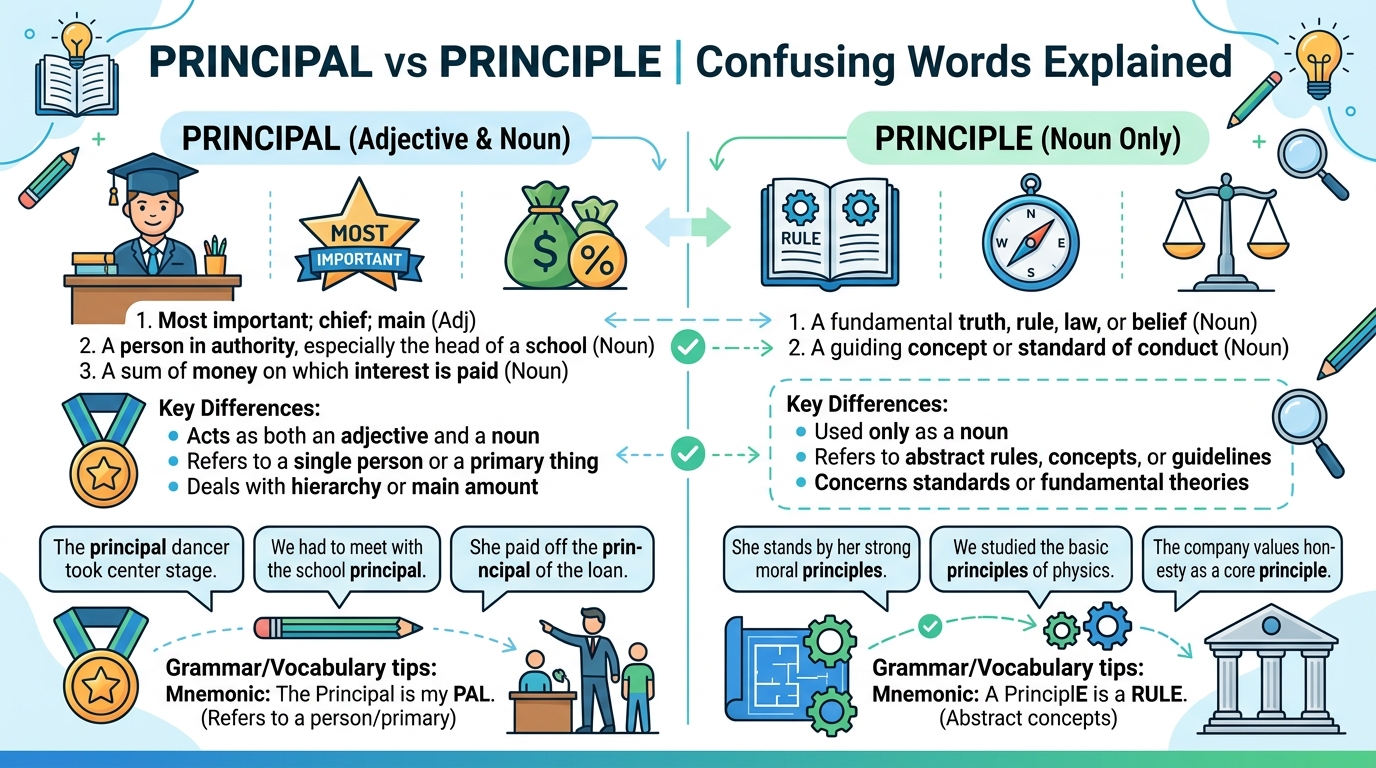
Many English learners get confused when they see the words “principal” and “principle.” They look almost the same, and when spoken, they sound exactly the same. Because of this, people often use the wrong word in writing, speaking, exams, emails, and even professional documents. This is one of the most common English mistakes worldwide.
The confusion becomes bigger because both words are very common in daily life. Students hear “principal” in school when talking about the head of the school. At the same time, they also hear “principle” when talking about rules, values, or moral ideas. Since both words are used in different situations, learners often mix them up.
This topic is important because using the wrong word can completely change the meaning of a sentence. For example, saying “school principle” instead of “school principal” is incorrect and confusing. Small spelling differences can create big misunderstandings in English communication.
In this guide, you will learn the simple difference between “principal vs principle” in very easy English. You will see meanings, rules, history, examples, tables, mistakes, FAQs, and real-life usage so you can understand and never confuse them again.
Principal vs Principle – Quick Answer
The difference is simple and clear:
- Principal = a person or something most important
- Principle = a rule, belief, or idea
Easy Examples:
- The principal of the school is kind.
- She follows strong moral principles.
- Our principal goal is success.
- This is a basic principle of science.
Simple Rule:
If it is a person or main thing → principal
If it is a rule, idea, or belief → principle
The Origin of Principal and Principle
Both words come from Latin, but their meanings developed differently over time.
Principal Origin:
The word principal comes from the Latin word principalis, which means “first,” “chief,” or “most important.” In old times, it was used to describe someone who is the leader or main authority. Later, English adopted it to mean the head of a school or something most important.
Principle Origin:
The word principle comes from the Latin word principium, which means “beginning” or “fundamental truth.” It was used to describe basic rules or foundations of thinking. Over time, it became a word used for moral rules, laws, and ideas.
Simple Understanding:
- Principal = main person or important role
- Principle = basic rule or belief
This historical difference is the reason why the spelling looks similar but meaning is different.
British English vs American English Usage
There is no difference in spelling between British and American English for these words. Both use the same forms.
However, learners still get confused because both words are used in different contexts.
Comparison Table:
| Situation | British English | American English |
|---|---|---|
| School head | Principal | Principal |
| Moral rule | Principle | Principle |
| Main importance | Principal idea | Principal idea |
| Scientific rule | Principle | Principle |
| Spelling difference | None | None |
Important Point:
Both British and American English follow the same rule. The confusion is not regional, it is meaning-based.
Which Word Should You Use?
Choosing the correct word depends on the meaning of your sentence.
Use “Principal” when:
- You are talking about a person (especially school or authority)
- You mean something most important
Examples:
- The principal called a meeting.
- Our principal reason is safety.
- She met the school principal today.
Use “Principle” when:
- You are talking about rules, beliefs, or ideas
- You are describing moral values or scientific laws
Examples:
- He lives by strong principles.
- This principle is used in physics.
- She believes in honesty as a principle.
Simple Memory Trick:
- Principal = Person / Priority
- Principle = Rule / Right idea
Common Mistakes with Principal vs Principle
Many learners make simple but serious mistakes.
Mistake 1:
❌ The principle of the school is absent
✔ The principal of the school is absent
Mistake 2:
❌ He follows strong principals
✔ He follows strong principles
Mistake 3:
❌ This is the main principle of the company (when meaning “important person”)
✔ This is the main principal of the company
Mistake 4:
❌ School principle announced holidays
✔ School principal announced holidays
Why mistakes happen:
- Same pronunciation
- Similar spelling
- Lack of meaning understanding
Principal vs Principle in Everyday Examples
1. School Life
- The principal gave a speech in assembly.
- Students must follow school principles.
2. Office Communication
- Our principal goal is customer satisfaction.
- The company follows strict ethical principles.
3. News Reports
- The school principal met parents.
- The law is based on democratic principles.
4. Social Media
- Respect is my main principle in life.
- Met my school principal today.
5. Science Context
- This principle explains gravity.
- The principal investigator led the research team.
Principal vs Principle – Google Trends & Usage Data
Search data shows that “principal vs principle” is a highly searched grammar topic globally.
Why people search this keyword:
- English exam preparation
- Grammar learning
- Writing improvement
- Job applications and CV writing
- School assignments
Top countries:
- India
- Pakistan
- United States
- United Kingdom
- Philippines
Common search phrases:
- principal vs principle difference
- when to use principal or principle
- principal or principle examples
- easy difference between principal and principle
SEO Insight:
This keyword is evergreen because English learners constantly struggle with spelling and meaning differences.
Comparison Table: Principal vs Principle
| Feature | Principal | Principle |
|---|---|---|
| Meaning | Main person or most important thing | Rule, belief, or idea |
| Type | Noun / Adjective | Noun |
| Usage | Education, authority, importance | Ethics, science, laws |
| Example | School principal | Moral principle |
| Memory Tip | Think “principal = person” | Think “principle = rule” |
FAQs about Principal vs Principle
1. What is the main difference between principal and principle?
Principal means a person or main thing, principle means a rule or belief.
2. How do I remember principal and principle?
Principal has “pal” like friend, so think of a person.
3. Is principal always a person?
Mostly yes, but it can also mean “main” or “most important.”
4. Can principle be plural?
Yes, principles means rules or beliefs.
5. Why are these words confusing?
Because they sound the same but have different meanings.
6. Is spelling different in UK and US English?
No, both use the same spelling.
7. Can I replace one with the other?
No, it will change the meaning completely.
Conclusion (150–200 words)
Understanding the difference between “principal” and “principle” is very important for clear English communication. These two words are often confused because they look and sound very similar, but their meanings are completely different. Principal is used for a person, such as the head of a school, or something that is most important. On the other hand, principle is used for rules, beliefs, or basic ideas that guide behavior or thinking.
Many learners make mistakes with these words in writing and speaking, especially in exams, emails, and formal communication. However, once you understand the simple meaning-based rule, it becomes very easy to choose the correct word. Always remember: principal is linked to a person or importance, while principle is linked to rules and ideas.
By practicing real-life examples and reading carefully, you can quickly master this difference. Over time, you will naturally start using both words correctly without thinking. Small grammar improvements like this can greatly improve your English writing skills and make your communication more professional, clear, and confident.

Ethan Carter is a language writer at Wordellect who helps readers understand word differences, grammar rules, and spelling variations through simple and accurate guides.







