You write a sentence. You pause. Should it be “exist” or “exists”? This small word trips up many writers, students, and even native speakers.
The answer depends on one thing: who or what is doing the action. English verbs change a little based on the subject. “Exist” and “exists” are not two random choices. They follow a clear, simple rule.
People search this word while writing essays, emails, reports, and social media posts. Some are not sure which form matches a singular subject. Others get confused with words like “everyone,” “data,” or “options,” which can feel tricky.
This article gives you the fast answer first. Then it explains the rule, common mistakes, and easy examples. After this, you will never second-guess this word again.
Exist or Exists – Quick Answer
Here is the short rule:
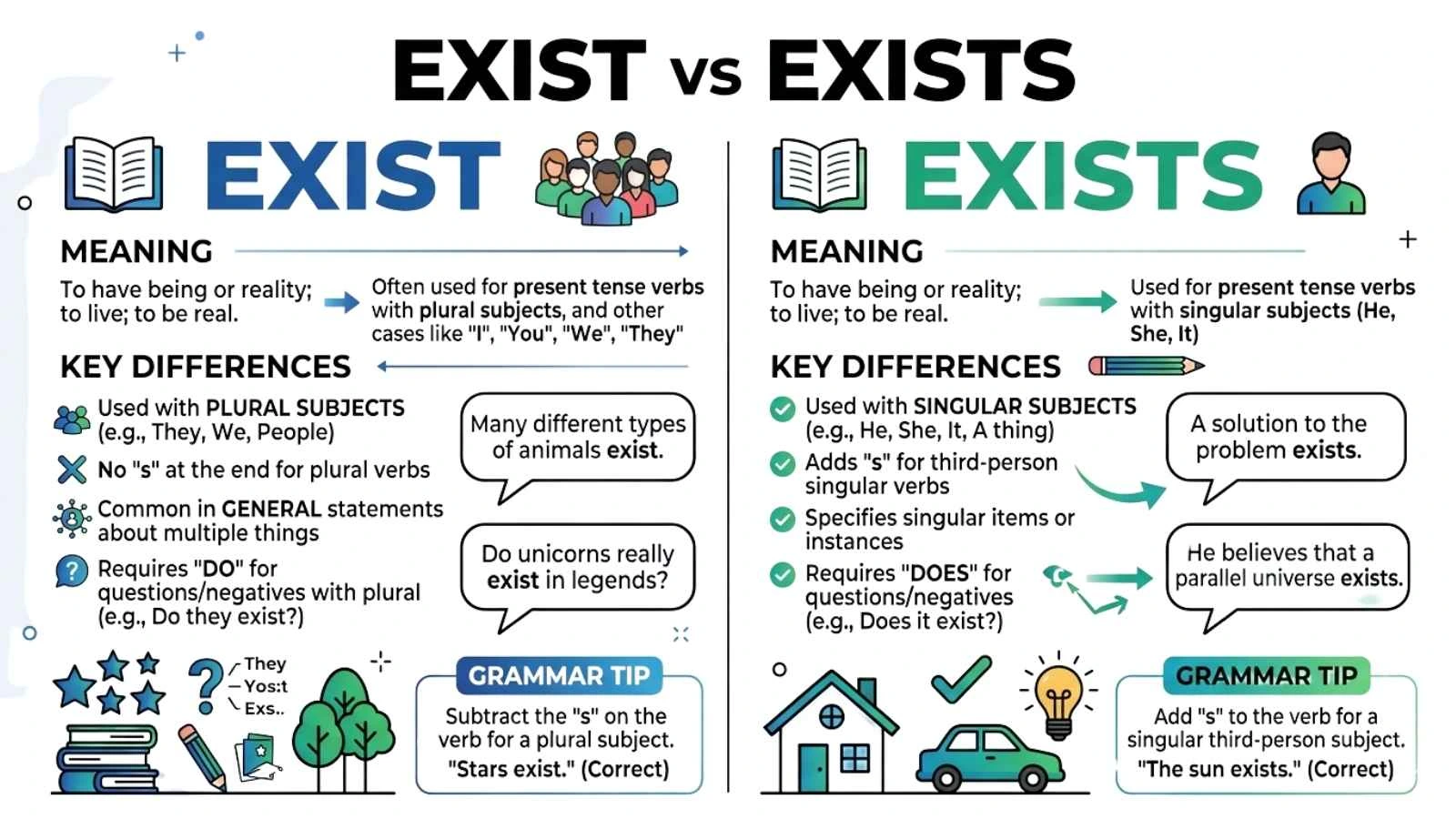
- Use “exist” with plural subjects, or with “I,” “you,” “we,” and “they.” Example: Many problems exist in this plan.
- Use “exists” with singular subjects, like “he,” “she,” “it,” or one named thing. Example: A problem exists in this plan.
The rule is simple: one thing “exists.” More than one thing “exist.”
The Origin of Exist or Exists
The word “exist” comes from an old Latin word meaning “to come forth” or “to be.” English borrowed this word hundreds of years ago and kept its basic meaning: to be real, or to be present.
The “s” at the end is not random. English verbs add an “s” in the present tense when the subject is singular and not “I” or “you.” This is called subject-verb agreement. It is one of the oldest patterns in English grammar.
So “exists” is not a separate word. It is the same word, “exist,” with an ending added to match a singular subject. This pattern is the same for most English verbs, like “run” and “runs,” or “work” and “works.”
Singular vs Plural Subjects
This is not a British versus American English issue. Both regions follow the exact same grammar rule here.
| Subject | Correct Verb | Example |
| I | exist | I exist in this story too. |
| You | exist | You exist as a key character. |
| He / She / It | exists | She exists only in his memory. |
| We | exist | We exist as one team. |
| They | exist | They exist in the old files. |
| A single noun (the rule, a problem) | exists | A problem exists in the plan. |
| A plural noun (the rules, the problems) | exist | Many problems exist in the plan. |
Both UK and US English use this same table. There is no spelling difference here, only the regular grammar rule.
Which Form Should You Use?
Pick the verb based on your subject, not your location or writing style.
- Singular subject (he, she, it, one item): Use “exists.”
- Plural subject (we, they, many items): Use “exist.”
- Tricky group words like “team” or “data”: “Team” is usually treated as one group, so use “exists” (“The team exists to support customers”). “Data” is often treated as plural in careful writing, so many writers use “exist” (“These data exist in the report”), though casual use often treats “data” as singular.
- Formal writing, like reports or essays: Double-check your subject before choosing the verb. Small mismatches stand out in formal work.
The real question is simple: is the subject one thing, or more than one?
Common Mistakes with Exist or Exists
Here are mistakes people often make:
- Using “exists” with a plural subject. Wrong: Many options exists for this project. Right: Many options exist for this project.
- Using “exist” with a singular subject. Wrong: This rule exist for a good reason. Right: This rule exists for a good reason.
- Getting confused by words between the subject and verb. Wrong: The list of problems exists. (correct, since “list” is singular) Wrong: The list of problems exist. (incorrect, ignore “problems” here, since “list” is the real subject)
- Mixing up “they” with a single named person. Wrong: My friend exist in this photo too. Right: My friend exists in this photo too.
- Forgetting the rule with “there.” Wrong: There exist a simple answer. Right: There exists a simple answer. (since “answer” is singular) Right: There exist many answers. (since “answers” is plural)
Exist or Exists in Everyday Examples
In an email: “A small issue exists with the current schedule.”
school essay: “Many theories exist about how this happened.”
news article: “A gap still exists between the two sides of the debate.”
social media post: “Real friendships still exist, even online.”
In a formal report: “Several risks exist within the current plan, and they should be reviewed.”
Each example follows the same rule: one thing gets “exists,” more than one thing gets “exist.”
Exist or Exists – Search Trends & Usage Data
People search this grammar pair often while writing school papers, work emails, and online content. Search interest stays fairly steady year-round, since grammar questions like this come up anytime someone writes in English, not just during one season.
English learners search this pair more than native speakers, since subject-verb agreement is one of the harder rules to fully memorize. Common searches include checking the verb form after tricky subjects like “everyone,” “each,” or “data.”
This question is common across the US, UK, Canada, and other English-speaking regions, since the grammar rule does not change by country.
Comparison Table: Keyword Variations
| Variation | Correct? | Use Case |
| Exist | ✅ Yes | Plural subjects, or I/you/we/they |
| Exists | ✅ Yes | Singular subjects (he/she/it/one item) |
| Existed | ✅ Yes | Past tense, any subject |
| Existing | ✅ Yes | Present participle, used as adjective or with “is/are” |
FAQs:
1. Is it “exist” or “exists” with “everyone”? Use “exists,” since “everyone” is treated as singular in standard grammar.
2. Is it “exist” or “exists” with “data”? Careful or formal writing often treats “data” as plural, using “exist.” Casual writing often treats “data” as singular, using “exists.” Either can work depending on your style guide.
3. Why does English add an “s” to verbs like this? This follows the subject-verb agreement rule. Singular subjects (other than “I” and “you”) usually take a verb ending in “s” in the present tense.
4. Is “exist” or “exists” used after “there”? It depends on what comes after. Use “exists” before a singular noun, and “exist” before a plural noun.
5. Do British and American English follow different rules here? No. Both follow the exact same subject-verb agreement rule.
6. What is the past tense of “exist”? The past tense is “existed,” and it stays the same for every subject.
7. Why do people often get this wrong? Because extra words between the subject and the verb can confuse the eye, making it easy to match the verb to the wrong word.
Conclusion:
The choice between “exist” and “exists” comes down to one simple question: is the subject one thing, or more than one? “Exists” matches a singular subject, like “he,” “she,” “it,” or one named item. “Exist” matches a plural subject, like “we,” “they,” or many items.
This rule stays the same across American, British, and global English. There is no regional spelling difference here, only the standard grammar rule of subject-verb agreement that applies to most English verbs.
Watch for the biggest trap: extra words sitting between the subject and the verb. Always look back to find the true subject before picking “exist” or “exists.” Once you remember this simple check, this word pair becomes easy to use correctly every time, whether you are writing an email, an essay, or a quick online post.

Ethan Carter is a language writer at Wordellect who helps readers understand word differences, grammar rules, and spelling variations through simple and accurate guides.







