Have you ever seen the symbol ≥ and wondered what it means? You are not alone. Many students see this sign in math problems, charts, and schoolwork but are not sure how to read it.
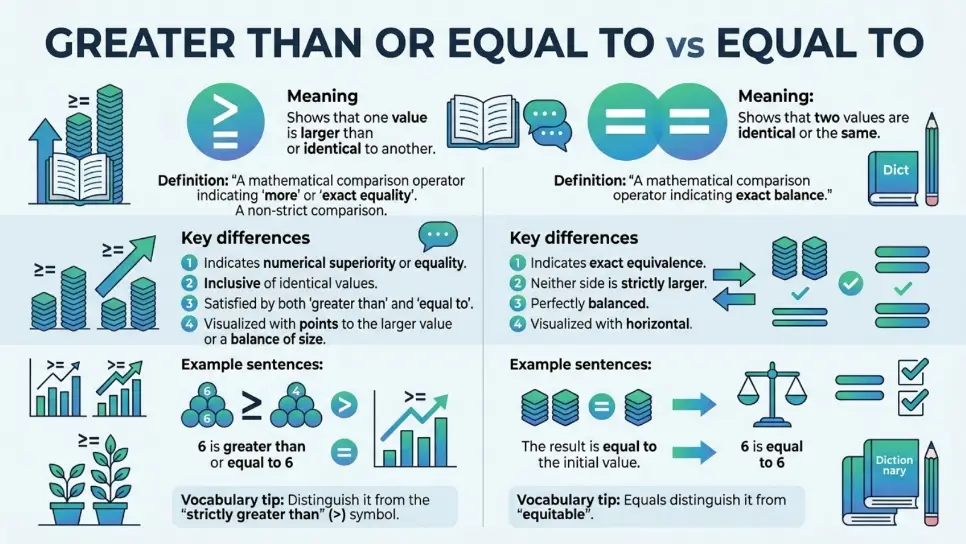
The phrase “greater than or equal to” is used when one number can be larger than another number or exactly the same. Its math symbol is ≥.
For example:
x ≥ 5
This means x is greater than or equal to 5. So, x can be 5, 6, 7, 10, 100, or any number greater than 5.
People often search for “greater than or equal to” because they want to know the correct symbol, meaning, spelling, or way to use it in a math problem. Some people also confuse it with “greater than” (>), which does not allow the two numbers to be equal.
This guide explains the meaning of greater than or equal to, its symbol, examples, common mistakes, and how to use it in school, work, and everyday writing.
Greater Than or Equal To – Quick Answer
Greater than or equal to means that one number is larger than another number or the same as that number.
The symbol is:
≥
For example:
8 ≥ 5
This is true because 8 is greater than 5.
Now look at:
5 ≥ 5
This is also true because the two numbers are equal.
What Does ≥ Mean?
The symbol ≥ has two parts:
- > means greater than.
- = means equal to.
Together, ≥ means greater than or equal to.
Simple Examples
| Math statement | Meaning | True or False? |
| 10 ≥ 5 | 10 is greater than or equal to 5 | True |
| 5 ≥ 5 | 5 is equal to 5 | True |
| 3 ≥ 5 | 3 is greater than or equal to 5 | False |
| 20 ≥ 20 | 20 is equal to 20 | True |
| 9 ≥ 12 | 9 is greater than or equal to 12 | False |
A simple way to remember it is:
≥ means “more than or the same as.”
The Origin of Greater Than or Equal To
The phrase “greater than or equal to” comes from basic mathematical language. It describes a relationship between two values.
The symbol ≥ was created to make this idea faster to write. Instead of writing:
x is greater than or equal to 5
a person can simply write:
x ≥ 5
The symbol combines the ideas of greater than and equal to.
The greater-than sign > and less-than sign < became common mathematical symbols in the 1600s. The equal sign = was also introduced in the 1600s.
Later, combined signs such as ≥ and ≤ became common ways to show that equality is also allowed.
There is no special British or American spelling for this phrase. The phrase is written the same way in both forms of English:
greater than or equal to
The symbol is also the same:
≥
This is important because some people search for a spelling difference when the real issue is the math meaning and symbol.
British English vs American English Spelling
There is no spelling difference between British English and American English for greater than or equal to.
Both use:
greater than or equal to
Both use:
≥
The phrase is used in math books, school lessons, science, business, and technical writing in both British and American English.
| Use | British English | American English |
| Phrase | greater than or equal to | greater than or equal to |
| Symbol | ≥ | ≥ |
| Short form | ≥ | ≥ |
| Meaning | Larger than or the same as | Larger than or the same as |
| Spelling difference | None | None |
Related Math Terms
| Term | Symbol | Meaning |
| Greater than | > | One value is larger |
| Greater than or equal to | ≥ | One value is larger or the same |
| Less than | < | One value is smaller |
| Less than or equal to | ≤ | One value is smaller or the same |
| Equal to | = | Both values are the same |
So, if you are writing for a British or American audience, you do not need to change the spelling.
Which Spelling Should You Use?
There is only one standard spelling:
greater than or equal to
You can use it in both British and American English.
If you are writing a school answer, use the full phrase when you need to explain the symbol:
The symbol ≥ means greater than or equal to.
If you are solving a math problem, the symbol is usually shorter and easier:
x ≥ 10
If you are writing a formal report, you can use either the words or the symbol. The best choice depends on the type of writing.
For Students
Use the full phrase when learning the idea:
7 is greater than or equal to 7.
Then use the symbol:
7 ≥ 7
For Math and Science
The symbol is often best:
Temperature ≥ 20°C
For General Readers
Write the phrase when you want to make the meaning clear:
The score must be greater than or equal to 80.
The main rule is simple: do not change the spelling based on whether you use British or American English.
Common Mistakes with Greater Than or Equal To
People often make mistakes because greater than, greater than or equal to, and equal to have different meanings.
Mistake 1: Using > Instead of ≥
Incorrect when equality is allowed:
x > 10
If the rule says x can also be 10, this is wrong.
Correct:
x ≥ 10
The difference is important.
x > 10 means x must be more than 10.
x ≥ 10 means x can be 10 or more.
Mistake 2: Thinking ≥ Means Only Greater Than
The symbol ≥ includes equality.
For example:
6 ≥ 6
is true.
The two numbers do not need to be different.
Mistake 3: Reading the Symbol Backward
Look at:
10 ≥ 5
Read it as:
10 is greater than or equal to 5.
The wide, open side faces the larger value.
Mistake 4: Confusing ≥ With ≤
These symbols have opposite meanings.
≥ = greater than or equal to
≤ = less than or equal to
For example:
10 ≥ 5 is true.
But:
5 ≥ 10 is false.
Mistake 5: Adding “Than” in the Wrong Place
The standard phrase is:
greater than or equal to
Not:
greater or equal than
Not:
greater then or equal to
Remember that than is used for comparison.
Greater Than or Equal To in Everyday Examples
Although greater than or equal to is mainly used in math, you can also see it in science, business, school rules, computer programs, and reports.
In School
A teacher may write:
Students need a score ≥ 70 to pass.
This means students need a score of 70 or higher.
In Science
A science report may say:
The temperature must be ≥ 100°C.
This means the temperature must be 100°C or higher.
In Business
A company may set a rule such as:
Orders ≥ $50 qualify for free shipping.
This means an order of exactly $50 qualifies, as do orders above $50.
In Email
Someone might write:
Please make sure the total is greater than or equal to 100 before sending the report.
This is clear and formal.
In Social Media
A math teacher may post:
Remember: ≥ means greater than or equal to!
This is a simple way to teach the symbol.
In Formal Writing
The full phrase can make a rule easy to understand:
Applicants must be 18 years old or greater than that age.
In many cases, however, “18 or older” sounds more natural in everyday English.
For example:
Applicants must be 18 or older.
This has the same basic meaning as:
Age ≥ 18
Greater Than or Equal To – Google Trends & Usage Data
People search for “greater than or equal to” for many reasons. Common reasons include school homework, math lessons, online tests, coding, spreadsheets, and general questions about math symbols.
Search interest can also change during school terms because students often look up math terms while studying or doing homework.
The phrase is used around the world because mathematical symbols are mostly universal. Students in the United States, United Kingdom, Canada, Australia, India, and many other countries use ≥ to show the same mathematical idea.
However, exact Google search interest can change over time and by country. Search tools may also group related searches, such as:
- greater than or equal to symbol
- greater than or equal to sign
- greater than or equal to meaning
- greater than or equal to symbol in keyboard
- greater than or equal to examples
- greater than or equal to in math
The most useful point is that ≥ has the same basic meaning across standard math use.
Comparison Table: Greater Than and Related Terms
| Term | Symbol | Can the numbers be equal? | Example |
| Greater than | > | No | 8 > 5 |
| Greater than or equal to | ≥ | Yes | 8 ≥ 5 or 8 ≥ 8 |
| Less than | < | No | 3 < 7 |
| Less than or equal to | ≤ | Yes | 3 ≤ 7 or 3 ≤ 3 |
| Equal to | = | Yes, must be equal | 5 = 5 |
This table shows why the equal part of ≥ matters.
How to Remember ≥
A simple trick can help you remember the symbol.
Think of the symbol ≥ as having an open side and an equal line.
The open side points toward the larger number.
For example:
9 ≥ 4
The open side faces 9 because 9 is larger.
The two short lines under the sign show that the numbers can also be equal.
So:
9 ≥ 4 → greater
9 ≥ 9 → equal
Both are correct.
Greater Than or Equal To in Inequalities
An inequality compares two values.
For example:
x ≥ 5
This tells us that x can be:
5, 6, 7, 8, 9, 10…
It can also include numbers between whole numbers, such as:
5.5, 6.2, 10.75
The key point is that x cannot be less than 5.
So the statement:
x ≥ 5
means:
x is 5 or any number greater than 5.
On a number line, the solution starts at 5 and moves to the right. Because 5 is included, the point at 5 is shown as a closed dot.
FAQs ;
1. What does greater than or equal to mean?
It means one number is larger than another number or exactly the same.
For example:
7 ≥ 7 is true.
2. What is the symbol for greater than or equal to?
The symbol is:
≥
It combines the greater-than sign > with an equal line.
3. Is 5 greater than or equal to 5?
Yes.
5 ≥ 5 is true because the two numbers are equal.
4. What is the difference between > and ≥?
> means greater than only.
≥ means greater than or equal to.
For example, 5 > 5 is false, but 5 ≥ 5 is true.
5. Is “greater than or equal to” spelled differently in British English?
No. The phrase is spelled the same in British and American English.
6. What does x ≥ 10 mean?
It means x can be 10 or any number greater than 10.
Examples include 10, 11, 20, and 100.
7. What is the opposite of greater than or equal to?
The opposite relationship is less than:
<
For example:
x ≥ 10
and
x < 10
describe opposite sides of the number line.
8. Can greater than or equal to include decimal numbers?
Yes. It can include whole numbers, decimals, fractions, and other real numbers.
For example:
5.5 ≥ 5
is true.
Conclusion;
Greater than or equal to is a simple math phrase with an important meaning. Its symbol is ≥, and it means that one value is larger than another value or equal to it.
For example:
8 ≥ 5 is true because 8 is greater than 5.
Also:
5 ≥ 5 is true because the two numbers are equal.
The main difference between > and ≥ is that ≥ allows the two values to be equal. This small line under the greater-than sign changes the meaning.
There is also no British English or American English spelling difference. The phrase is written greater than or equal to in both forms of English.
When you see x ≥ 10, simply read it as “x is greater than or equal to 10.” This means x can be 10 or any value above 10.
Once you remember that ≥ means “greater than or the same as,” this math symbol becomes easy to understand and use.

Ethan Carter is a language writer at Wordellect who helps readers understand word differences, grammar rules, and spelling variations through simple and accurate guides.