You are writing a sentence. You want to point at something. Do you say “this” or “these”? Both words point at something close to you. But they don’t always work the same way. This small stop trips up a lot of people.
People look this up a lot. Both words are used to point at things. But one is for one thing, and one is for more than one thing. This makes people feel unsure, mostly when a sentence feels tricky or long.
You may worry you picked the wrong word. You may just want a fast, clear answer. Good news. This is easy to fix once you know the small rule.
By the end, you will feel sure. Let’s go step by step, in easy words.
Quick Answer
Here is the short answer.
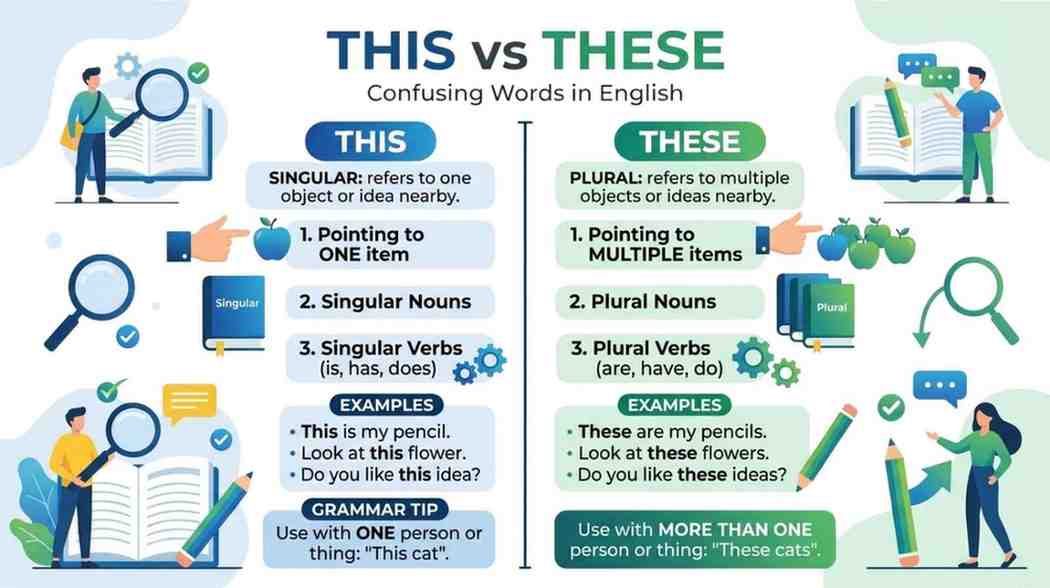
This points at one thing that is close to you.
These points at more than one thing that is close to you.
Easy examples:
- “This apple is fresh.” (one apple)
- “These apples are fresh.” (more than one apple)
In short: use “this” for one item. Use “these” for two or more items. The word you pick should match how many things you are talking about.
Where These Words Came From
Both words come from very old English. Long ago, English had more word forms than it does today, used to show number and closeness all at once.
“This” comes from an old English word that pointed at something near the speaker. It has stayed close to its old form and sound for a very long time.
“These” grew out of the plural form of “this.” Long ago, English changed many singular words into plural forms by adding new endings or small sound changes. “These” is what “this” turned into when English needed a word for more than one nearby item.
Over hundreds of years, English kept both forms, since they serve two different jobs: one for single items, and one for many items. Many other languages also have separate words for “this” and “these,” since telling one from many is such a basic and useful part of how people talk and write.
British English vs American English Spelling
This is not a British vs American spelling case, like “colour” and “color.” Both “this” and “these” are spelled and used the exact same way in the UK, the US, and all other English-speaking places.
| Word | Region | Example Sentence |
| This | US and UK | “This book is mine.” |
| These | US and UK | “These books are mine.” |
| This | Also Australia, Canada | “This idea sounds great.” |
| These | Also Australia, Canada | “These ideas sound great.” |
As you can see, there is no regional split here. The only rule that matters is whether you’re talking about one thing or more than one thing.
Which One Should You Use?
Your pick depends only on how many things you are talking about, not on where you live or how formal your writing is.
If you are talking about one item: Use “this.” Example: “This chair is broken.”
If you are talking about more than one item: Use “these.” Example: “These chairs are broken.”
You are talking about a group as one single idea: Still use “this,” since the group is treated as one thing. Example: “This team works hard,” even though a team has many people.
If you are not sure how many items you mean: Pause and count. it’s just one, use “this.” If it’s two or more, use “these.”
Easy rule to remember: This = one. These = many. Always match the word to the number of things.
Common Mistakes with These or This
People often mix these words up without noticing, mostly when writing fast. Here are common mistakes, with the fix.
Mistakes
1: Wrong: “These shoes are too small.” Fix: “These shoes are too small.” (Shoes come in a pair, so use “these.”)
2: Wrong: “These books are on the table.” Fix: “This book is on the table.” (One book needs “this.”)
3: Wrong: “I love this kind of movie.” Fix: “I love these kinds of movies,” or “I love this kind of movie.” (Match “this” or “these” with the matching singular or plural noun.)
4: Wrong: “These news is surprising.” Fix: “This news is surprising.” (“News” looks plural, but it is treated as one thing in English.)
5: Wrong: “This data are wrong.” Fix: “This data is wrong,” in most everyday writing, since “data” is often treated as one whole set of information in common use.
These or This in Everyday Examples
Let’s see how these words show up in daily life.
In an email (team update): “Please review this document before our meeting. These changes need approval by Friday.”
In news writing: “This decision affects thousands of workers. These new rules will start next month.”
On social media: “This coffee shop is my new favorite These pastries are amazing too!”
In formal or school writing: “This study looks at three key areas. These areas include health, education, and housing.”
These or This – Search Trends & Usage Data
Search interest in “these or this” often comes from students, new English learners, and writers checking grammar rules before sending or posting writing.
- United States and UK: Steady, year-round interest, mostly from students and writers double-checking basic grammar rules.
- New English learners: High and steady interest worldwide, since telling “this” from “these” is one of the first grammar rules taught in most English classes.
- Writers and editors: Some searches come from people checking tricky cases, like words such as “news” or “data,” which can feel confusing even to skilled writers.
Overall, this remains one of the most searched basic grammar topics, since it comes up in almost every type of writing, from school work to daily conversation.
Word Comparison Table
| Word | Number | Example |
| This | One (singular) | “This car is fast.” |
| These | Many (plural) | “These cars are fast.” |
| That | One, farther away | “That car is fast.” |
| Those | Many, farther away | “Those cars are fast.” |
Frequently Asked Questions
1. Is “this” only used for things that are close by? Yes. “This” and “these” both point to things that are near you, while “that” and “those” point to things farther away.
2. Why do some words like “news” and “data” feel confusing? These words look plural because of their spelling, but they are often treated as one whole idea in English, so they usually pair with “this,” not “these.”
3. Can “this” ever be used for more than one item? No. If you are talking about more than one item, “these” is the correct word to use.
4. Is there a British vs American rule for this word pair? No. “This” and “these” work the exact same way in both British and American English.
5. How can I quickly check which word to use? Count the items you are talking about. One item means “this.” Two or more items means “these.”
6. Do young English learners often mix these words up? Yes, this is a very common early mistake, since matching singular and plural words takes some practice to learn well.
7. Does this rule apply to spoken English too? Yes. The same rule applies whether you are speaking or writing: use “this” for one item, and “these” for more than one.
Conclusion:
These or this? The answer is simple once you remember one small rule. “This” points to one item that is close to you. “These” points to more than one item that is close to you. There is no British vs American split here, and no exceptions to worry about, aside from a few special words like “news” or “data” that are treated as one whole idea.
Just remember: count first, then pick your word. One item means “this.” Two or more items mean “these.”
Next time you write a sentence and need to point at something, you’ll know exactly which word fits. This keeps your writing clear, correct, and easy to follow, every single time.

Ethan Carter is a language writer at Wordellect who helps readers understand word differences, grammar rules, and spelling variations through simple and accurate guides.