English spelling can be confusing. One small ending can change the way a word is spelled. This is why many people search for or vs er when they write English words.
The endings -or and -er often appear at the end of words that name a person who does something. For example, we write teacher, driver, and writer. But we also write actor, creator, and editor.
So, why do some words use -er while others use -or?
The answer is not as hard as it may seem. The ending -er is very common in English. We often add it to a verb to make a word for a person who does an action. The ending -or also has this job, but many words with -or came into English from Latin or French.
Still, there is no rule that works for every word. Some words must simply be learned.
In this guide, you will learn the difference between or vs er, common examples, spelling rules, mistakes, and when to use each ending.
Or vs Er – Quick Answer
Both -or and -er can be used at the end of words.
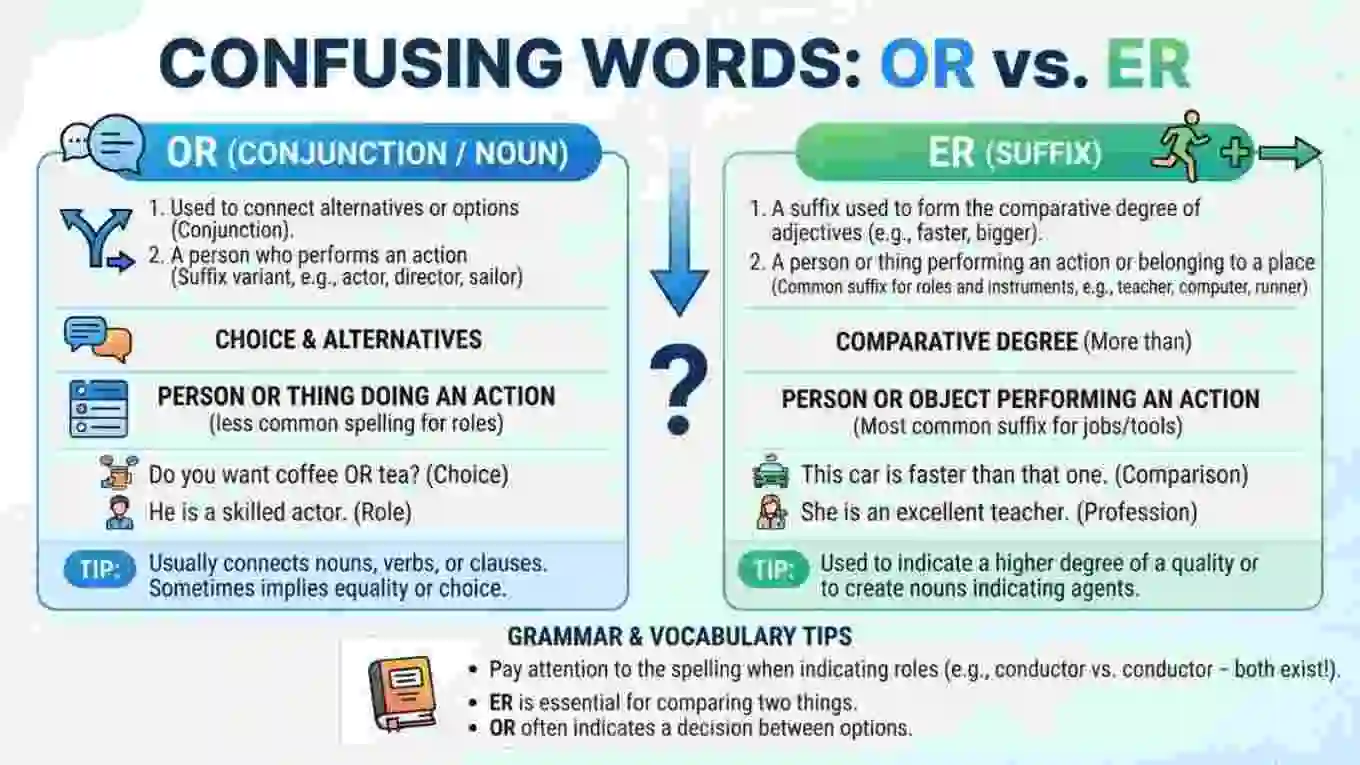
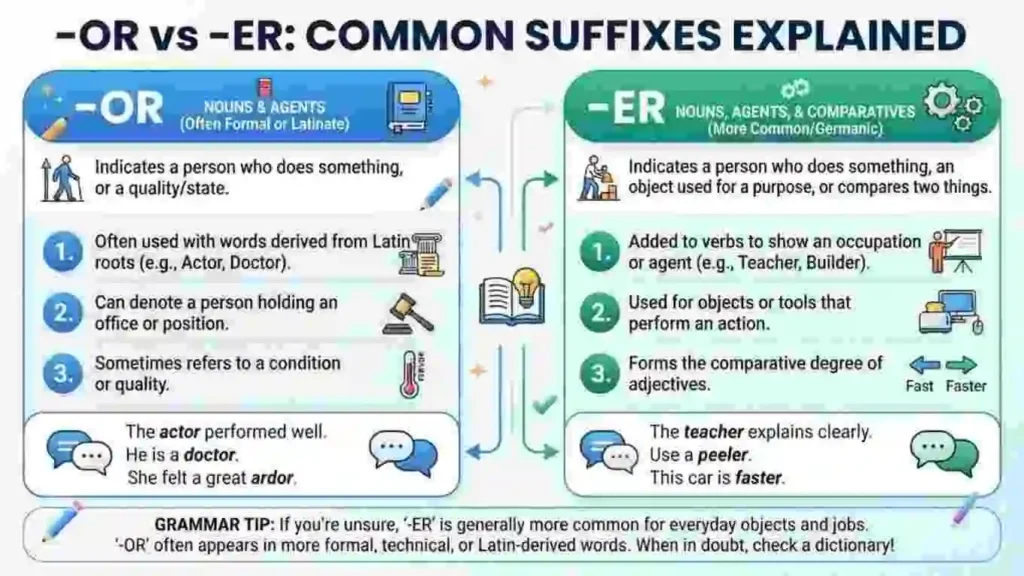
They can show a person or thing that does an action.
Words that use -er
Examples:
- teach → teacher
- drive → driver
- read → reader
- write → writer
- work → worker
- sing → singer
- run → runner
- play → player
Words that use -or
Examples:
- act → actor
- create → creator
- edit → editor
- direct → director
- operate → operator
- educate → educator
- inspect → inspector
- translate → translator
A simple way to remember it is:
-er is very common in everyday English words.
-or is common in many words that came from Latin.
But this is only a guide. It is not a perfect rule.
For example:
- teacher is correct, not teachor.
- actor is correct, not acter.
- creator is correct, not creater.
- driver is correct, not drivor.
So, when you are not sure, check the full word.
The Origin of Or vs Er
The difference between -or and -er comes from the history of English.
English has words from many languages. Old English had strong Germanic roots. Later, English took many words from French and Latin.
The ending -er has been used in English for a very long time.
We can see it in simple words such as:
- bake → baker
- farm → farmer
- teach → teacher
- work → worker
- read → reader
- speak → speaker
The ending -or often came into English through Latin and French.
Examples include:
- act → actor
- create → creator
- edit → editor
- direct → director
- inspect → inspector
- educate → educator
This is one reason English has two endings that can do a similar job.
Why does this cause confusion?
English did not grow from one language.
It borrowed words from many places. Some words kept their old endings. Other words changed over time.
This means you cannot always guess the correct spelling by looking at the verb.
For example:
create → creator
You may think the word should be creater, but the correct word is creator.
Another example is:
act → actor
The correct word is actor, not acter.
So, word history can help you understand the pattern, but you still need to learn common words.
British English vs American English Spelling
The good news is that British English and American English use most -er and -or words in the same way.
For example, both use:
- teacher
- driver
- writer
- reader
- actor
- creator
- editor
- director
- operator
There are some words where different forms are accepted or preferred.
British and American examples
| Word | British English | American English |
| Teacher | teacher | teacher |
| Driver | driver | driver |
| Writer | writer | writer |
| Actor | actor | actor |
| Creator | creator | creator |
| Editor | editor | editor |
| Director | director | director |
| Adviser | adviser / advisor | adviser / advisor |
| Adapter | adaptor / adapter | adapter / adaptor |
| Imposter | imposter / impostor | impostor / imposter |
The important point is that -or does not mean American English, and -er does not mean British English.
Both forms appear in both types of English.
What about -our and -or?
Do not confuse this topic with another spelling difference.
British English often uses:
- colour
- honour
- labour
- favour
American English often uses:
- color
- honor
- labor
- favor
This is a different spelling rule.
The or vs er question is about word endings such as:
- teacher
- actor
- creator
- driver
- editor
Which Spelling Should You Use?
The answer depends on the word and your readers.
If you write for American readers
Use the standard American spelling.
For example:
- teacher
- driver
- writer
- actor
- creator
- editor
If a word has two accepted forms, check which form is common in your field.
If you write for British readers
Use standard British English.
Most common -er and -or words stay the same.
For example:
- teacher
- reader
- writer
- driver
- actor
- creator
- director
Some words may have two accepted spellings.
If you write for a global audience
Use a common dictionary spelling.
Try to stay consistent throughout your article or website.
If a word has two accepted forms, you can mention both when it helps your readers.
The best rule
Do not change a word just because -or or -er looks better.
Learn the correct spelling of the whole word.
For example:
- creator ✅
- creater ❌
- actor ✅
- acter ❌
- teacher ✅
- teachor ❌
Common Mistakes with Or vs Er
People make several common mistakes when they try to choose between -or and -er.
Mistake 1: Writing “creater”
❌ creater
✅ creator
The correct noun from create is creator.
Mistake 2: Writing “acter”
❌ acter
✅ actor
The correct word is actor.
Mistake 3: Writing “teachor”
❌ teachor
✅ teacher
The word teacher uses -er.
Mistake 4: Thinking every verb takes -er
This is not true.
For example:
- act → actor
- create → creator
- educate → educator
- operate → operator
These words use -or.
Mistake 5: Thinking every word ending in -or is Latin
This is also not a safe rule.
English has many words with different histories. Some words have more than one accepted form.
So, word origin can give you a clue, but it cannot solve every spelling question.
Mistake 6: Changing spelling because of pronunciation
The sound of a word does not always tell you how to spell it.
For example:
creator and creater may look similar when you say them, but only creator is the standard spelling.
Or vs Er in Everyday Examples
You can see these endings in many types of writing.
In emails
-er example:
Please ask the manager to call me.
-or example:
I will contact the director today.
In news
-er example:
The driver was taken to the hospital.
-or example:
The governor gave a speech.
On social media
-er example:
I am a big book reader.
-or example:
That actor is in my favorite movie.
In school writing
You may see:
- teacher
- learner
- reader
- writer
- instructor
- professor
- editor
In formal writing
You may see:
The researcher collected the data.
Or:
The director approved the plan.
Both endings are normal in English.
Or vs Er: Comparison Table
| -er words | -or words |
| teacher | actor |
| driver | creator |
| reader | editor |
| writer | director |
| worker | operator |
| singer | educator |
| runner | inspector |
| speaker | translator |
| baker | professor |
| player | administrator |
| researcher | coordinator |
| manager | governor |
This table shows an important point.
The -er ending is very common in simple English words.
The -or ending is also common, especially in words with Latin roots.
But you should learn each word as a complete word.
Or vs Er – Google Trends & Usage Data
People search for or vs er because they want a simple answer to a spelling question.
The search is often linked to:
- English spelling
- English grammar
- word endings
- suffixes
- spelling mistakes
- English learning
- British English
- American English
- word formation
People may also search for specific words, such as:
- adviser or advisor
- adapter or adaptor
- imposter or impostor
- creator or creater
- actor or acter
The search intent is usually simple:
“Which spelling is correct?”
For most readers, the history of the word is useful, but the main goal is to find the correct spelling quickly.
Search intent by country
| Country | Common search need |
| United States | American English spelling |
| United Kingdom | British English spelling |
| Canada | British and American usage |
| Australia | British-based English usage |
| India | English learning and spelling |
| Pakistan | English spelling and grammar |
| Global | Correct word spelling |
There is no simple rule that says one country always uses -er and another always uses -or.
Most common words have the same spelling in both British and American English.
Some words have two accepted forms. In these cases, usage can depend on the country, school, company, or writing style.
FAQs About Or vs Er
1. What is the difference between -or and -er?
Both endings can make nouns that name a person or thing that does an action. -er is more common in everyday English, while -or appears in many words with Latin roots.
2. Is -er more common than -or?
Yes. The -er ending is very common.
Examples include:
- teacher
- driver
- writer
- reader
- worker
3. When should I use -or?
Use -or when that is the standard spelling of the word.
Examples include:
- actor
- creator
- editor
- director
- operator
4. Can I use -er for every person who does an action?
No.
For example:
- act → actor
- create → creator
- educate → educator
You cannot always add -er to a verb.
5. Is -or American English and -er British English?
No.
Both British and American English use -er and -or.
For example, both use teacher, driver, actor, and creator.
6. Is adviser or advisor correct?
Both adviser and advisor are accepted spellings.
The preferred form can depend on the country, organization, or writing style.
7. Is there an easy rule for or vs er?
There is a basic guide, but no rule works for every word.
-er is very common in normal English words.
-or often appears in words with Latin roots.
When you are unsure, check the spelling of the full word.
8. Why is creator not creater?
The standard English noun is creator.
The word comes from create, but English uses -or in this word.
So:
creator ✅
creater ❌
9. Why is actor not acter?
The standard word is actor.
The ending -or is part of the accepted spelling.
So:
actor ✅
acter ❌
Conclusion
The difference between or vs er is easier to understand when you look at common examples. Both endings can appear at the end of words. They can also describe a person or thing that does an action.
The ending -er is very common in everyday English. We use it in words such as teacher, driver, reader, writer, and worker. The ending -or appears in many words that came into English from Latin or French. Examples include actor, creator, editor, director, and operator.
However, word origin is only a guide. It does not give you a perfect spelling rule. English has many old words and exceptions.
British and American English also use most -er and -or words in the same way. So, you should not think that -or is always American or that -er is always British.
The safest choice is to learn the correct spelling of each word. When you are not sure, check a trusted dictionary.
For everyday and professional writing, correct spelling matters. Once you learn the most common -er and -or words, this spelling problem becomes much easier.

Ethan Carter is a language writer at Wordellect who helps readers understand word differences, grammar rules, and spelling variations through simple and accurate guides.