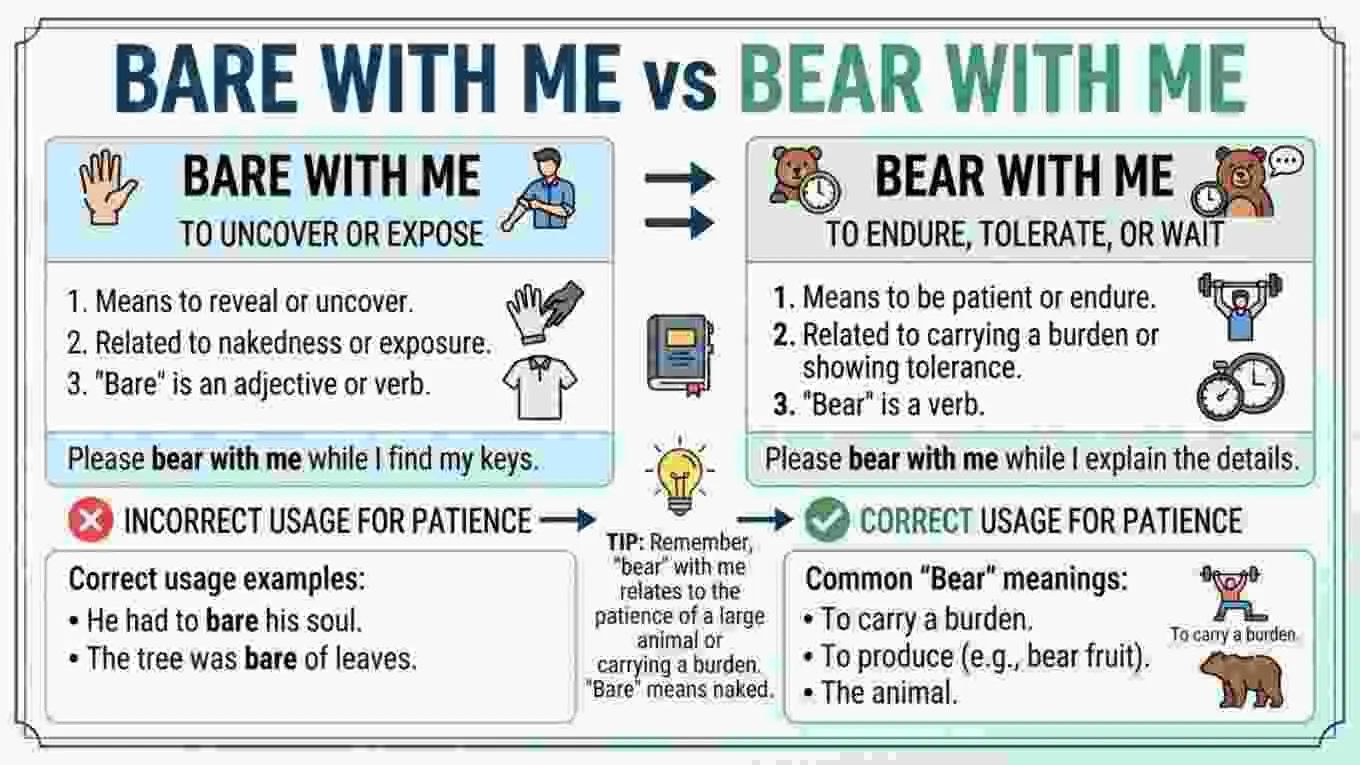
Have you ever written “bare with me” and then wondered if it should be “bear with me”? This is a very common English mistake. The two phrases sound exactly the same, but they have very different meanings.
The correct phrase is “bear with me.”
When you say “bear with me,” you are asking someone to be patient while you do something, explain something, or solve a problem. It is a polite way to say, “Please wait a little” or “Please be patient with me.”
“Bare with me” usually does not mean the same thing. The word bare means uncovered or without something. So, using “bare” in this phrase changes the meaning and usually makes the sentence wrong.
This small difference can cause problems in emails, school work, business messages, and everyday writing.
In this guide, you will learn the difference between bare with me or bear with me, why bear with me is correct, how to use it, common mistakes, and many simple examples.
Bare With Me or Bear With Me – Quick Answer
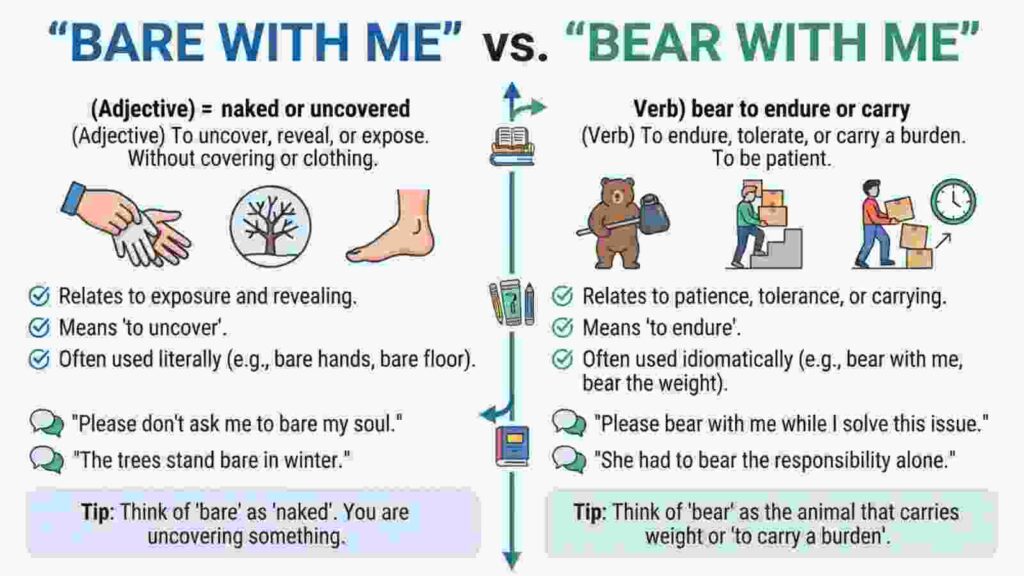
“Bear with me” is the correct phrase when you want to ask someone to be patient.
Please bear with me while I check the information.
Here, bear means to be patient with or tolerate something.
“Bare with me” is usually incorrect when you mean “please be patient.”
The word bare means uncovered, empty, or without something.
Easy rule
Bear with me = Please be patient.
Bare = Uncovered or without something.
So, if you want to ask someone to wait or be patient, always use:
Bear with me.
What Does “Bear With Me” Mean?
Bear with me means please be patient with me.
You can use this phrase when you need more time, when something takes longer than expected, or when you need to explain something.
For example:
Please bear with me while I find your file.
The speaker asks the other person to wait patiently.
Another example:
Bear with me while I explain the problem.
Here, the speaker asks the listener to stay patient during the explanation.
The phrase is common in both casual and professional English.
What Does “Bare With Me” Mean?
Bare with me is usually a spelling mistake when someone wants to say “bear with me.”
The word bare has a different meaning.
Bare can mean:
- Not covered
- Without clothes
- Empty
- Without something extra
- Plain or simple
For example:
The room had bare walls.
Here, bare means the walls had little or nothing on them.
Another example:
He walked on the bare ground.
So, bare does not mean “be patient.”
Why Do People Confuse Bare and Bear?
The main reason is simple: bare and bear sound the same in many common uses.
These words are called homophones. Homophones sound alike but have different spellings and meanings.
For example:
- Bear = be patient, or a large animal
- Bare = uncovered or without something
Because the two words sound the same, people often type the wrong one.
Easy memory trick
Remember:
Bear with me = Be patient with me.
You can connect bear with the idea of carrying or handling something difficult.
I can bear the wait.
So:
Please bear with me.
Main Difference Between Bare and Bear
| Word | Meaning | Example |
| Bear | To tolerate, handle, or be patient with something | Please bear with me. |
| Bare | Uncovered or without something | The walls were bare. |
The words look similar, but their meanings are not the same.
Why Is “Bear With Me” Correct?
The phrase uses the verb bear.
One meaning of bear is to tolerate, handle, or put up with something.
For example:
I cannot bear the noise.
This means:
I cannot tolerate the noise.
So when someone says:
Please bear with me.
They are asking you to tolerate a short delay or problem.
In simple English, it means:
Please be patient with me.
How to Use “Bear With Me”
You can use bear with me in many situations.
When you need more time
Please bear with me while I finish this report.
When you are checking something
Bear with me while I check the details.
When you are explaining something
Please bear with me while I explain the process.
When there is a delay
Bear with me. The system is taking a little longer than expected.
When learning something
Please bear with me while I learn how this works.
Is “Bear With Me” Formal or Informal?
Bear with me works in both formal and informal situations.
You can use it with friends, teachers, coworkers, customers, or other people.
Casual example
Bear with me for a minute.
Professional example
Please bear with me while I review the report.
Adding please can make the phrase sound more polite.
Origin and History
The word bear has a long history in English.
One old meaning of bear is to carry, support, endure, or tolerate something.
That meaning still appears in many modern phrases.
For example:
I cannot bear the pain.
Here, bear means tolerate or endure.
The phrase bear with me developed from this meaning. It asks another person to be patient while the speaker deals with something.
The word bare has a different history and meaning. It has long been used to describe something that is uncovered or without something.
This is why the two words should not be mixed up.
British English vs. American English
There is no major British and American English difference in this phrase.
Both British and American English use:
Bear with me.
The meaning stays the same.
| English Type | Correct Phrase |
| American English | Bear with me |
| British English | Bear with me |
| Canadian English | Bear with me |
| Australian English | Bear with me |
So, you do not need to change the phrase based on the country.
Which One Should You Use?
Use bear with me when you want someone to be patient.
In everyday writing
Bear with me for a moment.
In an email
Please bear with me while I check your request.
At work
Please bear with me while I prepare the report.
At school
Please bear with me while I explain my answer.
In formal writing
Please bear with me while I review the information.
Do not use bare with me when you mean “please be patient.”
Common Mistakes
Mistake 1: Writing “bare with me”
Incorrect:
Please bare with me.
Correct:
Please bear with me.
Why?
You are asking someone to be patient, so you need bear.
Mistake 2: Thinking “bare” means patient
Incorrect idea: Bare means to wait or tolerate.
Correct: Bear can mean tolerate or handle something.
Example:
I cannot bear the noise.
Mistake 3: Using “bear” when you mean uncovered
Incorrect:
The room had bear walls.
Correct:
The room had bare walls.
Here, bare means the walls had nothing covering or decorating them.
Mistake 4: Mixing up the animal meaning
Bear can also mean the large animal.
We saw a bear in the forest.
This is a different meaning from bear with me.
Mistake 5: Choosing by sound
Both words sound alike, so listening alone cannot help you choose the spelling.
Instead, think about the meaning.
Patient → bear
Uncovered → bare
10 Everyday Examples
- Please bear with me while I check the answer.
- Bear with me for a moment.
- Please bear with me while I fix the problem.
- Bear with me while I explain this idea.
- The customer asked us to bear with him during the delay.
- She asked her teacher to bear with her while she tried again.
- Please bear with me while I find the right file.
- Bear with me. I need a few more minutes.
- He asked everyone to bear with him during the meeting.
- Please bear with me while I learn the new system.
Examples of “Bare”
To understand the difference better, look at these examples.
- The walls were bare.
- He stood with bare feet.
- The room had only a few bare tables.
- The tree had bare branches.
- The floor was bare.
These sentences use bare because they describe something uncovered or without something.
Real-Life Usage
In Conversations
“Can you help me with this?”
“Sure. Bear with me for a minute.”
Here, the person asks the other person to wait.
In Emails
Please bear with me while I look into this issue.
This sounds polite and professional.
At Work
A manager may say:
Please bear with me while we work through this problem.
At School
A student may say:
Please bear with me while I explain my answer.
On Social Media
People also use the phrase casually:
Bear with me while I figure this out!
Related Search Questions
Is it bare with me or bear with me?
The correct phrase is bear with me when you mean “please be patient with me.” Bare means uncovered or without something, so it does not fit this common phrase.
What does bear with me mean?
Bear with me means please be patient with me. You can use it when you need more time, need to explain something, or are dealing with a delay.
What does bare mean?
Bare means uncovered, empty, plain, or without something. For example, “bare feet” means feet without shoes or socks.
Why do people say bear with me?
People say bear with me when they want another person to wait patiently or tolerate a short delay.
Is bear with me polite?
Yes. Bear with me can sound polite, especially when you add please. For example, “Please bear with me while I check the information” works well in a professional setting.
Is bare with me ever correct?
It can be correct in a very different sentence if bare has its normal meaning of uncovering something. But it is not correct when you want to say “please be patient with me.”
Is bear with me formal?
Bear with me works in both formal and informal English. In professional writing, “Please bear with me while I check the details” sounds polite and natural.
Usage and Search Trends
The phrase bare with me or bear with me is a common English spelling question because the two words sound alike.
People often search for variations such as:
- bare with me or bear with me
- bear with me or bare with me
- is it bear with me or bare with me
- bear with me meaning
- bare with me meaning
- bear with me meaning and example
- please bear with me
- what does bear with me mean
The search intent is usually simple. People want to know which phrase is correct and why.
The answer is also simple:
Use “bear with me” when you mean “please be patient with me.”
Exact search volume can change over time. Search volume should only come from a reliable keyword tool, so no made-up numbers are included here.
Comparison Table
| Phrase | Correct? | Meaning | Example |
| Bear with me | Yes | Please be patient | Please bear with me. |
| Bare with me | Usually no | Does not mean “be patient” | Please bear with me. |
| Bare | Yes | Uncovered or without something | He walked on bare feet. |
| Bear | Yes | Tolerate, carry, or endure | I cannot bear the noise. |
FAQs
1. Which is correct, bare with me or bear with me?
Bear with me is correct when you want to ask someone to be patient. The word bear can mean tolerate or handle something. Bare means uncovered or without something, so it does not have the right meaning in this phrase.
2. What is the easiest way to remember bear with me?
Think of the phrase as “be patient with me.” When you mean patience, use bear. You can also remember that bear can mean to tolerate something, which matches the meaning of the phrase.
3. Is “bare with me” always wrong?
No, but it is usually wrong when the writer means “please be patient.” In a different sentence, bare can have its normal meaning of uncovering something. The phrase people normally want is bear with me.
4. Are bear and bare homophones?
Yes. Bear and bare sound alike in many common uses, but they have different spellings and meanings. This makes them easy to confuse when writing.
5. Can I say “please bear with me”?
Yes. Please bear with me is a common and polite phrase. It works well when you need someone to wait, give you time, or stay patient while you deal with something.
6. Is “bear with me” rude?
No. The phrase is normally polite. Adding please can make it even more polite. Your tone and the situation also matter, so use it in a friendly way.
7. Can I use “bear with me” in a work email?
Yes. It works well in professional emails. For example: “Please bear with me while I review your request.” It tells the reader that you need some time and politely asks for patience.
Conclusion
The answer is simple: bear with me is the correct phrase when you want to ask someone to be patient.
For example:
Please bear with me while I check the details.
The word bear can mean to tolerate, handle, or endure something. That meaning gives us the phrase bear with me, which means please be patient with me.
The word bare has a different meaning. It can mean uncovered, empty, plain, or without something. For example:
He walked with bare feet.
Because bear and bare sound alike, people often mix them up. But their meanings are very different.
There is also no major British or American English difference in this phrase. Both forms use bear with me.
So, whenever you want to ask someone to wait or stay patient, remember this simple rule:
Need patience? Use “bear.”
Talking about something uncovered? Use “bare.”
That one small trick can help you choose the right word every time.

Ethan Carter is a language writer at Wordellect who helps readers understand word differences, grammar rules, and spelling variations through simple and accurate guides.







