Have you ever stopped while writing and wondered if you should use toward or towards? You are not alone. Both forms appear in books, websites, emails, school work, and daily speech. This can make the choice feel confusing.
The good news is simple: toward and towards are both correct.
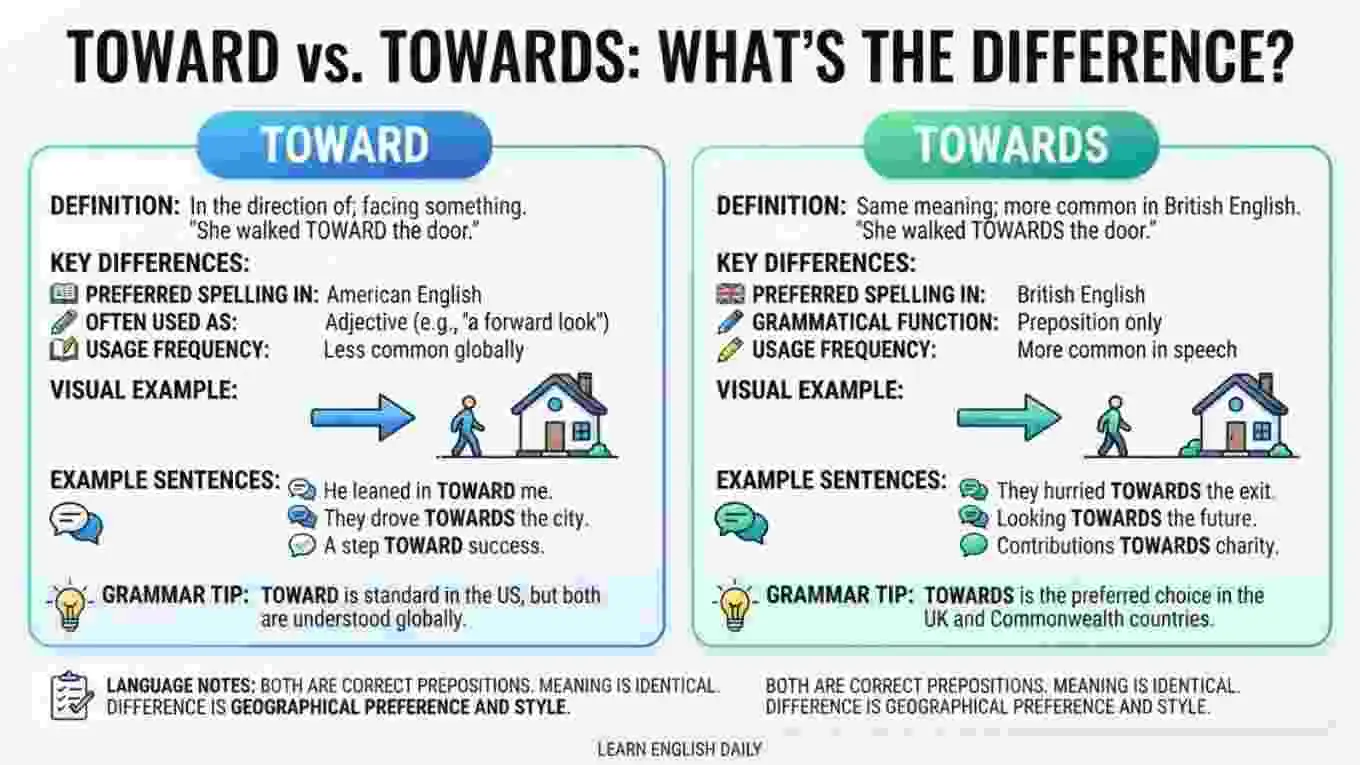
Both words have the same basic meaning. They can show movement in a direction or a change that moves closer to something. The main difference comes from English style and region.
Toward is more common in American English. Towards is more common in British English. However, both forms can appear in both types of English.
For example:
She walked toward the door.
You can also write:
She walked towards the door.
Both sentences are correct.
In this guide, you will learn the difference between toward or towards, when to use each form, how British and American English treat them, common mistakes, and many simple examples.
Toward or Towards – Quick Answer
Toward and towards are both correct spellings.
They have the same meaning and usually work in the same places.
The main difference is regional preference:
- Toward is more common in American English.
- Towards is more common in British English.
- Both are used in other English-speaking countries.
- Neither form is a spelling mistake.
Simple examples
American English:
He walked toward the car.
British English:
He walked towards the car.
The meaning does not change.
What Does Toward Mean?
Toward means moving in the direction of something.
It can describe physical movement.
The child ran toward his mother.
It can also describe a change or action that moves closer to a goal or result.
She is working toward her goal.
So, toward does not always mean that a person is physically moving.
Simple meanings of toward
Toward can mean:
- In the direction of something
- Closer to something
- In the direction of a goal
- With an attitude to someone or something
Examples
Walk toward the park.
We are moving toward a better plan.
He showed kindness toward his friend.
What Does Towards Mean?
Towards has the same basic meaning as toward.
It can also show movement, direction, progress, or an attitude.
For example:
She walked towards the window.
This means the same as:
She walked toward the window.
You can also use towards for an idea or goal.
He is working towards a new career.
Again, the meaning stays the same.
Toward vs. Towards: Main Difference
The biggest difference is English style, not meaning.
| Word | Meaning | Common Use | Example |
| Toward | In the direction of or closer to | More common in American English | She walked toward me. |
| Towards | In the direction of or closer to | More common in British English | She walked towards me. |
You can usually replace one with the other without changing the meaning.
Toward or Towards: Is One More Correct?
No.
Both toward and towards are standard English words.
You do not need to worry that one is wrong.
The best choice often depends on the type of English you use.
If you normally write in American English, toward may feel more natural.
If you normally write in British English, towards may feel more natural.
The most important thing is to stay consistent with your writing style.
When to Use Toward
Use toward when you want the shorter form that is common in American English.
Movement
The dog ran toward the gate.
Direction
Turn toward the left.
A goal
She is working toward a degree.
A change
The weather is moving toward colder conditions.
An attitude
He was kind toward his guests.
When to Use Towards
Use towards when you prefer British English style or when it fits the style of your writing.
Movement
The boy walked towards the school.
Direction
Look towards the mountains.
A goal
They are working towards success.
A change
The country is moving towards a new system.
An attitude
She showed respect towards her teacher.
Toward or Towards in American English
American English often prefers toward.
For example:
She walked toward the store.
We are moving toward our goal.
He looked toward the sky.
The company is working toward a solution.
This does not mean that towards is always wrong in American English. Americans do use it too.
However, toward is often the more common choice in American writing.
Toward or Towards in British English
British English often uses towards.
For example:
She walked towards the store.
We are moving towards our goal.
He looked towards the sky.
The company is working towards a solution.
British writers can also use toward. It is not incorrect.
So, British English does not ban toward, and American English does not ban towards.
The difference is mainly about common style.
Origin and History
The word toward comes from Old English.
The older form was linked to the idea of moving in the direction of something. Over time, English developed the forms toward and towards.
The ending -s in towards does not create a new meaning.
Both forms developed as standard English words.
Today, both forms remain in normal use.
British English vs. American English
The main difference is preference.
| Feature | American English | British English |
| Common form | Toward | Towards |
| Other form | Towards is also used | Toward is also used |
| Meaning | Same | Same |
| Pronunciation | Very similar | Very similar |
| Grammar | Same basic use | Same basic use |
So, there is no major grammar difference between them.
A simple rule
American English → toward is often preferred.
British English → towards is often preferred.
But both are correct.
Which One Should You Use?
The best choice depends on your audience.
For American English
Choose toward if you want to follow common American usage.
We are moving toward a solution.
For British English
Choose towards if you want to follow common British usage.
We are moving towards a solution.
For school writing
Use the form that matches the English style your school teaches.
For business writing
Follow your company’s style guide if it has one.
For websites
Choose one style and use it consistently.
If your website targets US readers, toward may be the better default.
If your website targets UK readers, towards may be the better default.
Common Mistakes
Mistake 1: Thinking “towards” is wrong
Wrong idea: Towards is always incorrect.
Correct: Towards is a correct English word.
Example:
She walked towards the door.
Mistake 2: Thinking “toward” is only American
Wrong idea: British English cannot use toward.
Correct: British English can use toward too.
Example:
He moved toward the window.
Mistake 3: Changing the meaning
Wrong idea: Toward and towards have different meanings.
Correct: They normally have the same meaning.
Example:
She walked toward the house.
She walked towards the house.
Both mean the same thing.
Mistake 4: Mixing styles without reason
You may use both forms in one piece of writing.
This can make your writing look less consistent.
Better: Pick the form that matches your main English style.
Mistake 5: Thinking the “-s” changes the grammar
The s in towards does not make it a plural word.
Toward and towards are both used as prepositions and can show direction or relation.
10 Everyday Examples
Here are simple examples with toward and towards.
- The boy ran toward the bus.
- She walked towards the door.
- He looked toward the sky.
- We moved towards the beach.
- The dog ran toward its owner.
- They are working towards a common goal.
- Turn toward the main road.
- She showed kindness towards the child.
- The plane flew toward the airport.
- The company is moving towards a new plan.
All of these sentences use the words correctly.
Real-Life Usage
In Conversations
People use both forms in normal speech.
“Which way is the station?”
“Walk towards the main road.”
An American speaker may say:
“Walk toward the main road.”
At School
Students may use the words when writing about goals or direction.
She worked toward her goal.
He worked towards his goal.
Both sentences are correct.
At Work
You may see these words in business writing.
The team is working toward a solution.
Or:
The team is working towards a solution.
In Emails
Both forms can work in a professional email.
We are moving toward the next stage.
Or:
We are moving towards the next stage.
On Social Media
People may use either form.
Moving toward better days.
Moving towards better days.
The choice often depends on the writer’s usual English style.
Related Search Questions
Is toward or towards correct?
Both toward and towards are correct. They have the same basic meaning. Toward is more common in American English, while towards is more common in British English.
Is toward American or British English?
Toward is often more common in American English, but British English also uses it. It is not an American-only word.
Is towards British English?
Towards is very common in British English. However, British speakers and writers can also use toward.
Do toward and towards mean the same thing?
Yes. They normally have the same meaning. Both can show direction, movement, progress, or an attitude.
Should I use toward or towards in an essay?
Use the form that matches the English style you are following. If your school uses American English, toward may be preferred. If it uses British English, towards may be preferred.
Is towards more formal than toward?
No. Neither word is clearly more formal. The main difference is regional and style-based. Both can appear in formal and informal writing.
Usage and Search Trends
People often search toward or towards because both forms appear in English writing.
Common searches include:
- toward or towards
- towards or toward
- is toward or towards correct
- toward vs towards
- toward or towards American English
- toward or towards British English
- difference between toward and towards
- should I use toward or towards
The search question usually comes down to one thing: Are both forms correct, and which one should I use?
The answer is yes, both are correct.
There is no need to treat one as a spelling mistake.
Exact search volume can change over time and can vary by country. Reliable keyword tools should be used for exact search numbers instead of guessed figures.
Toward or Towards Comparison Table
| Feature | Toward | Towards |
| Correct? | Yes | Yes |
| Basic meaning | Direction or closer to | Direction or closer to |
| Common in | American English | British English |
| Used in British English? | Yes | Yes |
| Used in American English? | Yes | Yes |
| Formal writing | Yes | Yes |
| Informal writing | Yes | Yes |
| Spelling mistake? | No | No |
FAQs
1. Which is better, toward or towards?
Neither is always better. Toward is often the better choice for American English, while towards is often the better choice for British English. If you are writing for a specific audience, match the style they use.
2. Can I use towards in American English?
Yes. Towards is used in American English too. However, toward is often more common in American writing. Using towards does not automatically make your sentence wrong.
3. Can I use toward in British English?
Yes. British English uses toward as well as towards. The form with -s is often more common, but the shorter form is still correct.
4. Is there a meaning difference between toward and towards?
No major meaning difference exists. Both words can show movement in a direction, movement closer to something, progress toward a goal, or an attitude toward someone or something.
5. Which spelling should I use for a US website?
For a US-focused website, toward is a good choice because it fits common American English style. You can still use towards, but keeping your writing consistent is usually better.
6. Which spelling should I use for a UK website?
For a UK-focused website, towards is a natural choice because it is common in British English. Still, toward is also correct and can appear in British writing.
7. Is “toward” a preposition?
Yes. Toward is commonly used as a preposition. It can show direction or a relationship. For example, in “She walked toward the door,” the word toward shows the direction of her movement.
Conclusion
So, should you use toward or towards?
The simple answer is that both are correct.
They have the same basic meaning. Both can show movement in a direction, movement closer to something, progress toward a goal, or an attitude toward someone.
The main difference comes from regional English style. Toward is more common in American English. Towards is more common in British English. But both forms can appear in both types of English.
For a US audience, toward is usually a good choice. For a UK audience, towards may feel more natural. If you write for a general audience, either form works.
You should also try to keep your writing consistent. If you choose toward, use it as your normal style. If you choose towards, use that form consistently.
Most importantly, do not think that towards is a spelling mistake or that toward is only American. Both are standard English words.
In short, choose toward for common American style and towards for common British style. The meaning

Ethan Carter is a language writer at Wordellect who helps readers understand word differences, grammar rules, and spelling variations through simple and accurate guides.







