If you study chemistry, you have likely seen the words anion or cation. These two words are easy to mix up because both describe ions. They both have an electric charge, but their charges are different.
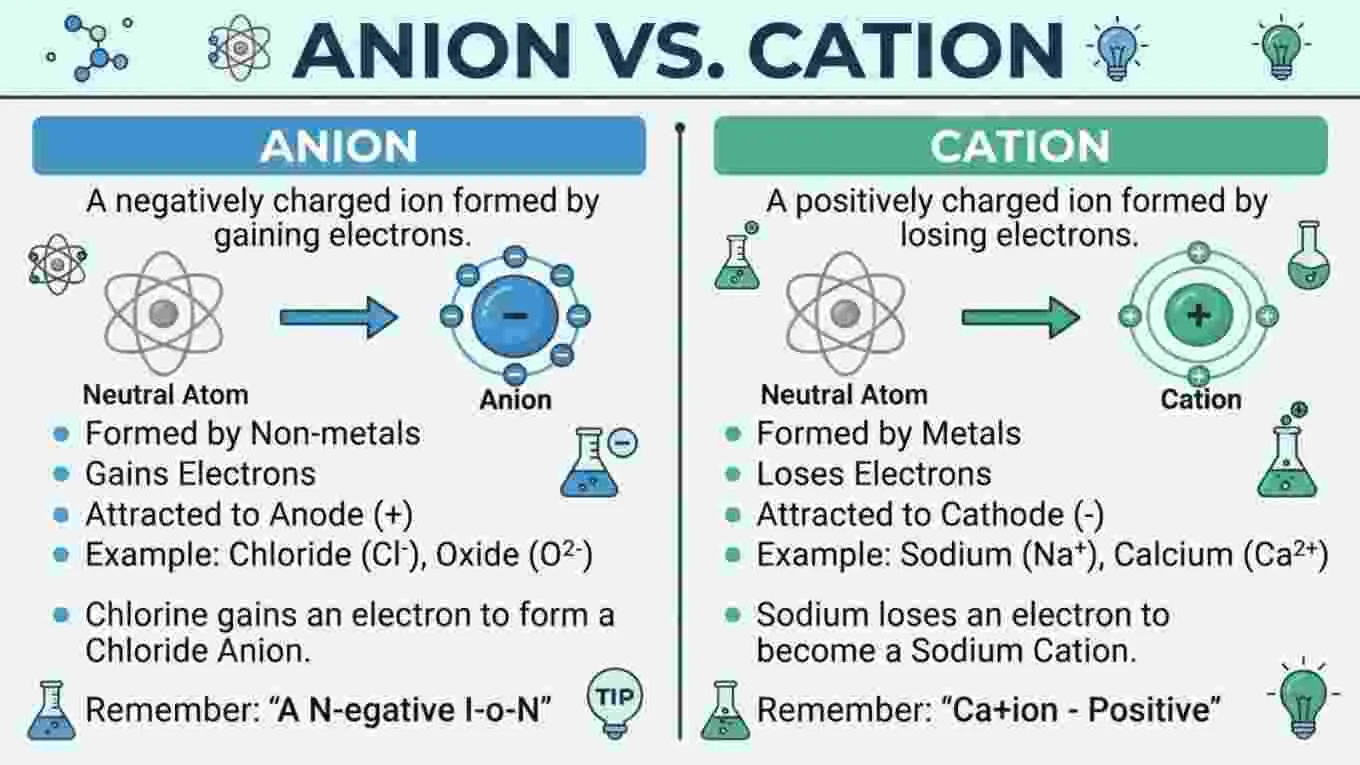
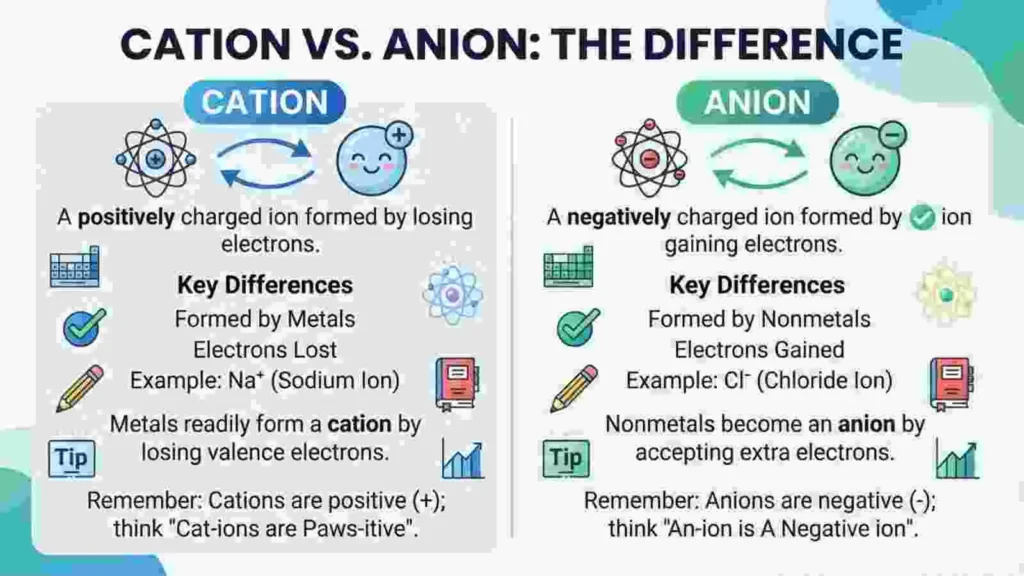
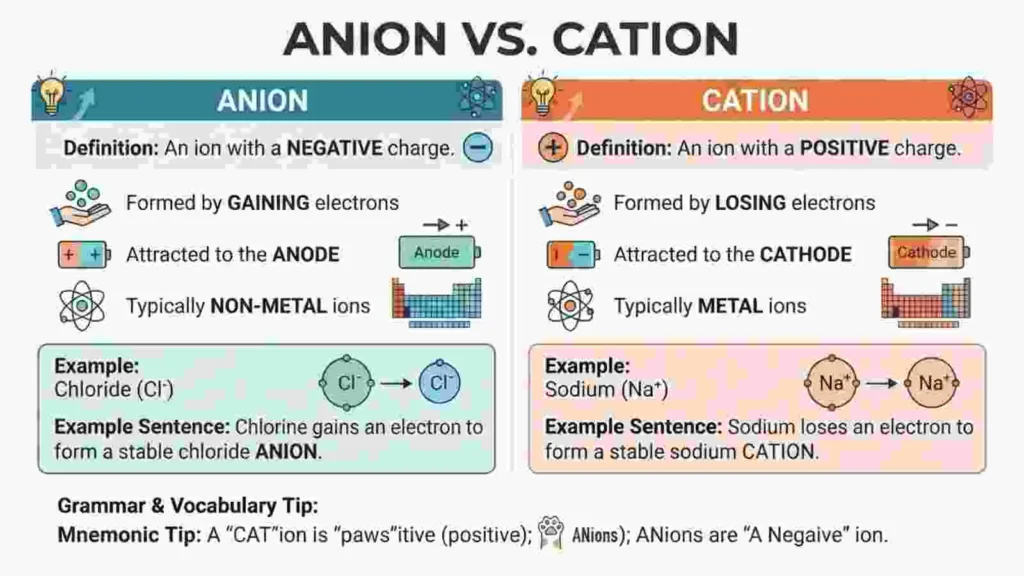
An anion is a negatively charged ion. A cation is a positively charged ion. This is the main difference you need to remember.
For example, a chloride ion, Cl⁻, is an anion because it has a negative charge. A sodium ion, Na⁺, is a cation because it has a positive charge.
Students often search for anion or cation because they want an easy way to tell these ions apart. The words can look similar, especially when you are learning chemistry for the first time. A simple memory trick can make the difference much easier.
There is also no British vs American spelling issue here. Both anion and cation are standard chemistry terms in English-speaking countries.
In this guide, we will explain what each word means, where the terms came from, common mistakes, easy examples, and a simple trick to remember which ion is positive and which is negative.
Anion or Cation: Quick Answer
The quick answer is:
Anion = negative ion (-)
Cation = positive ion (+)
| Ion | Charge | Example |
| Anion | Negative (-) | Cl⁻ |
| Cation | Positive (+) | Na⁺ |
What Is an Anion?
An anion is an ion with a negative charge.
An atom becomes a negative ion when it gains one or more electrons.
For example:
Cl + 1 electron → Cl⁻
The chloride ion has one extra electron, so it has a negative charge.
Other common anions include:
- F⁻, fluoride
- Cl⁻, chloride
- O²⁻, oxide
- S²⁻, sulfide
- OH⁻, hydroxide
What Is a Cation?
A cation is an ion with a positive charge.
An atom becomes a positive ion when it loses one or more electrons.
For example:
Na → Na⁺ + 1 electron
The sodium ion loses one electron, so it has a positive charge.
Other common cations include:
- Na⁺, sodium
- K⁺, potassium
- Mg²⁺, magnesium
- Ca²⁺, calcium
- Al³⁺, aluminum
Easy Rule
Remember:
Anion = negative
Cation = positive
Anions have more electrons than protons. Cations have fewer electrons than protons.
The Origin of Anion or Cation
The words anion and cation have a long history in chemistry.
The term ion comes from a Greek word that means “going” or “to go.” The terms anion and cation were created to describe ions that move toward different electrodes during electrolysis.
The English word anion comes from Greek roots linked to the idea of going upward or toward the negative electrode.
The word cation comes from Greek roots linked to the idea of going downward or toward the positive electrode.
The terms became part of scientific language in the 19th century as scientists studied electricity, ions, and chemical reactions.
Today, the words have a simple meaning:
- Anion means a negatively charged ion.
- Cation means a positively charged ion.
The similar endings can make the two words hard to remember at first. However, the charge difference is easy once you learn a simple memory trick.
Why Do They Sound Similar?
Both words end in -ion, which is common in chemistry.
For example:
- anion
- cation
- ion
They also have similar lengths and sounds. This is why students often confuse them.
The spelling itself does not tell you the charge. You need to learn the meaning of each term.
British English vs American English Spelling
Unlike words such as color/colour or center/centre, anion and cation do not have different British and American spellings.
Both British English and American English use:
anion
and
cation
The chemistry meanings also stay the same.
| Term | British English | American English | Meaning |
| Anion | anion | anion | Negative ion |
| Cation | cation | cation | Positive ion |
| Ion | ion | ion | Charged atom or group |
Examples
British English:
Chloride is an anion.
American English:
Chloride is an anion.
British English:
Sodium is a cation.
American English:
Sodium is a cation.
There is no spelling change.
The same rule applies in chemistry books, school lessons, university courses, lab reports, and scientific writing.
Which Spelling Should You Use?
There is no need to choose a British or American spelling.
Use:
anion
and
cation
in all standard English chemistry writing.
For US Students
Use anion for a negative ion and cation for a positive ion.
Example:
Na⁺ is a cation.
UK Students
Use the same terms.
Example:
Cl⁻ is an anion.
For Global Science Writing
The same terms work around the world.
Chemistry students and scientists use anion and cation regardless of whether they write British or American English.
This makes the terms easy to use in:
- Chemistry homework
- Lab reports
- Research papers
- Exams
- Textbooks
- Science websites
- Classroom notes
The important thing is not regional spelling. The important thing is remembering the correct charge.
Common Mistakes with Anion or Cation
Students often make the same few mistakes when learning these terms.
Mistake 1: Thinking anion is positive
❌ Anion = positive
This is wrong.
✅ Anion = negative
For example:
Cl⁻ is an anion.
Mistake 2: Thinking cation is negative
❌ Cation = negative
This is wrong.
✅ Cation = positive
For example:
Na⁺ is a cation.
Mistake 3: Mixing Up Electrons and Protons
Electrons have a negative charge. Protons have a positive charge.
When an atom gains electrons, it becomes negative.
So:
Gains electrons → anion
When an atom loses electrons, it becomes positive.
So:
Loses electrons → cation
Mistake 4: Thinking the Spelling Changes by Country
Some students think British and American chemistry books use different spellings.
They do not.
Both use:
anion
and
cation
Mistake 5: Forgetting the Charge
A student may know the words but forget which one is positive.
The best way to avoid this mistake is to use a memory trick.
Anion or Cation in Everyday Examples
You may not use these words in normal conversation every day, but they appear often in school, college, science, and lab work.
In Emails
A chemistry teacher may write:
Please identify whether each ion is an anion or a cation.
A student may reply:
Cl⁻ is an anion, while Na⁺ is a cation.
In News Writing
Science news may use these words when talking about batteries, water, health research, or new chemical studies.
For example:
The battery uses the movement of cations and anions.
On Social Media
Science pages may post:
Quick chemistry tip: anions are negative, while cations are positive.
This short rule helps students remember the difference.
In Formal Writing
Scientific writing may say:
The solution contains both cations and anions.
Another example is:
Sodium ions are cations, while chloride ions are anions.
In Chemistry Class
A teacher may write:
Identify the cation and anion in NaCl.
The answer is:
Na⁺ = cation
Cl⁻ = anion
Anion or Cation: Google Trends & Usage Data
People search for anion or cation mainly because they want help with basic chemistry terms. Students often need to know which ion is positive, which is negative, and how ions form.
Search interest for these terms is closely linked to education and science topics. Common search questions include:
- Is anion positive or negative?
- Is cation positive or negative?
- How do I remember anion and cation?
- What is the difference between anion and cation?
- Which ion gains electrons?
- Which ion loses electrons?
These searches are useful for students preparing for chemistry tests, homework, lab work, and exams.
The terms also appear in many science topics, including:
- Ionic compounds
- Electrolysis
- Chemical reactions
- Salts
- Batteries
- Electrochemistry
- Solutions
- Biology and cell science
Search interest can change by country and school calendar. Chemistry-related searches may rise when students prepare for exams or begin new science courses.
Unlike expiry vs expiration, there is no British vs American spelling trend to compare here. The terms anion and cation have the same spelling in both forms of English.
Anion or Cation: Comparison Table
| Feature | Anion | Cation |
| Type | Ion | Ion |
| Charge | Negative | Positive |
| Symbol | – | + |
| Electron change | Gains electrons | Loses electrons |
| Example | Cl⁻ | Na⁺ |
| Another example | O²⁻ | Ca²⁺ |
| Common in salts | Yes | Yes |
| British spelling | anion | cation |
| American spelling | anion | cation |
| Main memory point | Negative | Positive |
Anion Examples
| Anion | Name | Charge |
| F⁻ | Fluoride | -1 |
| Cl⁻ | Chloride | -1 |
| O²⁻ | Oxide | -2 |
| S²⁻ | Sulfide | -2 |
| OH⁻ | Hydroxide | -1 |
Cation Examples
| Cation | Name | Charge |
| Na⁺ | Sodium | +1 |
| K⁺ | Potassium | +1 |
| Mg²⁺ | Magnesium | +2 |
| Ca²⁺ | Calcium | +2 |
| Al³⁺ | Aluminum | +3 |
Easy Memory Trick for Anion or Cation
One of the easiest ways to remember the difference is:
Anion = A Negative Ion
The word anion starts with A, so think:
A = Anion = Negative
For cation, think:
Cation = Positive
Another useful trick is to remember what happens to electrons:
Anion gains electrons.
Cation loses electrons.
You can also remember:
Anions are negative. Cations are positive.
Write this rule a few times before a chemistry test. It can help you recall the answer quickly.
FAQs;
1. Is an anion positive or negative?
An anion is negative. It has gained one or more electrons.
2. Is a cation positive or negative?
A cation is positive. It has lost one or more electrons.
3. Does an anion gain or lose electrons?
An anion gains electrons. Extra electrons give it a negative charge.
4. Does a cation gain or lose electrons?
A cation loses electrons. Losing negative electrons leaves the ion with a positive charge.
5. Is Na⁺ an anion or cation?
Na⁺ is a cation because it has a positive charge.
6. Is Cl⁻ an anion or cation?
Cl⁻ is an anion because it has a negative charge.
7. Do British and American English spell anion and cation differently?
No. Both British and American English use anion and cation.
Conclusion;
The difference between anion or cation is simple once you remember their charges.
An anion is a negative ion. It forms when an atom or group gains one or more electrons. A cation is a positive ion. It forms when an atom or group loses one or more electrons.
For example, Cl⁻ is an anion, while Na⁺ is a cation. These ions often join to form ionic compounds such as sodium chloride, NaCl.
There is no British vs American spelling difference. Both forms of English use anion and cation in the same way. So, you do not need to worry about choosing a regional spelling.
The best memory rule is short:
Anion = negative.
Cation = positive.
You can also remember that anions gain electrons, while cations lose electrons.
Once you learn these two simple rules, you can identify most common anions and cations with ease. This will help you in chemistry homework, exams, lab work, and science writing.

Ethan Carter is a language writer at Wordellect who helps readers understand word differences, grammar rules, and spelling variations through simple and accurate guides.







