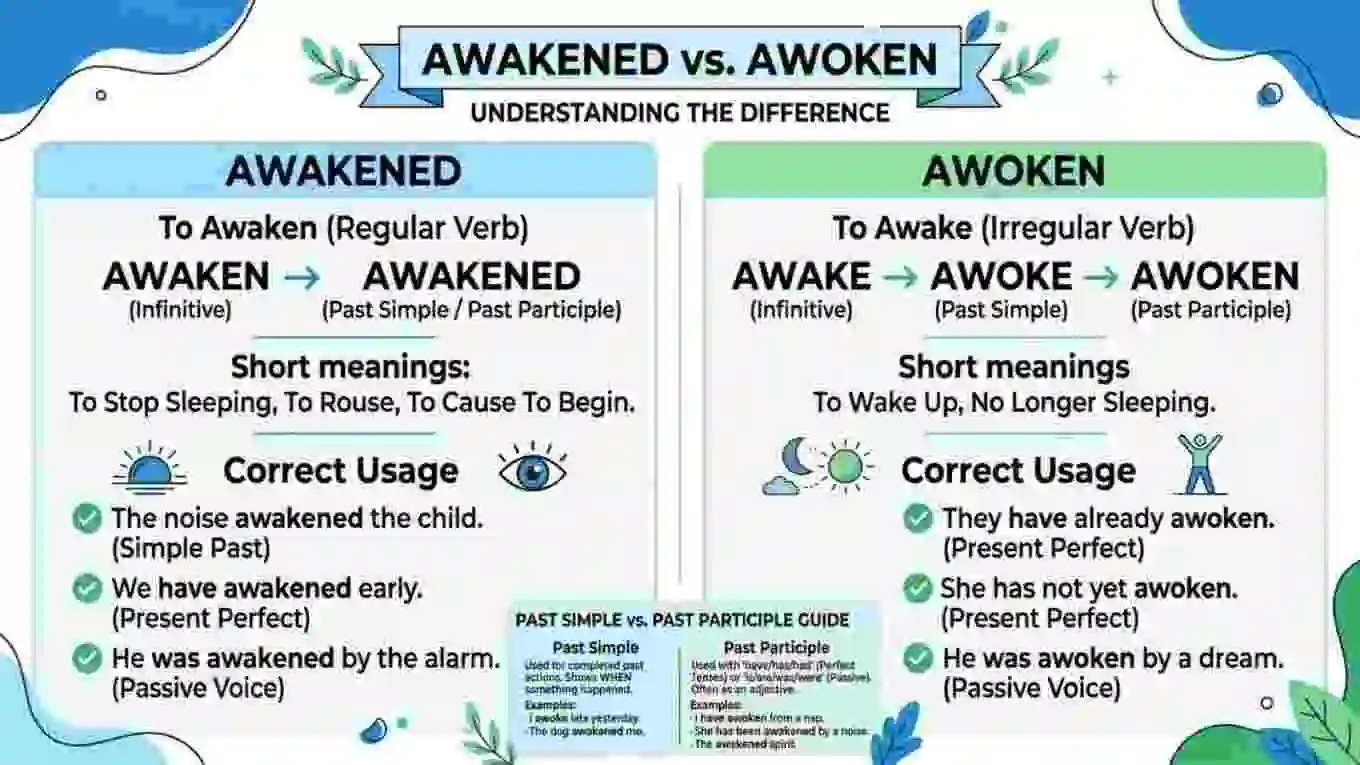
Have you ever written a sentence like “I have awakened” and wondered if “I have awoken” would be better? Both forms can be correct, but they come from two different verbs: awakened comes from awaken, while awoken comes from awake.
This makes the choice easy once you know the basic rule.
Awakened is the past tense and past participle of awaken. Awoken is the past participle of awake. The two words can have a similar meaning because both verbs can relate to waking from sleep.
The main difference is not American versus British spelling. It is verb form and usage.
You may also see awoke, which is the usual past simple form of awake. So we get a useful pattern:
awake → awoke → awoken
and:
awaken → awakened → awakened
This guide explains the difference, shows when to use each form, gives simple examples, and explains which choice sounds more natural in everyday and formal English.
Awakened or Awoken – Quick Answer
Both awakened and awoken are correct.
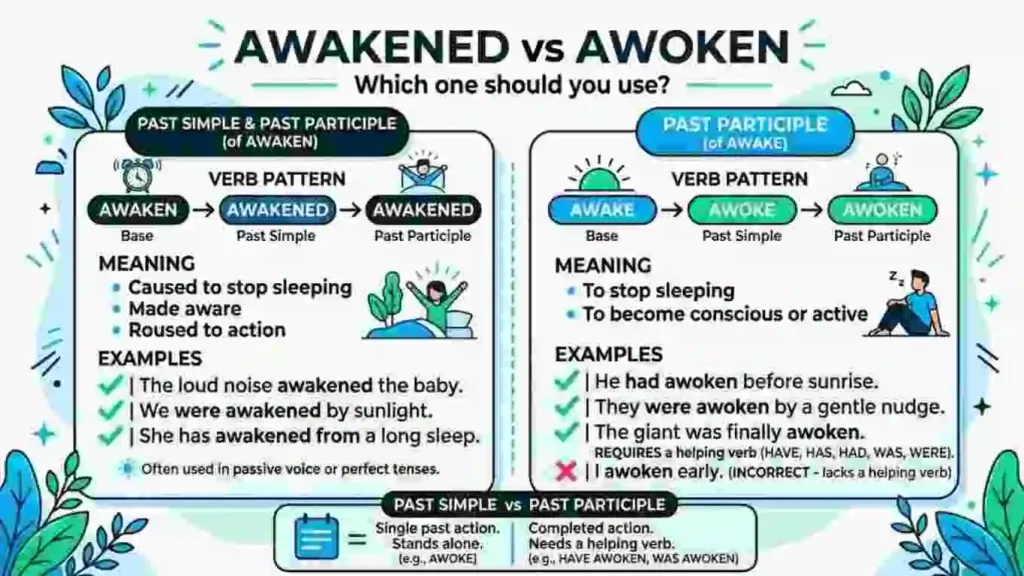
The key difference is the verb they come from:
- Awakened = past tense and past participle of awaken
- Awoken = past participle of awake
- Awoke = past simple of awake
Examples:
- She awakened early.
- She had awakened early.
- She had awoken early.
- She awoke early.
The forms do not work in exactly the same grammar patterns.
For example:
I have awakened.
I have awoken.
Both can work because the present perfect uses a past participle.
But:
I awoke at six.
Here, awoke is the past simple form of awake. Cambridge lists awoke as the past simple of awake and awoken as its past participle.
What Is the Difference Between Awakened and Awoken?
The easiest way to understand the difference is to look at the verbs.
Awakened
Awakened comes from awaken.
The verb awaken means to wake up or to cause someone to wake up. It can also describe starting to feel or understand something. Dictionaries often mark this verb as literary or formal.
Examples:
- The noise awakened the baby.
- She awakened before sunrise.
- The story awakened old memories.
Awoken
Awoken comes from awake.
It is the past participle of awake.
It often appears after helping verbs such as:
- have
- has
- had
- be
Examples:
- I have awoken early.
- She had awoken before the alarm.
- He was awoken by a loud noise.
The simple rule
Remember this:
Awaken → awakened
Awake → awoke → awoken
That small pattern solves most of the confusion.
Main Differences Between Awakened and Awoken
| Term | Comes from | Main grammar form | Example |
| awakened | awaken | Past simple / past participle | She awakened early. |
| awoken | awake | Past participle | She has awoken early. |
| awoke | awake | Past simple | She awoke early. |
| awake | awake | Base form | I may awake early. |
| awakening | awake / awaken | -ing form | He is awakening slowly. |
Oxford lists awake with the forms awoke and awoken. It lists awaken with awakened as both its past simple and past participle.
Awakened vs Awoken in Grammar
Grammar often gives you the easiest clue.
Use awakened as the past simple of awaken
You can use it for a finished event in the past.
She awakened at dawn.
The sound awakened me.
Here, no helping verb is needed.
Use awakened as a past participle
It can also follow have, has, or had.
She has awakened to the truth.
He had awakened before sunrise.
Use awoken as a past participle
Use awoken with forms of have when it comes from awake.
I have awoken from a deep sleep.
She had awoken before the alarm rang.
Use awoke for the past simple of awake
He awoke at five.
She awoke to the sound of rain.
Cambridge gives awoke as the past simple and awoken as the past participle of awake.
Origin and History
The words awake and awaken have old roots in English.
The verb awaken comes from an older English form related to waking. Collins traces awaken through Middle English to Old English forms connected with waking.
Over time, English kept several related forms:
- wake
- awake
- awaken
- waken
These verbs have similar meanings, but they developed different grammar patterns.
Modern English still keeps these differences.
The result can seem strange to learners because awake does not follow the simple “add -ed” pattern.
Instead, it has:
awake → awoke → awoken
The verb awaken follows a more regular pattern:
awaken → awakened → awakened
This is why awoken and awakened look similar but are not simply two spellings of the same word.
British English vs American English
There is no major British versus American spelling difference between these forms.
Both British and American English use:
- awakened
- awoken
- awoke
- awake
- awaken
The main difference comes from grammar, style, and context.
Cambridge lists awoken as the past participle of awake in both British and American English.
Collins also gives awoken as the past participle in British English and American English.
There can be differences in how often certain forms appear.
In everyday speech, wake and wake up are much more common than awake and awaken. Cambridge notes that wake and wake up are used in everyday language, while awake and awaken are more literary.
Which One Should You Use?
Choose the form based on the verb and sentence structure.
For everyday English
Wake and wake up often sound more natural.
Instead of:
I awakened at seven.
You might simply say:
I woke up at seven.
For formal or literary writing
Awakened, awoke, and awoken can fit well.
Examples:
The child awakened suddenly.
She awoke to the sound of rain.
He had awoken before sunrise.
Oxford notes that awake is usually used in writing, while waken and awaken are more formal.
For American English
Both forms are understood and used.
Awoken is not a British-only form. American dictionaries also list it as the past participle of awake.
For British English
The same basic grammar applies.
You can use:
She had awoken early.
or:
She had awakened early.
The choice depends more on the verb and writing style than on the country.
Common Mistakes
1. Using awoken as the simple past
Incorrect:
I awoken at six.
Correct:
I awoke at six.
Why?
Awoke is the past simple form of awake. Awoken is the past participle.
2. Using awakened as the past participle of awake
Confusing:
I have awakened from sleep.
This sentence can be correct, but it comes from the verb awaken, not awake.
If you want the awake verb, use:
I have awoken from sleep.
3. Writing “I have awoke”
Incorrect:
I have awoke early.
Correct:
I have awoken early.
The present perfect needs a past participle here.
4. Writing “She had awoke”
Incorrect:
She had awoke before me.
Correct:
She had awoken before me.
5. Thinking awoken is wrong
Incorrect idea:
“Awoken” is not a real word.
Correct:
Awoken is a standard past participle of awake. Major dictionaries list it.
6. Thinking awakened and awoken are only spelling choices
They are not simply two spellings.
They belong to different verbs:
- awaken → awakened
- awake → awoken
That is the key difference.
Awakened or Awoken: 10 Easy Examples
- She awakened before sunrise.
- The loud noise awakened the baby.
- I have awoken from a strange dream.
- He awoke when the phone rang.
- She had awoken before the alarm.
- The sound awakened everyone in the house.
- I awoke early this morning.
- He has awakened to a new idea.
- The experience awakened old memories.
- They had awoken before the storm arrived.
Notice the pattern:
awakened comes from awaken.
awoke and awoken come from awake.
Real-Life Usage
In conversation
Most people would usually say:
“I woke up late.”
This sounds more natural than:
“I awakened late.”
Cambridge explains that wake and wake up are common in everyday language.
In school writing
You may see:
“The character awoke to the sound of thunder.”
This has a more literary tone.
In formal writing
Awakened can work well when discussing ideas or feelings.
“The event awakened public interest.”
The verb can refer to more than sleep. It can also mean causing a feeling or awareness to start.
In emails
A normal work email would usually use simple language:
“I woke up feeling sick.”
There is rarely a need to use awoke or awakened unless the writing has a formal or literary tone.
In social media
Simple forms are usually best:
“I woke up at 5 a.m. today!”
This sounds more natural than using a formal verb.
Can Awakened and Awoken Mean the Same Thing?
Sometimes, yes.
Both can describe waking from sleep.
Compare:
She awakened suddenly.
She had awoken suddenly.
The meaning is close, but the grammar is different because the first uses awakened from awaken, while the second uses awoken from awake.
They can also appear in more figurative writing.
For example:
The speech awakened his interest.
Here, awakened means that the speech caused his interest to begin.
Oxford and Cambridge both show that awaken can be used for feelings, ideas, or awareness as well as waking from sleep.
Related Search Questions
Is “awoken” a correct word?
Yes. Awoken is the past participle of awake. For example:
“She has awoken from her sleep.”
Major English dictionaries list this form.
Is “awakened” a correct word?
Yes. Awakened is the past tense and past participle of awaken.
Example:
“The noise awakened the child.”
Cambridge and Collins both list this form.
Is “awoke” or “awoken” correct?
Both are correct, but they have different grammar roles.
Awoke is normally the past simple.
Awoken is the past participle.
Examples:
“She awoke early.”
“She had awoken early.”
Is “awakened” more correct than “awoken”?
No. Neither is simply more correct.
They come from different verbs. Choose the form that fits the verb and grammar of your sentence.
Is “awoken” American or British?
It is used in both American and British English. It is the past participle of awake.
Usage and Search Trends
Exact search-volume or Google Trends numbers should not be guessed without a current data source.
For language use, the clearer point is that these forms belong to a larger group of words connected with wake, wake up, awake, awoke, and awaken.
Everyday English usually favors wake and wake up. More formal or literary writing may use awake, awoke, or awaken. Cambridge and Oxford both make this style difference clear.
This also explains why people may see awoke, awoken, and awakened in books or formal writing but hear woke up more often in normal conversation.
Comparison Table
| Form | Verb | Grammar | Meaning | Example |
| awake | awake | Base form | Stop sleeping | I may awake early. |
| awoke | awake | Past simple | Stopped sleeping | I awoke at six. |
| awoken | awake | Past participle | Has/had stopped sleeping | I have awoken early. |
| awaken | awaken | Base form | Wake or cause awareness | The sound may awaken him. |
| awakened | awaken | Past simple / past participle | Woke or caused awareness | The sound awakened him. |
| waking | wake | -ing form | Becoming awake | I am waking up. |
FAQs
Is “I have awakened” grammatically correct?
Yes. Awakened is the past participle of awaken, so “I have awakened” is grammatically correct. It sounds more formal or literary than the everyday phrase “I have woken up.” Cambridge lists awakened as both the past simple and past participle of awaken.
Is “I have awoken” grammatically correct?
Yes. Awoken is the past participle of awake. The sentence “I have awoken” uses the present perfect correctly. Oxford and Cambridge both list awoken as the past participle of awake.
Should I say “I awoke” or “I awakened”?
Both can be correct. I awoke uses awake, while I awakened uses awaken. In normal speech, “I woke up” often sounds more natural. The choice depends on your style and the sentence.
What is the past tense of awake?
The usual past simple form is awoke. For example:
“She awoke early.”
The past participle is awoken:
“She had awoken early.”
Cambridge lists this pattern directly.
What is the past tense of awaken?
The past tense of awaken is awakened.
Example:
“The noise awakened me.”
The past participle is also awakened.
Which is more common, awakened or awoken?
The answer depends on the verb, sentence, and style. Awakened belongs to awaken, while awoken belongs to awake. In everyday speech, people often use woke or woken instead because wake is more common.
Can “awakened” describe feelings?
Yes. Awaken can mean to cause a feeling, interest, memory, or awareness to begin. For example:
“The song awakened old memories.”
This use often appears in formal or literary writing.
Conclusion
The choice between awakened and awoken becomes simple once you look at the verbs behind them.
Awakened comes from awaken. It works as both the past simple and past participle of that verb.
Awoken comes from awake. It works as the past participle, while awoke normally works as the past simple.
So remember these two patterns:
awaken → awakened → awakened
awake → awoke → awoken
There is no major British or American spelling difference here. Both forms work in both types of English.
For everyday speech, wake and wake up usually sound more natural. For formal, literary, or more serious writing, awaken, awoke, and awoken can fit well.
If you are unsure, check the grammar of the sentence first. Ask yourself which verb you are using. Once you know whether the verb is awake or awaken, the correct form becomes much easier to choose.

Ethan Carter is a language writer at Wordellect who helps readers understand word differences, grammar rules, and spelling variations through simple and accurate guides.







