A news site says “the latest poll shows,” and right next to it, a photo shows a tall pole with a flag on top. Same sound. Two totally different things. If you’ve ever stopped mid-sentence trying to pick the right one, you’re not alone.
This mix-up happens a lot, since “poll” and “pole” sound the same when spoken out loud. People search “poll or pole” mostly while writing about elections, surveys, or something long and thin, like a flagpole or fishing pole.
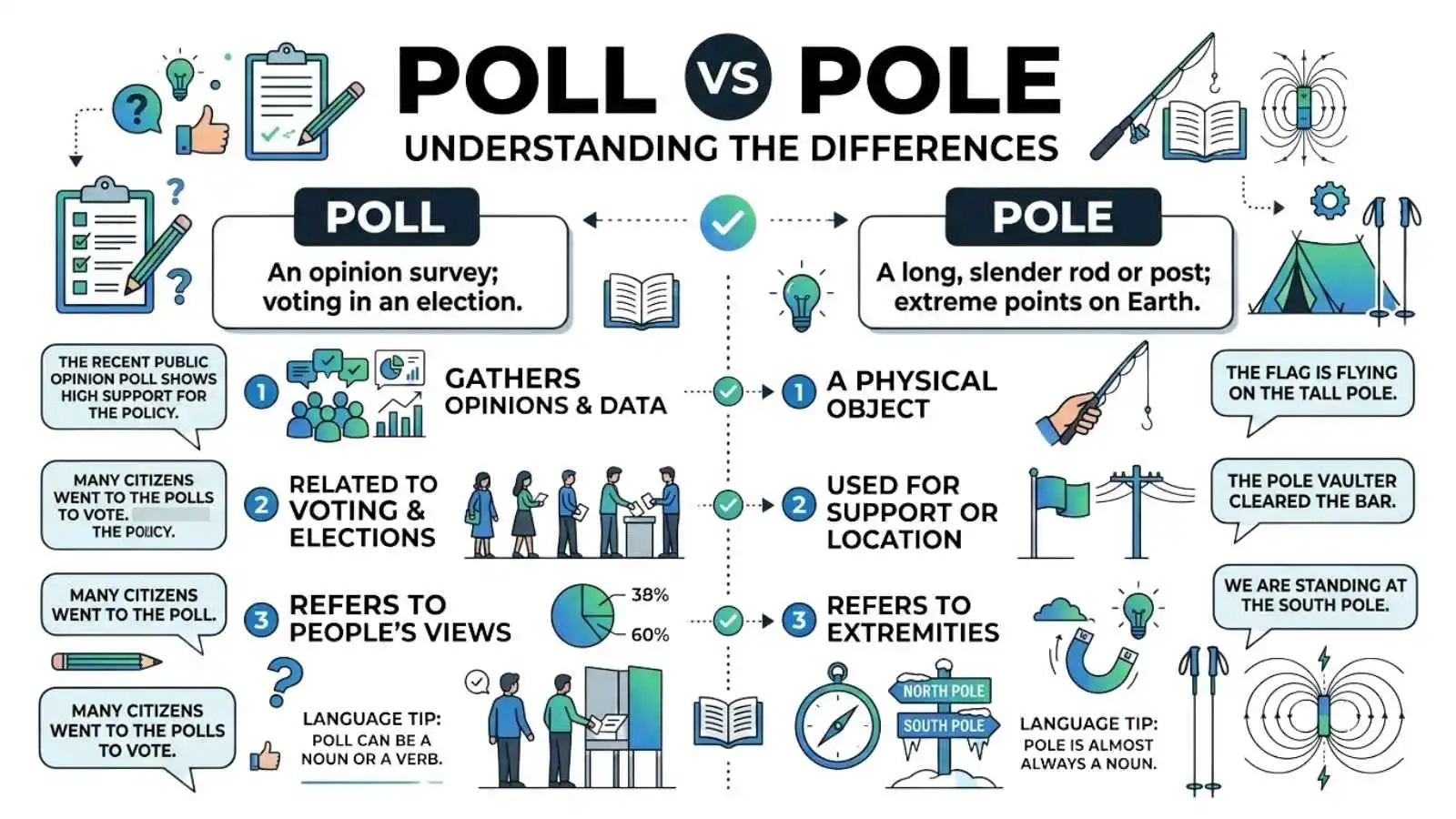
Here’s the short version: a “poll” is a survey or a vote, where people share their choice or opinion. A “pole” is a long, thin thing, made of wood, metal, or some other material, often used to hold something up. Same sound, nothing else in common.
Stick with this article, and you’ll walk away knowing the right word every time, with real examples you’ll actually run into.
Quick Answer
- Poll = a survey or vote, used to gather opinions or choices Example: “The poll showed most people like the new plan.”
- Pole = a long, thin object, often used to hold something up Example: “They raised the flag up the tall pole.”
Quick check: if it’s about opinions, votes, or surveys, use “poll.” If it’s a long stick-like object, use “pole.”
Where Do These Words Come From?
“Poll” first meant “the top of the head,” way back in old English. Over time, people tied this to counting heads, as in counting how many people picked one side or another. That’s how “poll” grew into the word we now use for surveys, votes, and elections.
“Pole” comes from an old Latin word meaning “stake” or “post.” This word stayed close to its early meaning for hundreds of years, always tied to a long, thin object, whether it’s a fishing pole, a flagpole, or a tent pole.
So these two words never had any real link. They just landed on the same sound after English changed a lot over time.
Poll vs Pole: Side-by-Side Look
Neither word is a spelling change tied to a country. This is not a British versus American thing. These are two separate words that just sound alike.
| Feature | Poll | Pole |
| Meaning | A survey or vote | A long, thin object |
| Word type | Noun (and a verb too, like “to poll voters”) | Noun |
| Common use | Elections, surveys, public opinion | Flagpoles, fishing poles, tent poles |
| Example | “A new poll found strong support for the plan.” | “The tent pole broke during the storm.” |
A Simple Way to Remember Which Is Which
Try this: “poll” rhymes with “roll,” so picture people “rolling in” their votes during an election. That small picture ties “poll” to voting and surveys.
“Pole” looks and sounds close to the word for a country, Poland, minus the “and.” Picture a tall flagpole in front of a building, and you get a clear image tied to something long and standing straight up.
Which One Should You Use?
Your pick depends only on what you’re talking about, not your writing style or where you live.
Talking about surveys, elections, or public opinion? Use “poll.” Example: “The poll results shocked everyone at the office.”
Talking about a long, thin object? Use “pole.” Example: “We need a longer pole to reach the top shelf.”
Writing about voting spots? Watch out here, since “polling place” or “polling station” uses “poll,” even though some people hear it and think of “pole” by mistake.
Common Mistakes with Poll and Pole
Mistake 1: “We ran a pole to see who was winning.”
Fix: “We ran a poll to see who was winning.” (This is about a survey, not an object.)
Mistake 2: “The flag hangs from a tall poll.”
Fix: “The flag hangs from a tall pole.” (This is about a real object.)
Mistake 3: Writing “polling booth” as “poling booth” or some odd mix.
Fix: Always keep “polling” for anything tied to voting or surveys.
Mistake 4: Mixing up “pole” with “Pole,” a word for a person from Poland.
Fix: A big “P” Pole means a person from Poland. A small “p” pole means the object.
Poll and Pole in Everyday Examples
In news: “New poll shows a shift in views ahead of the election.”
In daily talk: “Grab that pole from the garage, we need it for the tent.”
On social media: “Just ran a quick poll on my page, curious what you all think! 📊” “Finally fixed the broken pole on our patio umbrella.”
In formal writing: “The latest poll shows a rise in support for the new plan.” “The work crew put up a new pole along the street.”
Search Trends: What Do People Search More?
Search interest in “poll” tends to jump around elections, big news events, and any time a site runs a public survey. “Pole” gets searched a lot too, often tied to camping gear, fishing trips, or home projects with flagpoles or tent poles.
This stays fairly steady across English-speaking places, since this mix-up comes from how the words sound, not from any rule tied to a country.
| Keyword Variation | Meaning | Common Topic |
| Poll | Survey or vote | Elections, public opinion |
| Pole | Long, thin object | Camping, fishing, flags |
| Polling station | Voting spot | Elections |
| Fishing pole | Fishing gear | Outdoor trips |
Frequently Asked Questions
1. Do “poll” and “pole” sound the same? Yes, they sound exactly alike, which is why they’re so easy to mix up in writing.
2. What does “polling place” mean? It’s the spot where people go to vote during an election, always spelled with “poll,” not “pole.”
3. Is “Pole” always about the object? No. A big “P” Pole means a person from Poland. A small “p” pole means the long object.
4. Can “poll” be used as a verb? Yes. For example, “They polled hundreds of voters before the election,” meaning they asked those voters for their view.
5. Is this a British versus American spelling thing? No. Both words are spelled the same way in every English-speaking country. This is a sound mix-up, not a spelling rule tied to a place.
6. Why do people mix these words up so much? Since “poll” and “pole” sound the same, your mind sometimes grabs the wrong one while typing fast, without thinking through the real meaning.
7. What’s a fast way to remember the difference? Tie “poll” to voting and surveys. Tie “pole” to a long object, like a flagpole or fishing pole.
Conclusion:
“Poll” and “pole” sound the same, but they mean two very different things. “Poll” means a survey or vote, tied to elections and public opinion. “Pole” means a long, thin object, like a flagpole, fishing pole, or tent pole.
Once you tie “poll” to voting and “pole” to a real object, the mix-up gets much easier to avoid. Next time you write about an election or set up a tent, you’ll know right away which word fits your sentence.

Ethan Carter is a language writer at Wordellect who helps readers understand word differences, grammar rules, and spelling variations through simple and accurate guides.







