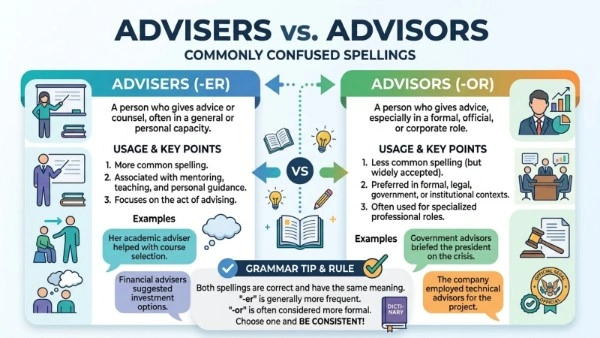
Have you ever written advisers or advisors and stopped to wonder which spelling is correct? You are not alone. Both forms are correct, and both mean the same thing. The main difference comes from regional spelling and style.
The word refers to people who give advice, guidance, or expert help. You may see it in jobs, schools, banks, businesses, government offices, and many other places. For example, a student may speak with an academic adviser, while a company may hire financial advisors.
People often search for advisers or advisors because they want to know which spelling looks right in professional writing. They may also wonder if one form is American and the other British.
The good news is simple: adviser and advisor have the same meaning. Both are standard English words. Your choice often depends on the country, writing style, or organization you are writing for.
Let us look at the difference so you can choose the right form with confidence.
Advisers or Advisors – Quick Answer
Adviser and advisor are both correct spellings.
They both mean a person who gives advice or guidance.
- Adviser is common in British English and is also used in American English.
- Advisor is very common in American English.
- Advisor also appears in many official job titles and business settings around the world.
Simple examples
- She is a financial adviser.
- She is a financial advisor.
- I spoke with my academic adviser.
- I spoke with my academic advisor.
The meaning does not change.
So, if you are asking, “Should I write adviser or advisor?”, the answer is: either one can be correct.
The best choice depends on your audience and the style you follow.
The Origin of Advisers or Advisors
Both words come from the verb advise.
The verb advise comes from Old French and Latin roots connected with the idea of giving an opinion or guidance. Over time, English developed nouns for people who give advice.
The spelling adviser follows a common English pattern:
advise → adviser
The spelling advisor uses -or instead of -er.
English has many words with both -er and -or forms. Some pairs have different meanings, but adviser and advisor do not.
Both forms developed in English and became accepted over time.
The spelling advisor became especially common in American English. It also became popular in business, finance, education, and government job titles.
That is why you may see titles such as:
- Financial Advisor
- Investment Advisor
- Academic Advisor
- Senior Advisor
- Legal Advisor
At the same time, adviser remains fully correct.
For example:
- Financial Adviser
- Academic Adviser
- Policy Adviser
- Career Adviser
The choice is often a matter of style rather than grammar.
British English vs American English Spelling
Both adviser and advisor can appear in British and American English. However, their popularity differs.
Adviser is traditionally more common in British English.
Advisor is especially common in American English.
Here is a simple comparison:
| Feature | Adviser | Advisor |
| Meaning | A person who gives advice | A person who gives advice |
| British English | Common | Used |
| American English | Used | Very common |
| Spelling ending | -er | -or |
| Grammar | Correct | Correct |
| Formal writing | Correct | Correct |
| Job titles | Common | Very common |
British English
British writers often use adviser.
Examples:
- government adviser
- financial adviser
- career adviser
- policy adviser
However, advisor is not wrong in British English.
American English
American English often favors advisor.
Examples:
- financial advisor
- academic advisor
- investment advisor
- senior advisor
Still, American writers also use adviser.
So, the difference is not as strict as some spelling pairs, such as color and colour.
Which Spelling Should You Use?
Your audience should guide your choice.
If you write for a US audience
Advisor is usually the safest choice.
For example:
Contact your financial advisor before making a decision.
This spelling is very common in American business and professional writing.
You write for a UK audience
Adviser is a natural choice.
For example:
Please speak to your financial adviser before making a decision.
If you write for a global audience
Either form works.
However, consistency matters more than the choice itself. If you choose adviser, use it throughout your article. If you choose advisor, keep that spelling consistent.
Follow official job titles
Sometimes an organization uses one spelling as part of an official title.
For example, if a university calls its staff Academic Advisors, keep that spelling when referring to the official role.
Do not change an official title just to match your personal spelling preference.
Common Mistakes with Advisers or Advisors
Because both spellings are correct, the biggest mistakes usually involve meaning, consistency, or related words.
Mistake 1: Thinking one spelling is wrong
Some people believe advisor is incorrect because adviser looks more natural.
That is not true.
Advisor is a standard English word.
Mistake 2: Thinking the words have different meanings
They do not.
Both words mean a person who gives advice.
Correct:
My advisor helped me choose my classes.
Also correct:
My adviser helped me choose my classes.
Mistake 3: Mixing spellings
Try not to switch between the two forms in the same article.
For example:
My academic advisor helped me. The adviser also explained the course rules.
This is not grammatically wrong, but it can look inconsistent if both refer to the same role.
Choose one spelling and use it consistently.
Mistake 4: Confusing advise and advice
These words are different.
Advise is a verb.
I advise you to wait.
Advice is a noun.
She gave me good advice.
Adviser and advisor are nouns for people who give advice.
Mistake 5: Writing “advicer”
Advicer is not the standard word.
Use:
adviser
or
advisor
Advisers or Advisors in Everyday Examples
You can see both spellings in many types of writing.
In emails
American style:
Please contact your academic advisor if you have questions.
British style:
Please contact your academic adviser if you have questions.
In business
The financial advisor reviewed the company’s plans.
Or:
The financial adviser reviewed the company’s plans.
Both are correct.
In news writing
News stories may use either form depending on the publication’s style.
The president’s advisers met with officials.
Or:
The president’s advisors met with officials.
The choice may depend on the publication or its style guide.
On social media
People often use advisor because it is common in professional job titles.
Proud to start my new role as a marketing advisor!
But adviser is also correct.
In formal writing
Both forms can work in reports, essays, and professional documents.
For example:
The policy adviser reviewed the proposal.
Or:
The policy advisor reviewed the proposal.
The most important point is consistency.
Advisers or Advisors – Google Trends & Usage Data
Search interest for advisers and advisors can vary by country.
In general, advisor has strong usage in the United States. This is especially clear in areas such as finance, education, business, and professional job titles.
Adviser has strong use in British English and other varieties of English influenced by British spelling.
The exact search volume can change over time. Google Trends also measures relative search interest rather than giving a fixed number of searches.
Context matters too.
For example, someone searching for financial advisor may be looking for a professional service. Someone searching for adviser may be checking spelling or British English usage.
For SEO, it can be useful to understand both forms. If your audience is mainly American, advisor may fit your main wording better. If your audience is mainly British, adviser may feel more natural.
Do not force both spellings into every sentence. Write naturally and use the form that fits your audience.
Advisers vs Advisors: Side-by-Side Comparison
| Word | Correct? | Main use | Example |
| Adviser | Yes | Common in British English | She is my career adviser. |
| Advisor | Yes | Very common in American English | She is my career advisor. |
| Advise | Yes | Verb | I advise you to wait. |
| Advice | Yes | Noun | He gave me good advice. |
| Advicer | No | Not standard English | Use adviser or advisor. |
Adviser
Adviser is a noun.
It means someone who gives advice.
The government hired a new policy adviser.
Advisor
Advisor is also a noun.
It has the same meaning.
The company hired a new business advisor.
There is no major difference in meaning between the two.
FAQs About Advisers or Advisors
1. Is adviser or advisor correct?
Both are correct. Adviser and advisor have the same meaning.
2. Is advisor American English?
Advisor is very common in American English, especially in business, education, and finance. However, Americans also use adviser.
3. Is adviser British English?
Adviser is traditionally common in British English. However, advisor is also used in the UK.
4. Which is more professional, adviser or advisor?
Neither is more professional by itself. Both are professional and correct. Use the spelling preferred by your audience or organization.
5. Should I use advisor in American writing?
Advisor is often a good choice for American readers because it is very common in the US. But adviser is also correct.
6. Are adviser and advisor pronounced the same?
Yes. In normal speech, the two words are pronounced the same or almost the same.
7. What is the plural of adviser and advisor?
The plural forms are:
- advisers
- advisors
For example:
The advisers met this morning.
The advisors met this morning.
Both plural forms are correct.
Conclusion;
So, advisers or advisors? The simple answer is that both are correct.
The two words have the same meaning. They both describe a person who gives advice, guidance, or expert help.
The main difference comes from usage and style. Advisor is especially common in American English and appears often in business, finance, education, and professional job titles. Adviser is traditionally common in British English and remains widely accepted in American English too.
If you write for US readers, advisor may feel more natural. If you write for UK readers, adviser may be a better fit. For a global audience, either spelling works.
The most important rule is consistency. Pick one form and use it throughout your writing unless you are copying an official job title.
Remember, adviser is not more correct than advisor, and advisor is not more correct than adviser. Both are standard English words. Choose the one that best matches your audience, style guide, or organization.

Ethan Carter is a language writer at Wordellect who helps readers understand word differences, grammar rules, and spelling variations through simple and accurate guides.







