You’re writing a note about your desk. “Put it in the top draw” or “top drawer”? Something feels off, but you’re not sure what. And if you’ve ever heard someone say these two words out loud, they can sound almost the same, which makes this mix-up even trickier to catch.
This one trips up more people than you’d think, and it’s not really about being careless. These two words are just close enough in sound and spelling to cause real confusion. Let’s fix that here, in plain, easy words.
Quick Answer
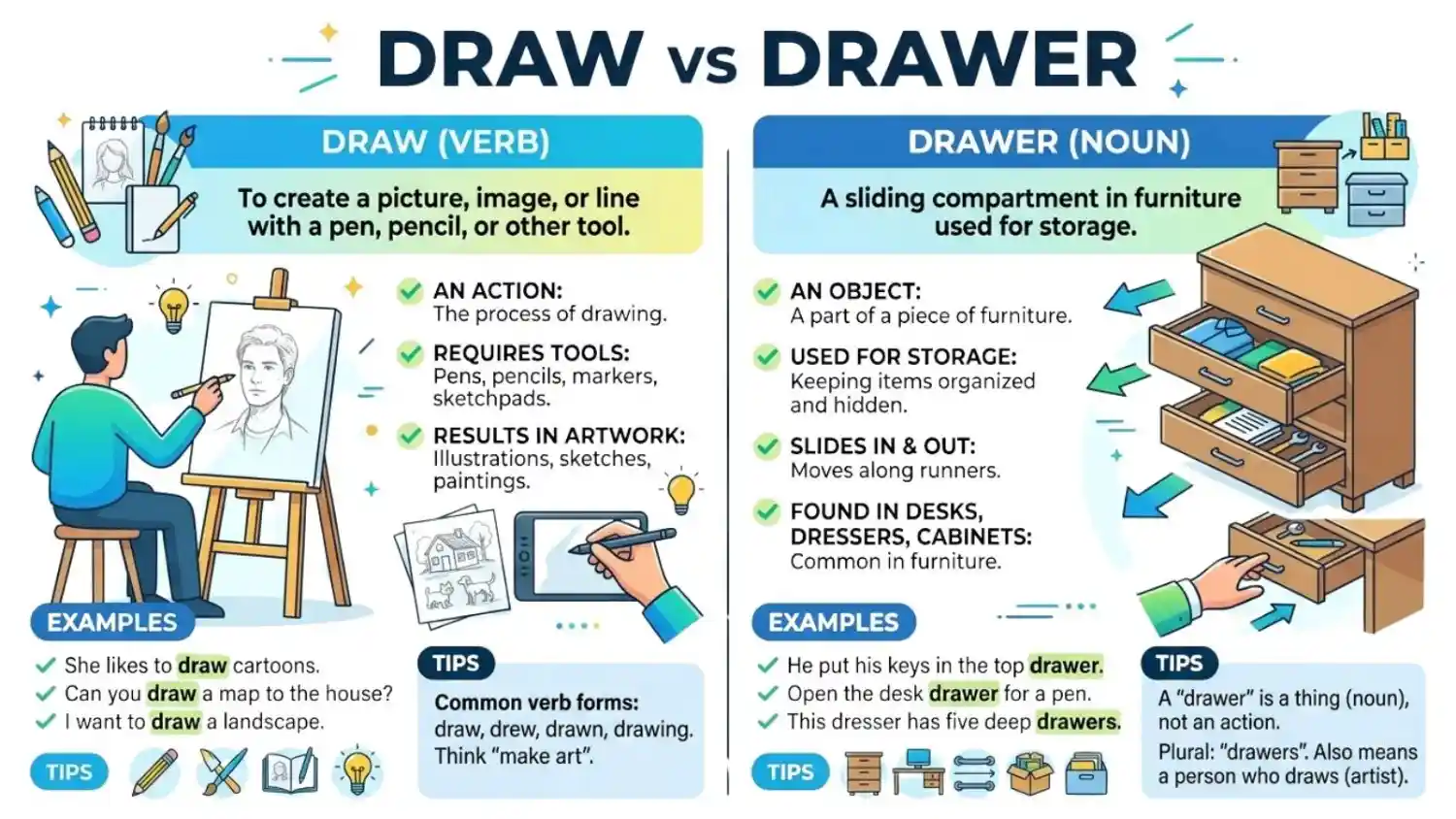
Draw is mostly a verb. It means to make a picture, to pull something toward you, or to end in a tie during a game. Example: “Can you draw a picture of a dog?”
Drawer is a noun. It’s the sliding box part of a desk or dresser where you keep things. Example: “My socks are in the top drawer.”
Simple way to remember it: draw is an action you do. Drawer is the thing you slide open and close.
Why This Mix-Up Happens So Often
Here’s where it gets tricky. In some ways of speaking, “draw” and “drawer” can actually sound really close, especially since many people don’t fully say the “r” sound at the end of “drawer” in certain accents. When that happens, the two words can almost blend together out loud, which makes writing them down correctly a lot harder.
On top of that, “drawer” is literally built from “draw” plus “er,” the same pattern used in words like “teach” and “teacher,” or “run” and “runner.” Someone who draws pictures for a living is even called a “drawer” too, which adds one more layer to the mix-up. So the words are related, but the item in your desk and the action of making a picture ended up needing two very different uses for the same base word.
Breaking Down the Real Difference
| Draw | Drawer | |
| Type of word | Verb (action), sometimes a noun for a tie in a game | Noun (a thing) |
| What it means | To make a picture, to pull something, or a tied game | The sliding storage part of furniture |
| Example | “She loves to draw animals.” | “Open the drawer and grab a pen.” |
| Sounds like | “Draw” | “Draw-er” (with the ending sound) |
A Simple Way to Check Yourself
Ask this: am I talking about doing something, or a thing you can open and close?
If you’re describing an action, like making art, pulling something closer, or a game ending in a tie, you want “draw.”
If you’re talking about the sliding part of a piece of furniture, you want “drawer,” every single time.
Try It Yourself
Guess the right word before checking the answer.
- “She likes to ___ pictures of her family.” → draw
- “Please put the keys in the top ___.” → drawer
- “The game ended in a ___, no winner at all.” → draw
- “My desk has three ___ for papers.” → drawers
- “Can you ___ me a map to your house?” → draw
If most of these felt easy, you already had a good sense of this before checking the answers.
When Each Word Actually Fits
Talking about making art: Use “draw.” Example: “He can draw really well for his age.”
Talking about the storage part of furniture: Use “drawer.” Example: “The bottom drawer sticks a little when you open it.”
Talking about a game with no winner: Use “draw.” Example: “The match ended in a draw after overtime.”
Talking about pulling something toward you: Still “draw.” Example: “Draw the curtains before it gets too bright.”
Talking about more than one storage box: Use “drawers,” the plural form. Example: “All the drawers in this dresser are stuck.”
Common Mistakes People Make
Writing “draw” when talking about furniture. This is the most common slip. “Put it in the top draw” should actually be “put it in the top drawer,” since you’re naming a thing, not describing an action.
Trusting how it sounds out loud. Since these words can blend together when spoken quickly, relying on sound alone often leads people the wrong way. Reading the sentence back and checking the meaning works much better.
Forgetting “drawer” also means a person who draws. It’s rare, but a “drawer” can technically mean someone who draws pictures, like an artist. Most of the time though, the desk furniture meaning is what people actually mean.
Assuming spellcheck will catch this one. It usually won’t, since both “draw” and “drawer” are correctly spelled words on their own. The mistake is about meaning, not spelling, so spellcheck often lets it slide right by.
Seeing These Words in Real Life
A text to a roommate: “Can you check the top drawer for scissors?”
An art class comment: “You’re getting really good at drawing faces.”
A sports headline: “Match ends in a draw after a tense second half.”
A furniture ad: “This dresser features six spacious drawers.”
A casual chat about hobbies: “I love to draw in my free time.”
Why People Search This So Often
Students and writers search “draw or drawer” a lot while typing quickly, pausing right before choosing the correct word in a sentence about furniture or art.
Shoppers browsing furniture websites run into this mix-up too, sometimes typing “draw” into a search bar by mistake when they actually mean “drawer.”
This confusion shows up the same way in every English-speaking country, since it comes down to how the words sound and connect, not any regional spelling habit.
A Few More Word Pairs Like This
| Pair | Meaning 1 | Meaning 2 |
| Draw / Drawer | To make a picture (action) | The sliding storage box |
| Teach / Teacher | To share knowledge (action) | The person who teaches |
| Run / Runner | To move fast (action) | The person who runs |
| Bake / Baker | To cook food (action) | The person who bakes |
Common Questions
Is “draw” ever spelled with an “er” at the end for the action meaning? No, never. “Draw” always stays as is when talking about making a picture or pulling something. Adding “er” changes it to talk about the furniture or a person who draws.
Why do “draw” and “drawer” sound so close when spoken? In many accents, the “r” sound at the end of “drawer” gets softened or dropped, making it sound very close to plain “draw,” even though the spelling stays different.
Can “drawer” ever mean something other than furniture? Yes, though it’s less common. A “drawer” can also mean a person who draws, like an artist, but this use is much rarer in everyday talk.
What’s the plural of drawer? “Drawers,” simply adding an “s” at the end, no other changes needed.
Is “draw” only used for art? No, it also means to pull something closer, or to describe a game that ends in a tie with no winner.
How can I remember the difference quickly? Picture a desk. If you’re opening or closing something, it’s a drawer. If you’re doing something, like making art or pulling an object, it’s draw.
Does this mix-up happen more in speech or writing? Mostly in writing, since the words can sound alike when spoken. In writing, it becomes clear which meaning is needed once you slow down and check the sentence.
Wrapping This Up
“Draw” and “drawer” are closely related, but they do very different jobs. “Draw” is an action, making art, pulling something, or ending in a tie. “Drawer” is a thing, the sliding storage part of furniture, or occasionally, a person who draws.
A quick way to check yourself: if you’re doing something, it’s draw. If you’re opening or closing something on a desk or dresser, it’s drawer. That one small check clears up the confusion almost every time.
Since spellcheck won’t always catch this one, it’s worth a quick second look, especially in anything about furniture, art, or games.

Ethan Carter is a language writer at Wordellect who helps readers understand word differences, grammar rules, and spelling variations through simple and accurate guides.







