Have you ever written frolick or frolic and wondered which spelling is correct? You are not alone. These words can cause confusion because English spelling rules change when we add endings to some words. The confusion becomes even greater when you see forms such as frolicked and frolicking.
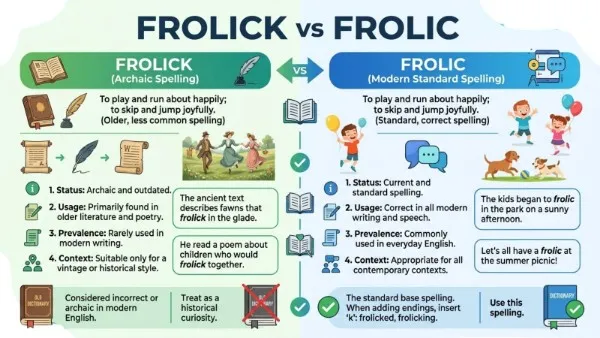
The good news is simple: frolic is the correct base spelling. Frolick is not the standard spelling of the word.
Frolic means to play, run, or move in a happy and lively way. It can describe children playing outside, animals running in a field, or people having fun.
People search for frolick or frolic because they may remember seeing forms like frolicked and frolicking. This can make them think that the base word should also contain a k. But English has a simple spelling rule here.
The base word is frolic. When certain endings are added, the final c changes to ck to keep the hard /k/ sound.
Once you learn this rule, the spelling becomes much easier to remember.
Frolick or Frolic – Quick Answer
Frolic is the correct spelling of the base word.
Frolick is not the standard form.
Frolic
Frolic can be a noun or a verb.
As a verb, it means to play or move around in a happy, lively way.
The children frolic in the park.
As a noun, it means playful activity or fun.
The puppies had a frolic in the garden.
Frolick
Frolick is not the standard spelling of the base word.
Do not write:
The children frolick in the park.
Write:
The children frolic in the park.
However, the spelling changes when some endings are added.
For example:
- frolic
- frolicked
- frolicking
This spelling change is one of the main reasons people get confused.
Easy rule
Remember:
Frolic = base word
Frolicked = past tense
Frolicking = -ing form
Do not add k to the base word.
The Origin of Frolick or Frolic
The word frolic has a long history.
It entered English from Dutch. It is related to the Dutch word vroolijk, which means cheerful or merry. The word later developed into the English frolic.
Over time, frolic became connected with happy play and lively movement.
Today, the word can describe both people and animals.
For example:
The children frolicked on the beach.
The lambs frolicked in the field.
The spelling frolick may look logical because the word becomes frolicked and frolicking.
But English spelling rules explain the difference.
When -ed or -ing is added to a word ending in c, English often adds k before the ending. This keeps the c sound hard.
For example:
- panic → panicked
- picnic → picnicked
- mimic → mimicked
- frolic → frolicked
The same pattern appears with -ing:
- panic → panicking
- picnic → picnicking
- mimic → mimicking
- frolic → frolicking
So, the k is added because of the spelling rule. It does not belong in the base word.
British English vs American English Spelling
There is no major British and American spelling difference for frolic.
Both British English and American English use:
frolic
Both also use:
frolicked
and:
frolicking
The spelling rule is the same in both varieties.
Here is a simple comparison:
| Form | British English | American English | Correct? |
| frolic | Yes | Yes | Yes |
| frolick | No | No | No |
| frolicked | Yes | Yes | Yes |
| frolicking | Yes | Yes | Yes |
| frolics | Yes | Yes | Yes |
| frolicker | Yes | Yes | Yes |
British English examples
The children frolicked by the river.
The puppies were frolicking in the garden.
American English examples
The children frolicked by the river.
The puppies were frolicking in the yard.
The spelling stays the same.
This makes frolic different from spelling pairs such as colour/color or centre/center. You do not need to choose a British or American version here.
Which Spelling Should You Use?
The answer is simple.
Use frolic as the base word.
Do not use frolick as the base form.
In American English
Use:
frolic
frolicked
frolicking
For example:
The children love to frolic outside.
In British English
Use the same forms:
frolic
frolicked
frolicking
For example:
The lambs frolicked in the field.
For a global audience
Use frolic.
There is no need to change the spelling based on the country of your readers.
The important point is to understand when the k appears.
Common Mistakes with Frolick or Frolic
The most common mistake is using frolick as the base word.
Mistake 1: Writing frolick
Incorrect:
The children frolick in the garden.
Correct:
The children frolic in the garden.
Mistake 2: Removing the k from frolicked
Some people know that frolic is correct and then remove the k from every form.
Incorrect:
The children froliced in the park.
Correct:
The children frolicked in the park.
The k is needed before -ed.
Mistake 3: Writing frolicing
Incorrect:
The dogs were frolicing outside.
Correct:
The dogs were frolicking outside.
The k is needed before -ing.
Mistake 4: Thinking frolick is the British form
It is not.
British English uses frolic, just like American English.
Mistake 5: Confusing frolic with frivolous
These words are not the same.
Frolic means to play or have fun.
The children frolicked on the beach.
Frivolous means not serious or sensible.
He made a frivolous comment.
Frolick or Frolic in Everyday Examples
The word frolic is not very common in casual speech, but you can find it in many types of writing.
In emails
The children will have time to frolic and play outside during the trip.
For a more natural casual email, you might simply say:
The children will have time to play outside.
In news writing
Young animals were seen frolicking in the open field.
The word often appears in descriptions of animals, nature, travel, and outdoor scenes.
On social media
Watching these puppies frolic in the grass is the best part of my day!
This use gives the sentence a playful and cheerful tone.
In formal writing
The young animals frolicked freely across the meadow.
The word can work well in descriptive writing.
In literature
Writers often use frolic because it creates a lively picture.
For example:
The children frolicked beside the stream.
The word gives the reader a sense of movement, joy, and energy.
Frolick or Frolic – Google Trends & Usage Data
Frolic is the standard spelling and the form people are most likely to search for when looking up the word.
Frolick is mainly searched because people are unsure about the spelling. It can also appear in searches related to forms such as frolicked and frolicking.
Search interest can vary by country and context. English-speaking countries may show interest in frolic because the word appears in dictionaries, books, articles, and educational content.
The word is also more common in certain topics, including:
- animals
- children
- nature
- travel
- literature
- poetry
- creative writing
For example, a travel article might say:
Visitors can frolic along the beach.
A nature article might say:
The young animals frolicked in the grass.
Google Trends measures relative search interest rather than an exact number of searches. Search levels can change over time.
For SEO, the best approach is to use frolick or frolic naturally when explaining the spelling difference, but use frolic when referring to the correct base word.
Do not repeat the keyword too often. Clear, useful content matters more than forcing the phrase into every paragraph.
Frolic vs Frolick: Side-by-Side Comparison
| Word or form | Correct? | Meaning or use | Example |
| frolic | Yes | Base form | The children frolic outside. |
| frolick | No | Incorrect base form | Do not use this spelling. |
| frolics | Yes | Third-person singular | She frolics in the garden. |
| frolicked | Yes | Past tense | The puppies frolicked outside. |
| frolicking | Yes | Present participle | The puppies are frolicking. |
| frolicker | Yes | A person or animal that frolics | The little frolicker ran across the field. |
Why does the k appear?
The final k appears in forms such as frolicked and frolicking because English spelling uses ck to keep the hard /k/ sound before certain endings.
This is not a difference in meaning.
It is simply a spelling change.
FAQs;
1. Is it frolic or frolick?
The correct base word is frolic. Frolick is not the standard spelling.
2. Is frolicked correct?
Yes. Frolicked is the correct past-tense form of frolic.
The children frolicked in the park.
3. Is frolicking correct?
Yes. Frolicking is the correct -ing form.
The dogs were frolicking in the yard.
4. Why does frolic become frolicked?
The spelling changes to keep the hard k sound before -ed. The k is added after the final c.
5. Is frolic used in British English?
Yes. Frolic is correct in both British and American English.
6. What does frolic mean?
Frolic means to play, move, or behave in a happy and lively way.
The puppies frolicked in the grass.
It can also be a noun for playful activity.
7. What is the easiest way to remember frolic?
Remember this simple rule:
Frolic is the base word.
When you add certain endings, the k appears:
frolic → frolicked → frolicking
Conclusion;
When choosing between frolick or frolic, remember that frolic is the correct base spelling. Frolick is not the standard form.
The word frolic means to play, move, or have fun in a lively way. You can use it for people, animals, and playful activity. For example, you can say that children frolic in a park or puppies frolic in the grass.
The main reason for the confusion is the spelling of its other forms. When you add endings such as -ed and -ing, the word becomes frolicked and frolicking. The extra k helps keep the hard k sound. This spelling rule can make it look like frolick is the base word, but it is not.
There is also no British versus American spelling difference here. Both varieties use frolic, frolicked, and frolicking.
So, the easiest rule is: frolic is correct, frolick is not. Add the k only when the spelling rule calls for it.

Ethan Carter is a language writer at Wordellect who helps readers understand word differences, grammar rules, and spelling variations through simple and accurate guides.







