You hear people say “Britain” and “England” like they mean the same place. Then someone says “UK” too. Now you’re confused. Are these all the same thing? Or are they different?
Many people search “Britain or England” because these words get mixed up all the time, even in news and movies. It feels like they should mean the same place, but they actually don’t. This mix-up happens because the names overlap, but they don’t cover the exact same area or the same thing.
Getting this wrong isn’t a big deal in casual talk. But if you’re writing, studying, or just want to sound informed, knowing the real difference matters.
This article makes it simple. You will learn exactly what “Britain” means, what “England” means, and how they connect to “UK” too. No confusing history lesson, just clear, easy facts.
Britain or England – Quick Answer
Here’s the short version.
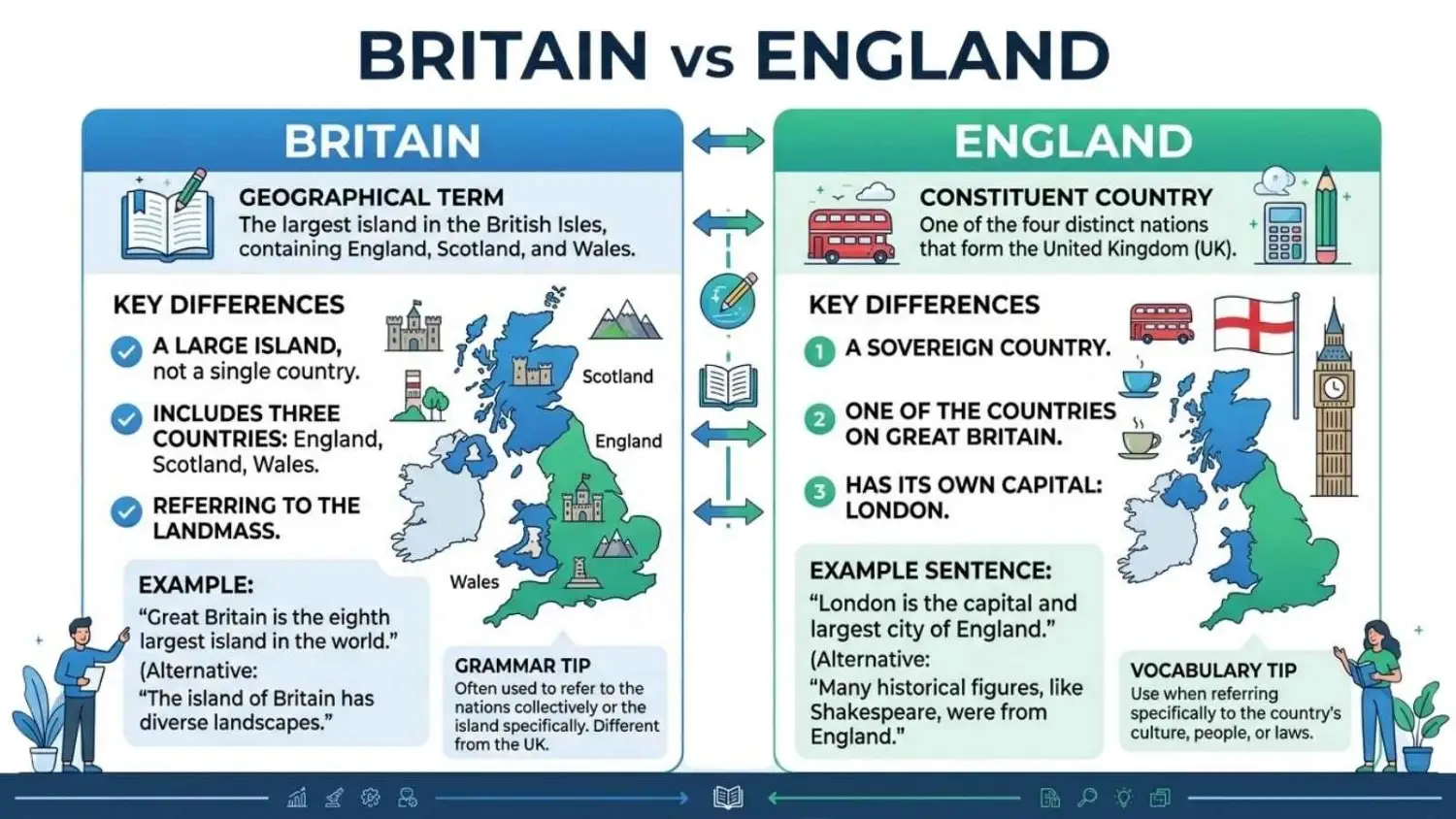
England is one country. It is part of a bigger group of countries.
Britain (short for Great Britain) is the name of the island that includes three countries: England, Scotland, and Wales.
Simple rule: England is one part. Britain is the whole island, made up of three parts.
Example: If someone says, “I’m from England,” they mean the country of England only. If someone says, “I’m from Britain,” they could mean England, Scotland, or Wales, since all three are part of Britain.
Where These Names Come From
England comes from “Angle-land,” named after the Angles, a group of people who moved there from northern Europe long ago. Over time, “Angle-land” became “England.”
Britain comes from an old word used by Romans and Greeks, “Britannia,” which referred to the whole island they saw when they arrived. This name stuck and later became “Britain” in English.
These names grew separately, for different reasons. “England” named one group of people and their land. “Britain” named the whole island, no matter who lived there. This is why the two names don’t match up perfectly, even today.
Britain, England, and UK: How They’re Different
This isn’t a spelling issue or a sound-alike mix-up. It’s about geography and what each name actually includes.
| Name | What It Means | What It Includes |
| England | One country | Just England |
| Scotland | One country | Just Scotland |
| Wales | One country | Just Wales |
| Great Britain (Britain) | The island | England, Scotland, and Wales |
| United Kingdom (UK) | The full country | England, Scotland, Wales, and Northern Ireland |
Which Term Should You Use?
The right word depends on exactly what you’re talking about.
If you mean just England, like London, Manchester, or Liverpool: Say “England.” Don’t say “Britain,” since that includes more than just England.
If you mean the island with England, Scotland, and Wales: Say “Britain” or “Great Britain.”
If you mean the full country, including Northern Ireland too: Say “United Kingdom” or “UK.” This is the correct term for official or political talk, like government, passports, or the Olympics team.
If you’re talking casually and just mean “that area over there”: Most people will understand “Britain” or “UK” in casual talk, but using “England” only when you truly mean England keeps you accurate.
Simple advice: When talking about government, laws, or the whole country, use “UK.” When talking about the island only, use “Britain.” When talking about just one part, use “England,” “Scotland,” or “Wales.”
Common Mistakes with Britain or England
Mistake 1: Saying “England” when you mean the whole country. Fix: If you mean Scotland or Wales too, say “Britain” or “UK,” not “England.”
Mistake 2: Thinking “Britain” and “UK” mean exactly the same thing. Fix: “Britain” is just the island. “UK” also includes Northern Ireland, which is not part of the island of Britain.
Mistake 3: Calling a Scottish or Welsh person “English.” Fix: People from Scotland are Scottish, and people from Wales are Welsh, not English. They are British, but not English.
Mistake 4: Using “Britain” and “England” as if they’re always interchangeable. Fix: They are related but not the same. England is one part of Britain, not the whole thing.
Mistake 5: Forgetting Northern Ireland is part of the UK, but not part of Britain. Fix: Northern Ireland is in the UK, but it’s a separate island, so it’s not part of Great Britain.
Britain or England in Everyday Examples
In a text message: “I’m visiting England this summer, going to London and Oxford.”
In news writing: “Britain announced new trade rules affecting the whole country.”
On social media: “Can’t believe I’m finally going to the UK next month!”
In a formal document: “This agreement applies to the United Kingdom of Great Britain and Northern Ireland.”
In everyday talk: “My friend is British, but she’s actually from Wales, not England.”
Britain or England – Search Trends & Usage
Search patterns show how people use these words differently depending on context.
- Worldwide: “England” is searched more often, mostly because of tourism, football (soccer), and popular cities like London.
- News and politics: “Britain” and “UK” are used more often in these contexts, since they refer to the whole country’s decisions and laws.
- Sports: England often competes as its own team (like in football), while “Team GB” (Great Britain) competes together in the Olympics.
- Global confusion: Many people outside the UK use “England” to mean the whole country, which is technically incorrect but very common in everyday casual speech worldwide.
This shows the mix-up isn’t about spelling or sound, but simply about not knowing where the borders and names actually apply.
Comparison Table: Related Terms Side by Side
| Term | Meaning | Example Use |
| England | One country | “England won the match.” |
| Scotland | One country | “Scotland has its own parliament.” |
| Wales | One country | “Wales has its own language, Welsh.” |
| Great Britain | The island (England, Scotland, Wales) | “Team GB competed in the Olympics.” |
| United Kingdom (UK) | Full country (Britain + Northern Ireland) | “The UK government announced new laws.” |
| British | Person or thing from the UK | “She has a British passport.” |
| English | Person or thing from England specifically | “He speaks with an English accent.” |
FAQs;
1. Is Britain the same as England? No. England is just one country. Britain includes England, Scotland, and Wales together.
2. Is the UK the same as Britain? Not exactly. The UK includes Britain (England, Scotland, Wales) plus Northern Ireland, which is not part of the island of Britain.
3. Are Scottish and Welsh people English? No. They are Scottish and Welsh, not English. They are British, since Scotland and Wales are part of Britain.
4. Why do people often say “England” when they mean the whole UK? Because England is the largest and most well-known part, many people use it as a shortcut, even though it’s not fully correct.
5. Is Northern Ireland part of Britain? No, Northern Ireland is part of the UK, but not part of Great Britain, since it’s on a separate island.
6. What should I call someone from the UK if I don’t know which country? “British” is the safe, correct term for anyone from England, Scotland, Wales, or Northern Ireland.
7. Why does this confusion exist in the first place? Because the names grew from different historical periods and different reasons; one from people (England), one from geography (Britain), and one from a political union (UK).
Conclusion:
“Britain” and “England” are not the same thing, even though they get used that way often. England is one country. Britain is the island made up of England, Scotland, and Wales. The UK goes even further, adding Northern Ireland into the mix.
Knowing this difference helps you speak and write more accurately, especially in news, travel, or formal writing. It also helps you avoid small but noticeable mistakes, like calling a Scottish person “English.”
Simple way to remember: England is one piece. Britain is three pieces together. UK is all four pieces combined.
Once this clicks, you’ll never mix them up again, and you’ll sound more informed every time you talk about this part of the world.

Ethan Carter is a language writer at Wordellect who helps readers understand word differences, grammar rules, and spelling variations through simple and accurate guides.







