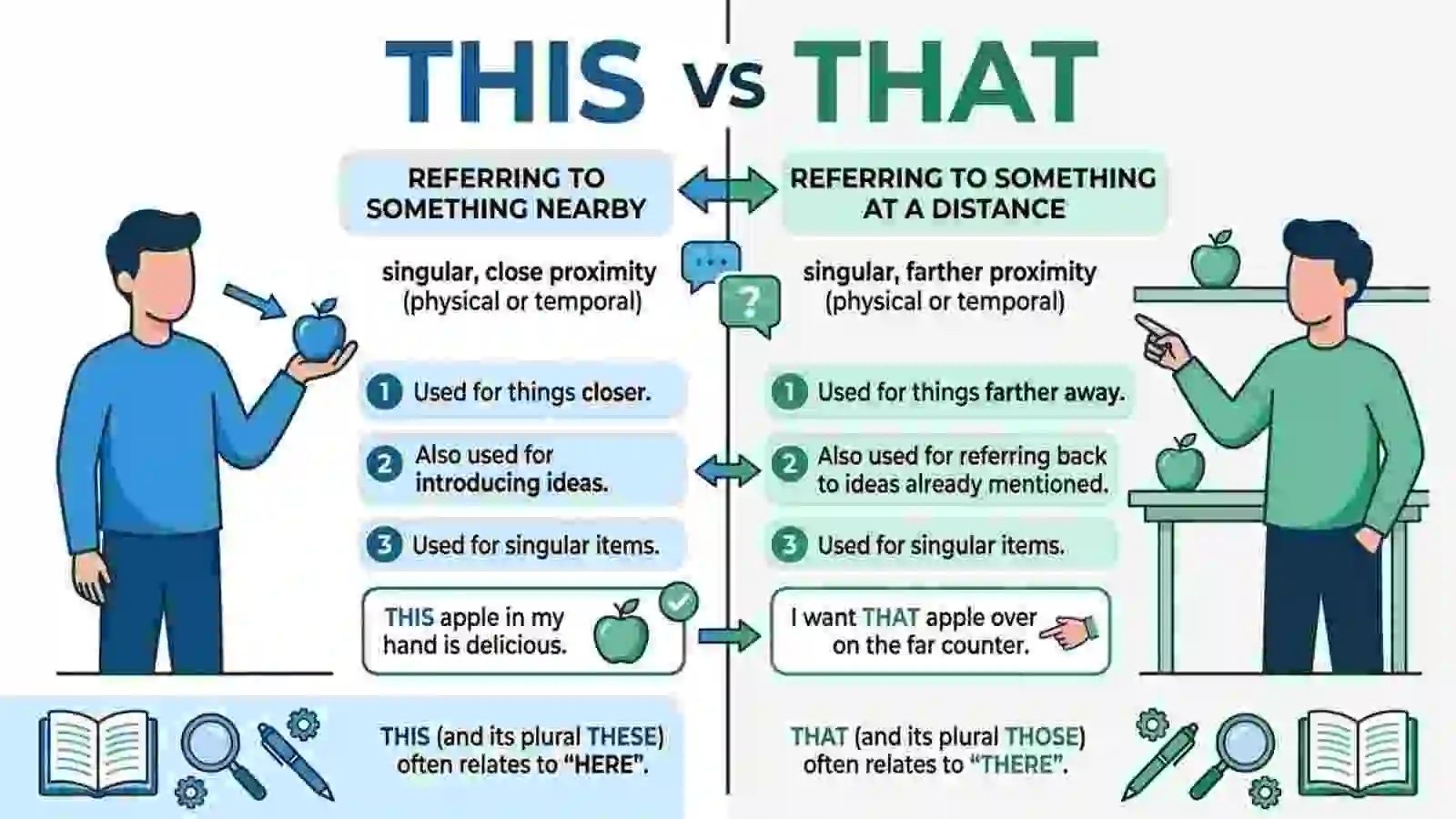
Choosing between this or that may seem easy, but these two small words can cause confusion. Both words point to something, but they do not point to things in the same way. The choice often depends on where the thing is, when it happens, or which thing you mean.
This usually points to one thing that is near you, near the person speaking, or close in time. That usually points to one thing that is farther away or less close to the speaker.
For example, you might say, “I like this book” when the book is in your hand. You might say, “I like that book” when the book is across the room.
People also search for this or that because these words can be used in many ways. They can point to objects, ideas, events, people, and choices. They can also appear in common phrases such as “this or that,” where someone asks you to choose between two things.
In this guide, you will learn the simple difference between this and that, with clear examples and easy rules.
This or That – Quick Answer
This and that are both correct words.
The main difference is distance.
Use this for something that is near.
Use that for something that is farther away.
Examples
This book is mine.
The book is near the speaker.
That book is yours.
The book is farther away.
The same idea can apply to time.
This week has been busy.
The week is happening now or is close to the present.
That week was very busy.
The week happened in the past.
Simple rule
This = near
That = farther away
The distance can be physical or related to time or ideas.
The Origin of This or That
This and that are very old English words. They have been used for many centuries.
The word this comes from Old English forms that were used to point to something near the speaker.
The word that also comes from Old English. It was used to point to something farther away or to something already known or mentioned.
These words belong to a group called demonstratives. Demonstratives help us point to people, objects, places, times, or ideas.
For example:
This is my phone.
The speaker points to something near.
That is your car.
The speaker points to something farther away.
English kept these words as it changed over time. Their basic use has stayed quite stable.
Today, this and that can point to more than physical objects. We can also use them for ideas.
For example:
This is a good idea.
That was a strange thing to say.
In these examples, the words point to an idea or situation rather than a physical object.
British English vs American English Spelling
There is no spelling difference between British English and American English for this or that.
Both forms of English use the same words.
| English Type | Near | Far |
| British English | this | that |
| American English | this | that |
| Canadian English | this | that |
| Australian English | this | that |
The grammar is also mostly the same.
Examples
British English:
This is my phone.
American English:
This is my phone.
British English:
That is my house.
American English:
That is my house.
The words do not change based on the country.
The main thing to learn is how their meanings change based on distance, time, and context.
Which Spelling Should You Use?
You should use this and that based on what you mean.
There is no special US or UK spelling choice.
Use “this” for something near
This chair is comfortable.
This phone is new.
This food tastes good.
Use “that” for something farther away
That chair is broken.
That phone belongs to John.
That food looks good.
Use “this” for something happening now
This week is busy.
This month has been great.
This year feels different.
Use “that” for something in the past
That day was special.
That year was hard.
I remember that summer.
Use “this” for a current idea
This is what I mean.
Use “that” for an idea already mentioned
That is a good point.
The correct choice depends on the situation.
Common Mistakes with This or That
1. Using “this” for something far away
Incorrect:
This car across the street is mine.
This can sound wrong if the speaker clearly treats the car as far away.
Better:
That car across the street is mine.
2. Using “that” for something close
If you are holding an object, this is usually the natural choice.
This pen is mine.
Not:
That pen is mine.
However, context can change the choice.
3. Confusing “this” and “these”
This is singular.
These is plural.
Correct:
This book is new.
Correct:
These books are new.
Incorrect:
This books are new.
4. Confusing “that” and “those”
That is singular.
Those is plural.
Correct:
That car is fast.
Correct:
Those cars are fast.
Incorrect:
That cars are fast.
5. Forgetting that “this” can refer to time
This does not only mean something physically close.
For example:
This morning was cold.
This week has been busy.
It can show that the time is close to the present.
6. Thinking “that” always means something physically far away
That can also refer to an idea, event, or statement.
For example:
That was a great movie.
The speaker does not need to point to a physical object.
This or That in Everyday Examples
The words this and that are very common in everyday English.
In emails
I have attached this report for your review.
Please check that document before the meeting.
In news writing
This decision could affect many people.
That event took place last year.
On social media
This is my favorite song!
That was such a fun day!
In formal writing
This study examines the effects of sleep.
That result supports the earlier finding.
In conversation
What is this?
What is that?
I like this one.
I do not like that one.
When making a choice
The phrase this or that is also very common.
For example:
Do you want this or that?
It means:
Which one do you want?
You can use the phrase when choosing between two things.
This or That – Google Trends & Usage Data
This and that are two of the most common words in English. People use them in daily speech, writing, questions, conversations, and online searches.
The exact use can change based on the situation.
Searches for this or that can have different meanings. Some people want to learn the grammar difference between the two words. Others search for the phrase because they want ideas for questions, games, choices, or social media posts.
For grammar searches, the main question is usually about distance and context.
People may also search for:
- this vs that
- this or that questions
- this or that game
- this or that meaning
- this and that meaning
- this or that examples
The words are used widely in the United States, United Kingdom, Canada, Australia, and other English-speaking countries.
There is no major British-American difference in spelling. The main difference comes from how the speaker uses the words in context.
This vs That: Comparison Table
| Feature | This | That |
| Main use | Near | Farther away |
| Number | Singular | Singular |
| Physical example | This book | That book |
| Time | Close to now | Earlier or farther in time |
| Idea | Current idea | Earlier idea |
| Plural form | These | Those |
| Example | This is good. | That is good. |
Side-by-side examples
| This | That |
| This book | That book |
| This car | That car |
| This house | That house |
| This week | That week |
| This year | That year |
| This idea | That idea |
| This problem | That problem |
This, That, These, and Those
Learning this or that also means learning their plural forms.
This
Use this for one thing that is near.
This apple is fresh.
That
Use that for one thing that is farther away.
That apple is fresh.
These
Use these for more than one thing that is near.
These apples are fresh.
Those
Use those for more than one thing that is farther away.
Those apples are fresh.
A simple chart can help:
| Near | Far |
| This | That |
| These | Those |
Remember:
This = one near
That = one far
These = many near
Those = many far
What Does “This or That” Mean?
The phrase this or that usually means choosing between two options.
For example:
Do you want tea or coffee?
You could also say:
Do you want this or that?
The exact meaning depends on what the speaker is pointing to.
The phrase is also popular in games and social media posts.
Examples:
Pizza or burgers? This or that?
Summer or winter? This or that?
Books or movies? This or that?
These questions ask someone to choose one of two options.
Practice Exercise
Choose this or that.
- ________ book in my hand is new.
- Can you see ________ house across the street?
- ________ week has been very busy.
- I remember ________ day very well.
- What is ________ thing next to you?
Answers
- This
- that
- This
- that
- that
Bonus Exercise
Choose this, that, these, or those.
- ________ shoes near me are new.
- ________ car over there is red.
- ________ books on my desk are mine.
- ________ house across the road is old.
Answers
- These
- That
- These
- That
FAQs ;
1. What is the difference between this and that?
This usually points to something near the speaker. That usually points to something farther away.
2. Is “this or that” grammatically correct?
Yes. This or that is a correct phrase. It often asks someone to choose between two things.
3. What is the plural of this?
The plural of this is these.
This book.
These books.
4. What is the plural of that?
The plural of that is those.
That car.
Those cars.
5. Can this and that refer to time?
Yes. This can refer to a time close to now, while that can refer to an earlier or more distant time.
This week is busy.
That week was busy.
6. Can this and that refer to ideas?
Yes. They can point to ideas, statements, or situations.
This is a good idea.
That was a bad decision.
7. Is this or that different in British and American English?
No. British and American English use this and that in the same basic way.
Conclusion;
The difference between this or that is simple when you remember the idea of distance. This usually points to one thing that is near the speaker, close in time, or part of the current situation. That usually points to one thing that is farther away, happened earlier, or was already mentioned.
For example, you can say, “This book is mine” when the book is near you. You can say, “That book is yours” when the book is farther away.
The words also work with ideas and time. You can say, “This week is busy” or “That day was special.” The meaning comes from the context.
British and American English use the same spellings, so you do not need to learn a different spelling for either word.
Also remember the plural forms: this becomes these, and that becomes those.
Finally, this or that can simply mean a choice between two things. Once you understand these basic rules, you can use all four words, this, that, these, and those, with confidence.

Ethan Carter is a language writer at Wordellect who helps readers understand word differences, grammar rules, and spelling variations through simple and accurate guides.







