Seeing gray and grey can make a simple spelling question surprisingly confusing. Is one wrong? Does the spelling change the meaning? And which form should you use in an essay, email, website, or professional document?
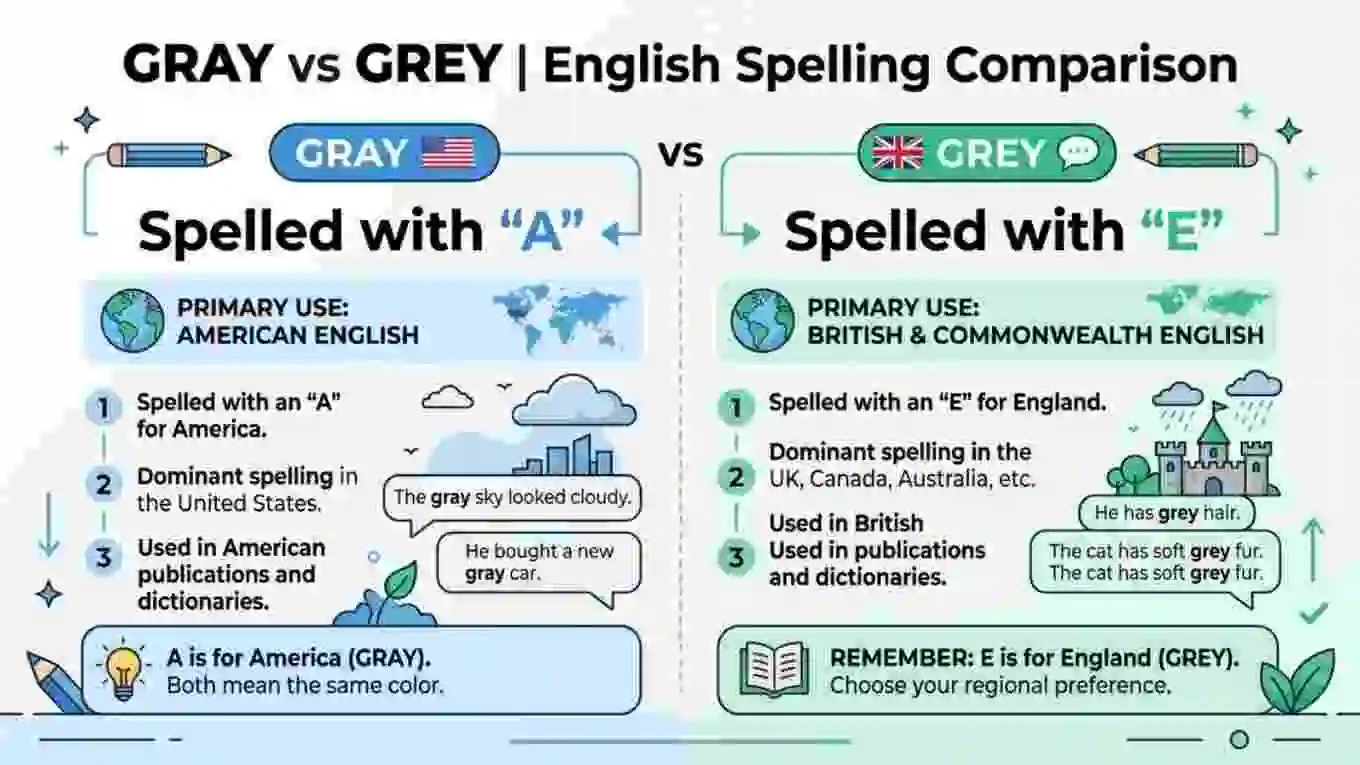
The good news is simple: gray and grey are both correct spellings of the same word. The main difference is regional. Gray is the usual spelling in American English, while grey is preferred in British English and is also common in Canada, Australia, and New Zealand.
People often search for “gray or grey” because English spelling changes between countries. This can be especially confusing when reading books, news articles, websites, or documents from another English-speaking country.
In this guide, you will learn where both spellings came from, how British and American English use them, which spelling you should choose, and how to avoid common mistakes. You will also see simple examples from everyday and professional writing.
Gray or Grey – Quick Answer
Gray and grey mean the same thing. Both describe the color between black and white.
- Gray = preferred in American English
- Grey = preferred in British English
- Grey = also commonly preferred in Canada, Australia, and New Zealand
Examples
American English:
The sky is gray today.
British English:
The sky is grey today.
Neither sentence is wrong. The spelling simply follows a different English variety. Cambridge lists gray as the US spelling and grey as the mainly UK spelling.
| Spelling | Main usage | Example |
| gray | American English | a gray shirt |
| grey | British English | a grey shirt |
| grey | Canadian English | a grey building |
| grey | Australian English | grey hair |
| grey | New Zealand English | grey clouds |
Quick rule: If you are writing for a US audience, choose gray. For a UK, Canadian, Australian, or New Zealand audience, grey is usually the safer choice.
The Origin of Gray or Grey
Both spellings have the same historical origin. They come from the Old English word grǣg, meaning gray. The word is also related to older Germanic forms found in other languages.
The spelling difference developed over time. English did not always have one fixed spelling for the word. Historical forms included variations such as gray and grey.
The modern regional difference became clearer in the 20th century. Grey became established as the British form, while gray became strongly associated with American English.
This is not a difference in meaning. It is mainly a difference in spelling tradition.
The same pattern appears in many other English words:
- colour / color
- centre / center
- labour / labor
- neighbour / neighbor
- theatre / theater
British English often keeps forms with -our and -re, while American English often uses -or and -er. Cambridge lists these as common British-American spelling differences.
So, grey vs. gray is part of a larger pattern in English.
British English vs American English Spelling
The main difference is easy to remember:
British English → grey
American English → gray
Cambridge identifies grey as the mainly UK spelling and gray as the US spelling.
Comparison Table
| English variety | Preferred spelling | Example |
| American English | gray | a gray car |
| British English | grey | a grey car |
| Canadian English | grey | a grey coat |
| Australian English | grey | grey hair |
| New Zealand English | grey | grey clouds |
| International writing | Either | Choose one and stay consistent |
Canada is especially interesting because Canadian English combines British and American spelling patterns. The Government of Canada says Canadians generally prefer grey, although gray is also correct.
Gray Examples
- gray eyes
- gray hair
- gray clouds
- a gray jacket
- a gray area
- light gray paint
Grey Examples
- grey eyes
- grey hair
- grey clouds
- a grey jacket
- a grey area
- light grey paint
The meaning stays the same.
Which Spelling Should You Use?
The best spelling depends on who will read your writing.
Writing for a US Audience
Use gray.
The company uses light gray in its new logo.
His hair is turning gray.
This is the standard choice for American English.
Writing for a UK Audience
Use grey.
The company uses light grey in its new logo.
His hair is turning grey.
Writing for Canada or Australia
Grey is generally the better choice. The Government of Canada specifically notes that Canadians prefer grey, while Australian English generally uses grey as well.
Writing for a Global Audience
Either spelling can work.
The most important rule is consistency. If your website uses American English, use gray throughout. If it follows British English, use grey throughout.
Do not switch between gray and grey without a reason.
Common Mistakes with Gray or Grey
Although both spellings are correct, writers often make mistakes when they mix regional forms or change proper names.
Mistake 1: Mixing Spelling Styles
Incorrect style:
The colour of the wall is gray, but the center is grey.
The sentence mixes American and British forms.
A consistent American version would be:
The color of the wall is gray, but the center is gray.
A consistent British version would be:
The colour of the wall is grey, but the centre is grey.
Mistake 2: Thinking One Spelling Is Wrong
Some writers believe grey is incorrect because they learned American English, while others think gray is wrong because they learned British English.
Both are standard spellings.
Mistake 3: Changing a Proper Name
Proper names should keep their official spelling.
For example:
- Earl Grey is the name of a tea.
- Gray’s Anatomy is a famous medical reference work.
- Grey’s Anatomy is the name of a television series.
Do not change a proper name simply to match your preferred regional spelling.
Mistake 4: Confusing Gray With the Scientific Unit
Gray is also the name of an SI unit used to measure absorbed radiation dose.
It is written gray, with an a, regardless of whether the surrounding English is British or American.
Gray or Grey in Everyday Examples
Both spellings appear in many types of writing.
In Emails
US English:
Please send me the final version with the gray background.
UK English:
Please send me the final version with the grey background.
In News
American news writing may use:
The city woke under a gray sky.
British news writing may use:
The city woke under a grey sky.
On Social Media
People may write:
Loving this soft gray color!
or:
Loving this soft grey colour!
Social media is less formal, so either spelling is easy to understand.
In Formal Writing
Your spelling should match the style of the document.
American:
The report examines the effects of gray matter loss.
British:
The report examines the effects of grey matter loss.
In Design and Marketing
Designers may use terms such as:
- dark gray / dark grey
- light gray / light grey
- warm gray / warm grey
- blue-gray / blue-grey
Choose the spelling that matches your brand or publication style.
Gray or Grey – Comparison Table
| Word or phrase | American English | British English |
| color | gray | grey |
| gray/grey hair | gray hair | grey hair |
| gray/grey eyes | gray eyes | grey eyes |
| gray/grey sky | gray sky | grey sky |
| gray/grey area | gray area | grey area |
| light gray/grey | light gray | light grey |
| dark gray/grey | dark gray | dark grey |
| gray/grey matter | gray matter | grey matter |
| gray/grey clouds | gray clouds | grey clouds |
| gray/grey suit | gray suit | grey suit |
The important point is that the meaning does not change. Only the regional spelling changes.
Gray or Grey – Google Trends & Usage Data
Search interest for “gray” and “grey” follows the same broad regional pattern seen in dictionaries and language resources.
Google Trends is useful for comparing search interest, but its results are relative, not a count of every word used online. A term can also receive searches for names, titles, brands, or other meanings. For that reason, a Google Trends graph should not be treated as a precise measure of spelling correctness.
The broader usage pattern is clear:
- United States: gray is strongly preferred.
- United Kingdom: grey is strongly preferred.
- Canada: grey is generally preferred, although gray is also used.
- Australia: grey is the usual spelling.
- New Zealand: grey is generally preferred.
- Other international English: Both forms appear, with local style often deciding the choice.
Merriam-Webster confirms that gray is more frequent in American English, while grey is preferred in Canada, the UK, and elsewhere.
The Government of Canada also confirms the Canadian preference for grey.
Why Search Results Can Look Different
Online searches can be affected by:
- The country where people search.
- The spelling style of the websites they read.
- Proper names such as Grey or Gray.
- Book, film, and television titles.
- Scientific terms.
- Search interest in the color itself.
So, seeing more results for one spelling does not mean the other spelling is incorrect.
Gray or Grey: Special Cases to Remember
Some words and names have a fixed spelling.
Earl Grey
Earl Grey is the established name of the tea.
Do not write Earl Gray when referring to the tea’s proper name.
Gray’s Anatomy
Gray’s Anatomy is the title of the medical reference work. The spelling is part of the title.
Grey’s Anatomy
Grey’s Anatomy is the television series title. Its spelling is also fixed.
The Gray Unit
The SI unit is gray, named after British physicist Louis Harold Gray.
This is a good reminder that regional spelling rules do not always control proper names or specialized terms.
FAQs About Gray or Grey
1. Is gray or grey correct?
Both are correct. Gray is the standard American spelling, while grey is mainly used in British English and is also common in Canada and Australia.
2. Is grey British or American?
Grey is mainly British. American English normally uses gray.
3. Do gray and grey mean the same thing?
Yes. Both words describe the same color between black and white.
4. Should I use gray or grey in the US?
Use gray for American English.
The wall is light gray.
5. Should I use gray or grey in the UK?
Use grey for British English.
The wall is light grey.
6. Which spelling does Canada use?
Canadians generally prefer grey, although gray is also correct and used in Canadian English.
7. Which spelling is used in Australia?
Grey is the usual Australian spelling for the color.
8. Is “gray” ever correct in British English?
Yes. Gray can appear in British English, especially in proper names and specialized terms. The regional preference, however, is grey.
Conclusion;
The answer to “gray or grey?” is simple: both spellings are correct. They describe the same color and have the same historical origin. The main difference is regional spelling.
Use gray when writing in American English. Use grey when writing in British English. Canadian, Australian, and New Zealand English generally prefer grey, although regional usage can vary.
For professional writing, the best approach is to know your audience and follow its English style. If your readers are in the United States, choose gray. If they are in the UK, choose grey. For international content, either form is acceptable, but consistency matters.
Also remember that proper names and specialized terms may keep their established spelling. Earl Grey, Gray’s Anatomy, and the scientific unit gray should not be changed simply to match your preferred English variety.
So, there is no need to worry about which spelling is “more correct.” Gray and grey are both correct; your audience determines the better choice.

Ethan Carter is a language writer at Wordellect who helps readers understand word differences, grammar rules, and spelling variations through simple and accurate guides.